

Long stock is lying on the floor beside the laser again. The saw is ready. The crane or side forklift is waiting. Somebody has to move one bundle just to reach the next one. That is how a cutting bay turns into a queue with steel in it.
The Bay Gets Jammed Before the Machine Even Starts
That is the ugly part of a metal processing center. When long raw stock and WIP live on the floor, the machine does not get fed. The operator waits. The crane swings. The forklift hunts around. The whole bay starts acting like a holding pen instead of a production area.
You know the shop talk. “Move that bar.” “Clear that lane.” “The next bundle is behind it.” That kind of nonsense burns minutes every cycle. And once the waiting starts, the machine is still there burning money with the green light off.
If you are the plant manager or equipment procurement supervisor, the problem is not the saw, laser, or lathe. It is the material path. The stock is in the wrong place, so the machine gets fed like an afterthought.
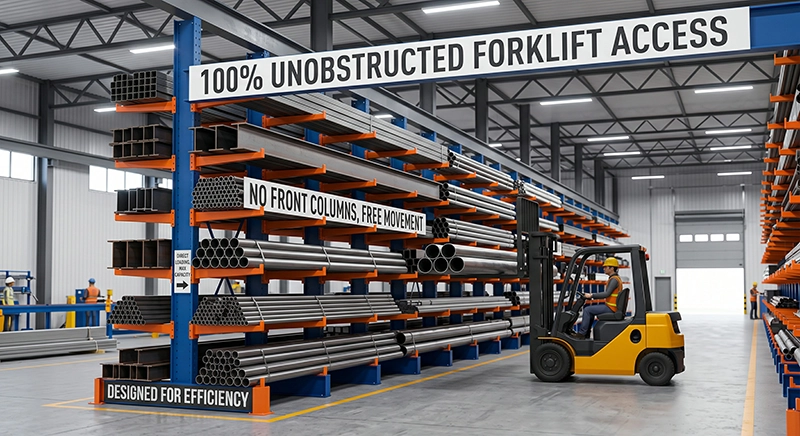
Why Floor Staging Slows the Whole Line
Long material buffer storage is not there to make the bay look tidy for a photo. It is there to stop the bad moves before they happen. Floor staging invites double handling, blocked lanes, and rough picks.
- The machine waits while stock is hunted down.
- Forklifts do short, messy moves they should not need to do.
- The cutting area gets clogged with temporary piles.
- One wrong pull can scratch or bend material before it ever gets processed.
That is why processing center cantilever matters. It gives the bay a buffer zone, not a mess.
What a Better Buffer Zone Does
A proper cantilever gives the crew a controlled place to stage incoming and outgoing stock beside the machine. The long material stays separated. The access stays open. The crane or forklift can grab what it needs without tearing up the whole lane.
That is the practical way to improve OEE. Less hunting. Less shifting. Less waiting around while the machine sits there doing nothing useful.
It sounds plain because it is plain. Keep the right bundle near the machine and out of the floor pile.

What Changes Once the Bay Is Fixed
When the rack plan is right, the line stops tripping over itself.
- Less time spent moving stock just to reach stock.
- Less machine waiting on a fork or crane.
- Less re-stacking around the cutting bay.
- Less chance of damage to WIP and pre-cut material.
That is where the value shows up. Not in slogans. In fewer queue-ups, fewer interruptions, and fewer people standing around looking at the same pile.
Reality Check
This is not a magic fix. There are still some hard rules.
1) Bay dimensions still matter
The rack has to match the machine zone. If the aisle is too tight, the buffer becomes another problem.
2) Floor loading still matters
The slab has to take the weight. Weak or uneven concrete is a bad place to start.
3) Handling discipline still matters
No shortcut pulls. No blocking the lane. No “we’ll move it later” nonsense. That is how the bay gets jammed.
4) It is not for every layout
If the site is trying to run a fully different automation concept, a manual cantilever buffer may need a different slotting plan to fit.
What the Team Should Check Next
- Where is long stock still sitting on the floor beside the machines?
- Which bundles get touched most often?
- Where are the aisle pinch points?
- How much time gets spent moving material just to reach the next bundle?
If those answers are ugly, the layout needs a proper review, not another promise that the next shift will sort it out.
Next Step
Download the line layout whitepaper, then submit your company email and main machine types to get the free 3D line-side buffer design guide. That gives you a straight answer on what belongs next to the machine and what needs to move out of the way.
Need the Whitepaper or a 3D Layout?
Submit your company email and machine types. We will review the route and send back practical advice.

 EN
EN  DE
DE  RU
RU  NL
NL  PT
PT  JA
JA  ES
ES  IT
IT