

|
Your CNC tube laser is a six-figure investment designed for relentless output. But if it’s constantly waiting for a forklift to navigate a cluttered workspace, you’re not capitalizing on its speed—you’re paying for its idle time. The real bottleneck isn’t your machine; it’s the inefficient material flow feeding it. Let’s fix that. |
Why Your CNC Machine is Starving: The Floor Storage Bottleneck
In any high-performance metal fabrication shop, the area around the CNC tube laser cutter is prime real estate. Yet, it’s often the most chaotic. Raw stock, like HSS steel tubes and stainless steel pipes, is typically stored on the floor or in static, oversized racks. This “traditional” method creates critical operational drags that directly impact your machine’s uptime.
- Forklift Gridlock: The wide turning radius of a forklift makes it slow and hazardous to maneuver in the narrow aisles between expensive machines. Every material move is a high-risk, time-consuming operation.
- Material Damage & Waste: Pipes stored on the floor are susceptible to scratches, dings, and contamination from dust and moisture. This leads to rejected parts and direct material loss.
- Wasted Operator Time: Your skilled CNC operator’s time is wasted waiting for material, or worse, helping to manually sort through a disorganized pile of tubes to find the right stock for the next job. This waiting game can halt production for 15-20 minutes every hour.
This inefficiency isn’t a people problem; it’s a system problem. You need a material handling system as agile as your CNC machine. You need portable pipe storage racks that bring the material directly to the point of use.
The Solution: Mobile Racks as “Buffer Magazines” for Your CNC Laser
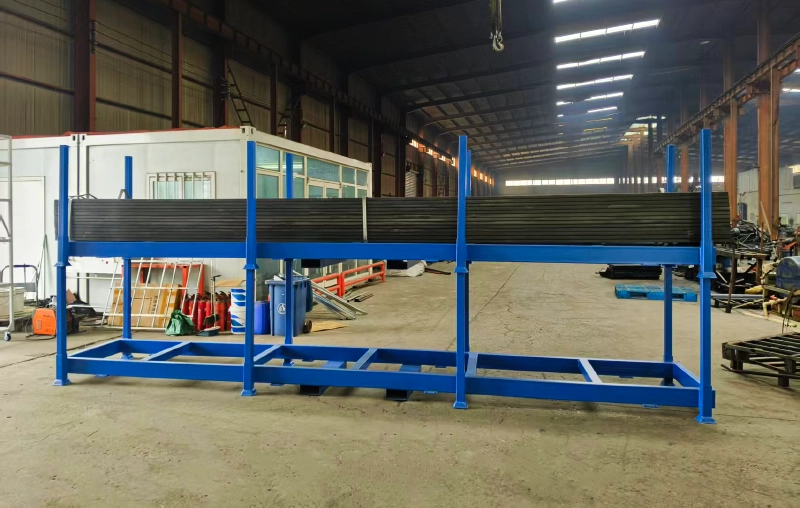
Instead of bringing the machine to the material (via downtime), the right system brings a pre-loaded “magazine” of material directly to the machine. Bpirack’s pluggable, rolling pipe storage racks are engineered specifically to solve the CNC feeding challenge. Here’s how they transform your workflow.
1. Point-of-Use Mobility: Decouple from the Forklift
Our racks can be customized with heavy-duty, bolt-on casters. This simple addition fundamentally changes your material flow. In the main warehouse, a forklift can load a full rack (up to 3,300 lbs) and place it in a staging area. From there, a single operator can safely and easily roll the entire unit through narrow passages and position it perfectly next to the CNC machine’s auto-loader. This eliminates the forklift from the final, most congested part of the journey, drastically improving safety and speed.

2. Vertical Density: Reclaim Your Floor Space
Floor space is profit. Our stackable pipe racks allow you to go vertical, safely stacking up to 4 layers high. This instantly multiplies your storage capacity on the same footprint, clearing the floor around your CNC machine. This creates organized, designated zones for incoming raw materials and work-in-progress (WIP) jobs. The result is a cleaner, safer, and more professional-looking workshop that impresses clients and improves morale.

3. Unmatched Flexibility: Adapt to Any Job
Unlike permanently bolted cantilever racks, Bpirack’s pluggable design offers total layout flexibility. When a large project is complete and the extra staging racks are no longer needed, your team can simply pull out the vertical posts. The empty bases then nest into each other, reducing their storage footprint by up to 80%. This “space magic” allows you to reclaim valuable floor area for other operations, adapting your layout on the fly without calling a maintenance crew.

The “After” Scenario: A Lean and Profitable Workflow
Implementing a mobile pipe racking system delivers tangible results that show up on your production reports. Based on real client feedback, shops that switch from floor storage to our system see:
- Up to 18% Increase in Daily Output: By eliminating material-related pauses, your CNC machine spends more time cutting and less time waiting.
- 90% Faster Material Retrieval: Finding and delivering the correct bundle of pipes is reduced from a 20-minute scavenger hunt to a 2-minute planned movement.
- Near-Zero Material Damage: The Q235 steel frame protects your valuable pipe and tube stock from ground-level hazards, reducing the scrap rate to less than 0.1%.
Technical Specifications at a Glance
| Parâmetro | Especificação |
|---|---|
| Material Grade | Q235 Structural Carbon Steel |
| Standard Dimensions (L x W x H) | ~90.5″ x 43.9″/47.8″/51.8″ x 51.2″ |
| Dynamic Load Capacity (Moving) | 3,300 Lbs (1.5 Tons) |
| Static Load Capacity (Stationary) | 9,900 Lbs (4.5 Tons) |
| Safe Stacking Height | Up to 4 units high |
| Acabamento de superfície | Industrial-grade Powder Coating (Corrosion & Scratch Resistant) |
Frequently Asked Questions for CNC Workshops
1. Can a single person move a fully loaded rolling rack?
Yes. On a smooth, level concrete floor, a single operator can safely maneuver a rack loaded with up to 3,300 lbs of material, thanks to the high-quality industrial casters. This empowers your team to manage material flow without waiting for a certified forklift operator.
2. How do the rolling racks handle cracks or debris on the workshop floor?
We recommend using heavy-duty casters with a larger diameter for floors with imperfections. This provides a smoother roll-over capability. For optimal performance and safety, maintaining a clean and well-kept floor in your high-traffic CNC area is always best practice.
3. Can we stack the racks if they have wheels installed?
No. This is a critical safety rule. The casters are designed for mobility on the ground level only. Before stacking the racks with a forklift, the bolt-on caster assemblies must be removed. This ensures the steel stacking feet make a secure, metal-on-metal connection for maximum stability.
4. How does this system compare to a fixed cantilever rack next to our machines?
Cantilever racks are static. Once installed, your layout is locked in. They also require a wide aisle for forklift access. Our portable pipe storage racks offer superior flexibility. You can change your staging area layout daily if needed, and their mobility in narrow aisles is something cantilever racks simply cannot offer.
5. What is the typical ROI for investing in these racks?
Most of our clients in metal fabrication see a full return on investment within 12-18 months. The ROI is calculated based on increased machine uptime, reduced labor costs for material handling, and savings from eliminating material damage and waste.

 EN
EN  DE
DE  RU
RU  NL
NL  PT
PT  JA
JA  ES
ES  IT
IT