

|
Your pipe yard is costing you more than just rent. Every minute spent by your forklift operator untangling a pile of HSS tubing to find the right bundle is a direct hit to your bottom line. Every Schedule 40 pipe damaged from ground moisture or crush-loading is pure profit loss. It’s time to stop paying for disorganized space and start investing in operational velocity. |
How to Calculate ROI on a Steel Pipe Storage Rack Investment?
For a General Manager or Warehouse Operations Manager in a metal service center or fabrication facility, any capital expenditure must answer one question: “What’s the payback?” An investment in a new rack de armazenamento de tubos de aço system isn’t just about tidying up the yard; it’s a strategic move to unlock hidden profitability. The traditional method of floor-stacking pipes on wooden dunnage is a silent killer of efficiency and materials.
Calculating the Return on Investment (ROI) isn’t abstract. It’s a concrete formula based on reclaiming wasted space, labor, and materials. Let’s break down the calculation into tangible gains you can measure in your own facility.
The basic ROI formula is:
ROI (%) = ( (Total Annual Gains – Annual Depreciation) / Initial Investment ) x 100
The “Initial Investment” is the purchase price. The real work is in quantifying the “Total Annual Gains.” Here are the four key areas where a Bpirack pluggable system generates returns.
1. Gain from Reclaimed Warehouse & Yard Space
The “Before” Scenario: Pipes are spread across the floor, often in a single layer. A 5,000 sq. ft. area might only be storing what could fit in 1,250 sq. ft. if you utilized vertical height. This is a massive waste of expensive industrial real estate.
The “After” Logic: Bpirack racks de empilhamento de tubos are engineered for safe, vertical stacking up to 4 or 5 layers high. This immediately multiplies your storage capacity on the same footprint by up to 400%. During slow seasons or when racks are empty, the pluggable uprights can be removed and the bases nested together, reducing the empty rack’s footprint by 80%—a feature fixed cantilever racks can’t offer.

How to Calculate the Gain:
- Square Footage Reclaimed: (Current Area Used for Pipes) – (Area Required with Stackable Racks)
- Annual Space Cost Savings: Reclaimed Sq. Ft. x Annual Rent Cost per Sq. Ft.
- Example: Reclaiming 3,000 sq. ft. in a facility where rent is $8/sq. ft./year equals $24,000 in annual savings. This reclaimed space can now be used for a new CNC tube laser cutter or another revenue-generating activity.
2. Gain from Reduced Labor & Equipment Costs
The “Before” Scenario: Your material handler needs a specific bundle of DOM tubing buried under three other bundles. This “华容道” (Chinese sliding block puzzle) requires a forklift to move the top layers, find the target, and then re-stack everything. A single pick can take 20-30 minutes of skilled labor and expensive forklift time.
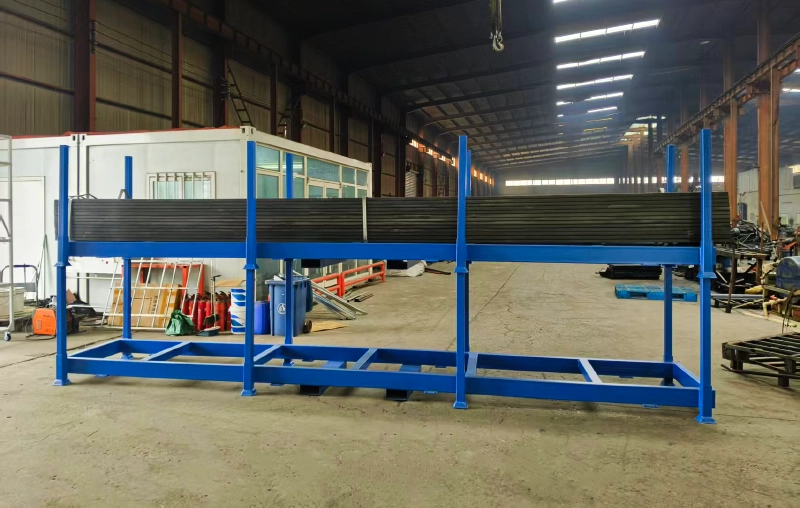
The “After” Logic: Each Bpirack rack acts as a “unitized load.” The entire rack—containing a specific material type and size—is a single, grabbable unit. Your forklift operator can directly access any rack at any level without disturbing others. This transforms your inventory into a 100% selectable system.
How to Calculate the Gain:
- Time Saved per Pick: (Old Average Pick Time) – (New Pick Time of 2-3 mins)
- Total Time Saved Annually: Time Saved per Pick x Picks per Day x Work Days per Year
- Annual Labor Cost Savings: Total Hours Saved x Loaded Hourly Rate for Operator & Forklift
- Example: Saving 20 minutes per pick over 15 picks a day with a loaded labor/equipment rate of $45/hour translates to 5 hours saved daily, or $58,500 annually (260 work days).
3. Gain from Minimized Material Damage
The “Before” Scenario: Pipes at the bottom of a floor stack bear the weight of the entire pile. This leads to compression, warping, and “banana-ing,” especially with materials like PVC. Contact with damp concrete causes rust and corrosion on steel pipes. This damage often means the material is rejected by customers or must be sold as scrap, resulting in a 2-5% loss rate.
The “After” Logic: With a heavy duty pipe storage rack, the load is borne entirely by the Q235 structural steel frame. The pipes on the bottom experience zero pressure from the layers above. The powder-coated finish and elevation off the ground protect against moisture and contamination, reducing the material damage rate to less than 0.1%.

How to Calculate the Gain:
- Damage Rate Reduction: (Old Damage %) – (New Damage %)
- Annual Material Savings: Annual Pipe/Tube Throughput ($) x Damage Rate Reduction (%)
- Example: A distributor moving $1M of PVC pipe annually reduces their damage rate from 3% to 0.1%. The annual saving is $29,000.
4. Gain from Increased Safety and OSHA Compliance
This gain is harder to quantify but critically important. Unsecured, round pipes are a major safety hazard. Rolling pipes can cause severe injuries, leading to worker compensation claims, lost time, and potential OSHA fines. A well-organized pipe rack storage system demonstrates a commitment to safety, improving morale and reducing liability.
How to Calculate the Gain:
- Cost of a Single Incident: Consider the direct and indirect costs of one major workplace accident (medical, legal, insurance premium hikes, lost productivity).
- Annual Savings: This is a risk-mitigation value. Even preventing one minor incident a year can save thousands of dollars.
Putting It All Together: A Sample ROI Calculation
Let’s assume a mid-sized metal service center makes an initial investment of $60,000 on a system of Bpirack portable pipe storage racks.
| Gain Category | Cálculo | Annual Value |
|---|---|---|
| Economia de espaço | Reclaiming 3,000 sq. ft. @ $8/sq. ft. | $24,000 |
| Poupança de mão de obra | 5 hours/day @ $45/hr for 260 days | $58,500 |
| Material Savings | 2.9% reduction on $1M inventory | $29,000 |
| Total Annual Gains: | $111,500 | |
Using these numbers (and ignoring depreciation for simplicity in this example):
ROI = ($111,500 / $60,000) x 100 = 185.8%
The payback period would be just over 6 months. This demonstrates that investing in proper pipe storage solutions is not an expense; it is a high-yield investment in operational excellence.
Perguntas frequentes (FAQ)
1. How do these stackable pipe racks compare to traditional cantilever racks for ROI?
While cantilever racks organize material, they are fixed installations that require wide aisles for forklift maneuvering. Bpirack’s portable and stackable design offers higher storage density and flexibility. When empty, our racks can be nested to reclaim 80% of their footprint, a significant advantage over the fixed “dead space” of an empty cantilever system, leading to a faster ROI through better space utilization.
2. What is the typical lifespan of a Q235 steel rack, and how does that affect the ROI calculation?
Our racks are built from industrial-grade Q235 carbon steel with a powder-coated finish. With proper use, they are a long-term asset with a lifespan of 10-15+ years. For ROI calculations, you can depreciate the asset over 7-10 years, which makes the annual cost minimal compared to the massive operational gains, ensuring a strong ROI from year one.
3. Can these racks handle the different lengths and weights of our inventory, like HSS and Schedule 80 pipe?
Absolutely. The racks are designed to hold pipe and tubing up to 6 meters (approx. 20 feet) long. Each individual rack has a dynamic (moving) load capacity of 1.5 tons (3,300 lbs) and a static (stacked) capacity of 4.5 tons (9,900 lbs). This makes them ideal for the heavy loads associated with structural steel and high-pressure pipe.
4. Our yard is outdoors. How does the powder coating hold up and prevent rust?
The industrial-grade powder coating provides a durable barrier against corrosion and UV degradation. It’s significantly more robust than standard paint, preventing rust that could contaminate your steel pipe inventory. This finish ensures long-term structural integrity and a professional appearance, even in outdoor pipe yards.
5. How does a unitized system improve our integration with downstream processes like CNC laser cutting?
By unitizing your inventory, you can stage a full rack of specific material directly at the laser cutting station. For even greater efficiency, our optional caster wheels turn the rack into a mobile cart. This eliminates the need for a forklift in tight production spaces, creating a seamless “point-of-use” material flow that minimizes machine downtime and dramatically increases throughput.

 EN
EN  DE
DE  RU
RU  NL
NL  PT
PT  JA
JA  ES
ES  IT
IT