

In the industrial enclosure manufacturing sector, the integrity of your raw material determines the quality of your finished cabinet. If you are fabricating NEMA-rated enclosures, server racks, or electrical switchgear, dragging heavy gauge steel sheets off a floor stack is a recipe for surface scratches and laser cutter downtime. You need a system that treats your raw sheet metal with the same precision as your CNC bending process.
The Hidden Bottleneck in Enclosure Fabrication: Raw Material Access
When manufacturing industrial enclosures, your production flow is dictated by the pulse of your laser cutters and turret punch presses. The industry standard for enclosures—whether wall-mount or freestanding—often involves high-mix, low-volume production. You might need 16-gauge stainless steel for a pharmaceutical cabinet in the morning and 10-gauge mild steel for a heavy-duty electrical housing in the afternoon.
Se o seu estante para armazenamento de chapas metálicas system relies on forklifts digging through mixed stacks on the floor, your expensive laser cutter is sitting idle while operators hunt for the right material. This “search and rescue” mission destroys your OEE (Overall Equipment Effectiveness).

Positioning storage directly next to processing machinery eliminates transport time.
Protecting Surface Integrity for Premium Enclosures
For manufacturers of stainless steel or aluminum enclosures, surface finish is non-negotiable. A single deep scratch from “depalletizing” or dragging one sheet over another can turn a pristine sheet into scrap metal, or force your team into hours of unnecessary polishing and finishing work.
Utilizando um horizontal sheet metal storage system with roll-out drawers, each bundle of material is isolated. The drawers glide out on high-strength bearings, allowing you to pick a single sheet using a vacuum lifter without it ever touching the sheet below or above it. This is critical when working with #4 brushed stainless or other sensitive finishes common in the enclosure market.
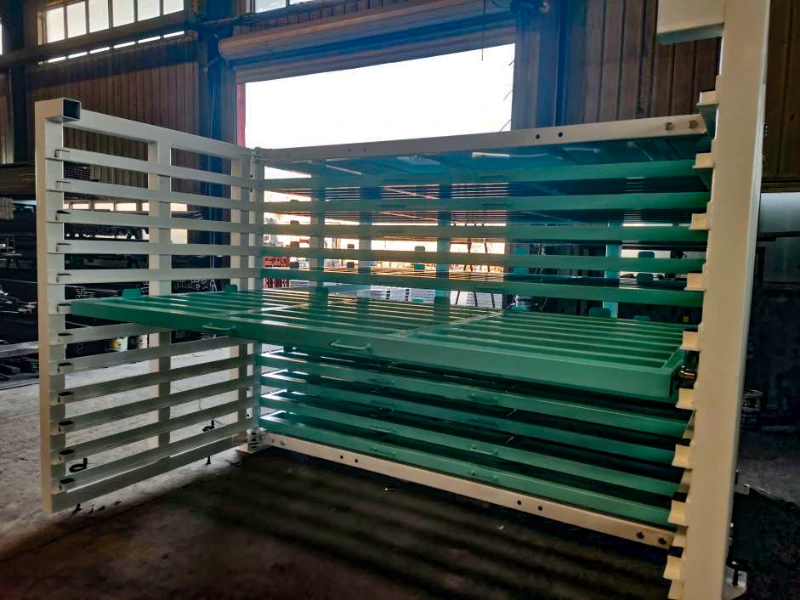
Smooth drawer operation ensures delicate finishes like stainless steel remain scratch-free.
Maximizing Floor Space for Assembly, Not Storage
Industrial enclosures are bulky. Once the metal is cut and bent, the WIP (Work In Progress) takes up massive amounts of floor space. You cannot afford to waste square footage on raw material storage. Traditional floor stacking eats up 400% more space than necessary because you cannot safely stack different gauges or materials (e.g., carbon steel on top of stainless) without risking contamination or instability.
Implementing steel plate storage racks allows you to go vertical. A single rack can hold up to 20 levels of material in the footprint of just two pallets. This frees up valuable floor space for your welding stations, powder coating lines, and final assembly areas.
Safety in Handling Heavy Gauge Steel
Manufacturing large freestanding enclosures often requires thicker plates (up to 0.25 inches or more) for structural rigidity. Manually wrestling these sheets or using makeshift forklift maneuvers is a leading cause of back injuries and crush hazards in the metalworking industry.
O nosso Estante de folhas enroláveis systems are engineered with safety as the primary feature. Whether you choose a hand-cranked model for heavy loads (reducing pull force to under 40 lbs) or a forklift-compatible model, the operator is kept at a safe distance. The rack structure itself is built from Q235 structural steel, capable of supporting up to 10,000 lbs (4.5 tons) per drawer, ensuring stability even when fully loaded with dense steel plate.

Vacuum lifter compatibility makes single-sheet picking safe and ergonomic.
Integration with Automated Workflows
Modern enclosure manufacturing is moving towards automation. Your storage system must be “automation ready.” Our racks are designed with precise dimensions and robust positioning that allow for integration with automatic loading/unloading systems and gantry cranes. This creates a seamless flow from the estante para armazenamento de chapas metálicas directly to the laser or punch press shuttle table, minimizing manual intervention and maximizing throughput.

Industrial-grade bearings ensure longevity even in high-cycle manufacturing environments.
Frequently Asked Questions for Enclosure Manufacturers
| Can these racks hold standard 4′ x 8′ and 5′ x 10′ sheets common in enclosure fabrication? | Yes. We offer standard drawer sizes to fit 4′ x 8′, 5′ x 10′, and even 6′ x 20′ sheets. We can also customize the dimensions to fit specific blank sizes if you purchase pre-cut material for standard cabinet lines. |
| We use a lot of stainless steel. Will the rack scratch the bottom sheet? | No. The drawers are designed to be flat and smooth. For critical applications, we can provide lining options or specific drawer designs to ensure the raw material surface remains pristine for your NEMA-rated enclosures. |
| What is the weight capacity per drawer? We stock heavy gauge plate. | Our standard heavy-duty racks can support up to 10,000 lbs (approx 4.5 tons) per drawer. This is sufficient for full bundles of heavy gauge steel used in seismic-rated or explosion-proof enclosure manufacturing. |
| Can I use a vacuum lifter with this rack? | Absolutely. This is the recommended workflow. The 100% extension of the drawers allows a vacuum lifter or magnetic crane to access the entire sheet surface from above without obstruction. |
| Do you offer racks for the “skeleton” scrap or off-cuts? | Yes. We have specific designs and cassettes that can be used to organize off-cuts and skeletons, keeping your shop floor clean and maximizing material yield. |

 EN
EN  DE
DE  RU
RU  NL
NL  PT
PT  JA
JA  ES
ES  IT
IT