
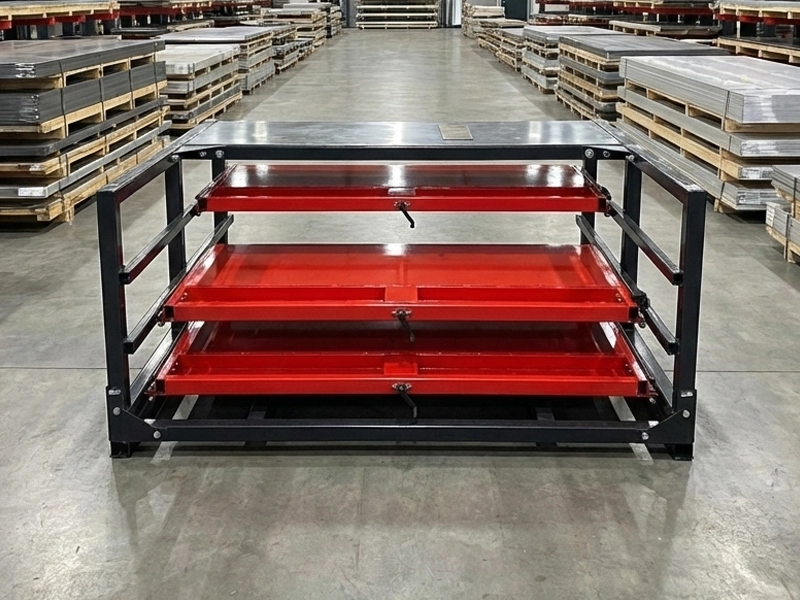
Your high-speed laser cutter’s efficiency is being throttled by slow, manual material handling. The time spent waiting for a forklift or clearing an aisle is costing you valuable production uptime. It’s time to transform your storage from a passive container into an active part of your production line, directly feeding your machine and maximizing its output.
Is Your Laser Cutter Waiting for Steel? How Dual Access Racks Eliminate Bottlenecks
In modern metal fabrication, the speed of your Fiber Laser Cutting Machine is a key competitive advantage. Yet, this advantage is often nullified by an overlooked bottleneck: the time it takes to get the right raw material from storage to the machine bed. If your operators spend more time coordinating forklifts and overhead cranes than cutting metal, your most valuable asset is underutilized. The core issue isn’t the storage capacity, but the storage *accessibility*. Traditional, single-access racks create logistical conflicts that force production to a halt.
From Static Storage to a Dynamic Workflow Hub
The solution lies in fundamentally rethinking the role of your sheet metal storage. Instead of a passive warehouse unit, imagine a dynamic hub that integrates directly into your workflow. This is the principle behind a dual access sheet rack, a system designed not just to hold material, but to actively channel it from the logistics area to the production zone without interruption. This pass-through design creates two independent operational fronts, breaking the cycle of “equipment waiting for material.”

The Mechanics of Uninterrupted Production Flow
A pass-through or dual-directional system is engineered to solve specific, costly problems in a high-volume fabrication shop. By enabling access from both the front and back, it creates a seamless and efficient material supply chain right at the point of use.
Eliminating the Forklift vs. Crane Conflict
In a standard layout, the same aisle is used by a forklift to replenish the rack and by an overhead crane or vacuum lifter to feed the laser cutter. This creates a constant conflict. When the forklift is working, the crane must wait, and the laser sits idle. A double sided rack resolves this by design. The forklift restocks drawers from the main warehouse aisle at the back, while on the machine side, the operator can simultaneously and safely pull out a different drawer to feed the laser. The two operations never interfere, ensuring continuous production.
The Two-Minute Material Changeover with Crank-Out Ergonomics
Speed is critical. A manual crank-out sheet rack utilizes a gear and pinion mechanism, often with a 1:1.5 gear ratio, to make moving heavy loads effortless. This system allows a single operator to extend a drawer carrying 3-5 tons of steel with minimal physical effort. The entire process of selecting, extending, and presenting the correct material for crane access can be completed in under two minutes, a stark contrast to the 15-20 minutes often required for traditional forklift-based retrieval.

Achieving 5S and IATF 16949 Compliance Through Organization
For shops serving the automotive industry or adhering to Lean Manufacturing principles, workplace organization is non-negotiable. Floor stacking is a direct violation of 5S principles and poses a significant risk for companies seeking IATF 16949 Standard certification. By consolidating horizontally stacked material into a vertical, high-density system, you reclaim valuable floor space, improve safety, and create a clean, auditable environment. Each drawer becomes a designated location for a specific material type (e.g., Cold Rolled Steel Sheet, Stainless Steel Plate), ensuring perfect inventory traceability and eliminating material damage.
| Métrica | Traditional Workflow (Floor Stacking / Static Racks) | Integrated Workflow (Dual Access Rack) |
| Material Changeover Time | 15-20 minutes (requires forklift, 2 personnel) | Under 2 minutes (single operator, manual crank) |
| Operational Conflict | High (Forklift and crane share the same aisle) | Zero (Separate aisles for replenishment and production) |
| Machine Uptime | Reduced due to “waiting for material” delays | Maximized through continuous, just-in-time feeding |
| Safety & Compliance | High risk of accidents; difficult to maintain 5S standards | Ergonomic operation; inherently supports 5S and IATF 16949 |
Beyond Speed: Protecting High-Value Materials Like Stainless Steel
For manufacturers of electronic enclosures, food processing equipment, or architectural panels, material integrity is as important as efficiency. Stacking expensive materials like polished stainless steel or aluminum sheets directly on top of each other inevitably leads to scratches and surface damage, resulting in costly scrap. A drawer-based system provides a crucial advantage: each batch of material is stored in its own fully-supported, independent compartment. This isolation eliminates sheet-on-sheet abrasion during storage and retrieval, ensuring that every piece of raw material is in perfect condition when it reaches your press brake or laser cutter.

Perguntas frequentes
1. What is the typical load capacity of these sheet metal racks?
Standard models offer a capacity of 1,000 kg to 5,000 kg (2,200 to 11,000 lbs) per drawer. The entire structure is built from high-strength Q235 carbon steel to ensure durability and safety even under maximum load, making them true heavy-duty sheet metal racks.
2. Can the rack be used for storing items other than sheet metal?
Absolutely. The robust, fully-extendable drawers are ideal for storing other heavy, flat items such as stamping dies, molds, heavy tools, and fixtures. The 100% extension allows for direct overhead crane access, which is a significant safety improvement for die handling.
3. How does the dual access feature work if the rack needs to be placed against a wall?
If a true pass-through layout isn’t possible, the system still functions as an extremely efficient single-sided roll-out rack. You retain all the benefits of ergonomic crank-out access, high-density storage, and material protection. The dual-access capability simply provides additional layout flexibility for future workshop optimization.
4. What are the foundation requirements for installing a heavy-duty rack?
Installation requires a solid concrete floor, typically C30 grade or higher, with a recommended thickness of at least 200mm (approx. 8 inches). Each vertical post must be securely fastened to the ground using heavy-duty chemical or expansion anchor bolts to counteract the tipping force when a fully loaded drawer is extended.
5. How does this manual system compare to a fully automated storage tower?
A Dplarack system offers approximately 80% of the efficiency gains of a fully automated tower at about 10% of the cost. It provides immediate, random access to any material type without the high capital investment, complex maintenance, software integration, or risk of electrical failure associated with automated systems. It is the ideal solution for achieving significant workflow improvements with a much faster ROI.

 EN
EN  DE
DE  RU
RU  NL
NL  PT
PT  JA
JA  ES
ES  IT
IT