

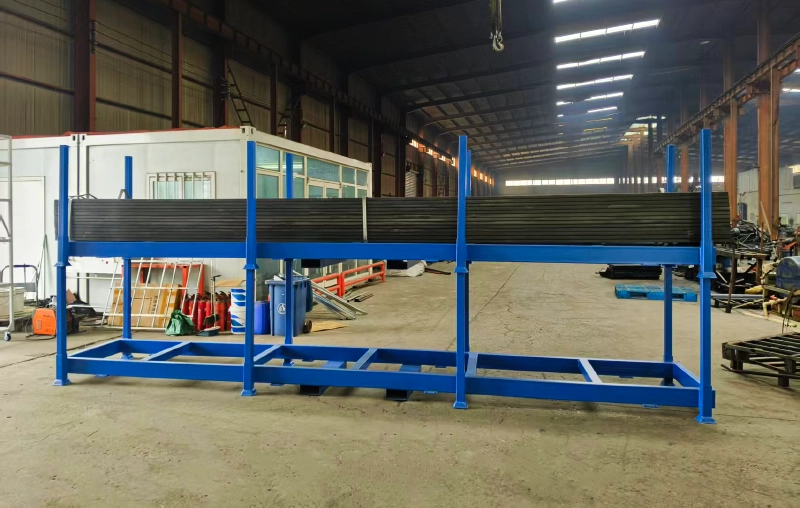
One of the most common buyer mistakes is judging an industrial rack by how heavy it looks. In shops handling structural steel, long profiles, and pipe for robotic welding cells, that instinct can lead to the wrong decision. Bpirack uses a channel-steel base not because it is light-duty, but because it delivers structural efficiency without unnecessary dead weight that would burden daily handling and transport.
Why Heavier-Looking Steel Can Be a Misleading Signal
Procurement teams often compare industrial racks visually and assume the bulkier base is automatically safer. But a storage structure has to do more than just sit there. It has to handle forklift movement, repeated repositioning, vertical stacking, and transport logic. If the base becomes unnecessarily heavy, the workshop pays for that excess steel again and again in less efficient handling.

What the Channel-Steel Base Is Actually Solving
The Q235 channel-steel base is chosen because it offers strong resistance to the vertical bending demands of the rack while avoiding redundant mass. In practical terms, that means the system can support the unit’s static 4.5-ton design logic without turning the entire rack into a dead-weight problem. That matters in any operation where the rack is handled often rather than left forever in one position.
Why This Matters for Material Protection Too
In Bpirack, the base is part of the larger structural logic that transfers weight into the frame instead of into the stored material itself. That helps support the zero-compression concept that protects lower bundles from the crushing conditions common in loose floor piling. For shops worried about banana-ing, misalignment at the welding jig, or scratched stock during chaotic retrieval, the base design is part of the answer.
What Buyers Should Compare Instead of Just Steel Bulk
- Actual structural behavior under load, not visual heaviness
- How the base affects forklift handling and movement
- Whether the design supports stacking and material protection together
- How much dead weight is being added without real operational benefit
The Better Buying Question
Instead of asking, “Which base looks thicker?” ask, “Which base gives me the right combination of strength, handling efficiency, and workflow practicality?” That is the more useful comparison for a shop that depends on forklifts, changing layouts, and fast response to robotic welding or laser-cutting demand.
Need to Explain Channel Steel vs Square Tube to a Buyer?
Send us your target load, movement frequency, and what the buyer is comparing against. We can help frame the channel-steel base as an engineering decision, not a shortcut.

 EN
EN  DE
DE  RU
RU  NL
NL  PT
PT  JA
JA  ES
ES  IT
IT