

|
Is your laser cutting machine constantly idle, waiting for a forklift that can’t maneuver in the tight space beside it? When every square foot of your workshop is prime real estate, conventional pipe storage creates bottlenecks that directly kill productivity. The constant shuffle of moving bulk pipe bundles just to access the one you need isn’t just inefficient—it’s a direct drain on your daily output and a safety hazard for your team. |
What are the best pipe storage solutions for narrow aisles?
For metal fabrication shops and steel service centers, the space between production machines is often the most challenging area to manage. Narrow aisles, essential for maximizing floor space for equipment like CNC tube lasers and band saws, become logistical nightmares when it’s time to handle long, heavy materials. Traditional storage methods simply don’t work here. This article explores how to transform these constrained spaces from bottlenecks into efficient, point-of-use storage zones.
The “Before” Scenario: The Narrow Aisle Impasse
Picture the area next to your new laser tube cutting machine. It’s likely a 10-foot-wide aisle. A standard forklift needs a much wider radius to turn and safely place a 20-foot bundle of steel tubing. The result? Operators end up staging material far from the machine, leading to a chaotic and inefficient workflow:
- Production Halts: The laser cutter, a machine that costs hundreds of dollars per hour to run, sits idle while operators wait for a forklift to clear a path and deliver the next job’s material. This waiting time can accumulate, causing a 15-minute shutdown every hour, as noted in operational studies.
- Material Damage: To save time, bundles of DOM tubing or rectangular steel tubes are often temporarily placed on the floor, using scrap wood as dunnage. This leads to scratches, contamination from floor debris, and an unprofessional appearance that worries visiting clients.
- Safety Risks: Maneuvering a forklift in a tight space with pedestrians and other machinery is a high-risk activity. The pressure to feed the machine quickly can lead to collisions, and pipes can roll off forks, creating a serious hazard.
The Solution: Decoupling Movement from the Forklift with Mobile Racks
The core problem isn’t the narrow aisle itself, but the over-reliance on forklifts for every material movement. The most effective solution is to introduce a system that gives your pipe stock “the ability to walk” without forklift assistance in confined areas. This is achieved with portable pipe storage racks equipped with heavy-duty castors.
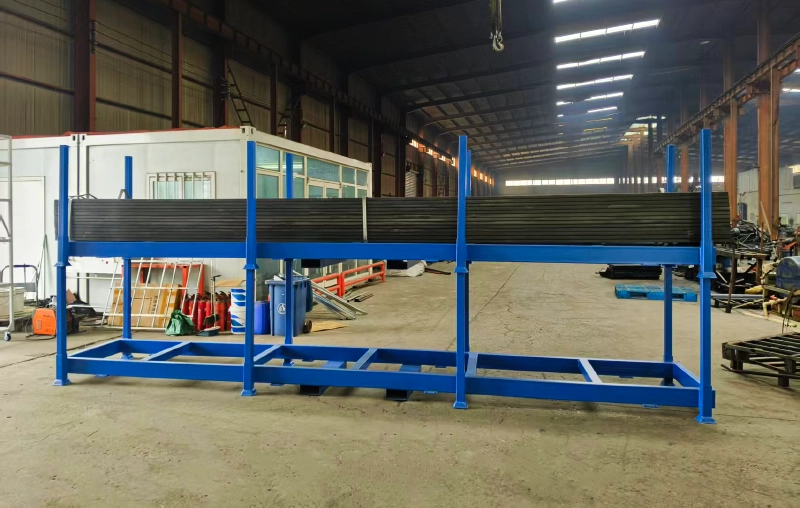
The Bpirack pluggable pipe rack is engineered for this exact scenario. With its pre-drilled base, you can implement a mobile customization strategy by bolting on industrial-grade castors.

This simple addition transforms the rack from a static storage unit into a dynamic material cart. The workflow is fundamentally changed:
- Load in an Open Area: A forklift picks a full Bpirack unit, loaded with up to 1.5 tons of pipe, from the main storage yard or receiving area.
- Stage at the Aisle Entrance: The forklift places the mobile rack at the entrance of the narrow aisle, a quick and safe operation that doesn’t require complex maneuvering.
- Manual “Last-Mile” Delivery: A single operator can then safely and smoothly roll the entire rack directly to the laser cutter’s loading point. There’s no need for a forklift to ever enter the constrained space.
The “After” Scenario: A Streamlined, Point-of-Use System
Implementing rolling パイプスタック棚 creates a “point-of-use” inventory system that eliminates production delays. As seen with clients like a California-based furniture manufacturer, this approach resolved their production line blockages entirely.
- Increased Machine Uptime: By eliminating the reliance on forklifts for final positioning, the laser cutter’s daily productive output can increase by as much as 18%. This translates to a direct increase in daily revenue—potentially over $1,200 for a single machine.
- 100% Material Accessibility: Each rack holds a specific type or size of pipe. When a job is complete, the empty rack is rolled out and a new, pre-loaded rack is rolled in. This cuts the material changeover time from 20-30 minutes down to less than 3 minutes.
- Enhanced Safety and Organization: The shop floor becomes cleaner and more organized. With pipes neatly contained within the rack’s steel frame, the risk of rolling or tripping hazards is eliminated, contributing to better OSHA compliance.
Optimize Your Narrow Aisle Workflow
Beyond Mobility: The Compounding Benefits of a Better System
While mobility solves the narrow aisle challenge, the Bpirack system offers further advantages that enhance overall warehouse efficiency.
Vertical Space Maximization
Even in narrow aisles, vertical space is available. These stackable pipe racks are designed to be safely stacked up to 4 layers high. A specialized “public-female mortise and tenon” structure, consisting of stacking feet and receiving holes, creates a secure physical lock between layers. This allows you to multiply your storage density by 400% in the same footprint, turning overhead air space into profitable storage.
Reclaiming Space During Downtime
Unlike permanently fixed racks, Bpirack’s upright posts are pluggable. During slow periods or when a storage bay is not needed, the posts can be removed in minutes. The channel steel bases then nest into each other, reducing the empty rack’s storage footprint by 80%. For a facility paying rent by the square foot, this “space magic” returns valuable floor area for other productive uses.

In conclusion, the best pipe storage solution for narrow aisles isn’t a smaller rack; it’s a smarter, more flexible system. By integrating mobility, stackability, and collapsibility, you can conquer the constraints of your facility layout, boost the productivity of your key machinery, and create a safer, more efficient working environment.
よくある質問
1. How does a rolling rack solve the forklift bottleneck near our machines?
It creates a two-stage material handling process. The forklift, a “macro-mover,” does the heavy lifting in open, safe areas. The rolling rack, a “micro-mover,” handles the final, precise positioning in tight spaces where forklifts are slow and dangerous. This decouples the machine’s uptime from forklift availability and maneuverability.
2. Is it safe to stack these racks if they have wheels on them?
No. This is a critical safety protocol. The wheels are designed for horizontal movement on the ground floor only. Before a rack is stacked, the castors must be unbolted and removed to ensure the stacking feet can engage securely with the rack below, providing a stable, load-bearing connection.
3. What is the real-world capacity for heavy steel tubing?
Each individual Bpirack unit has a dynamic load capacity of 1.5 tons (3,300 lbs) for movement and a static load capacity of 4.5 tons (9,900 lbs) when stationary. When stacking, the total weight on the bottom rack must not exceed its 4.5-ton static limit. This is more than sufficient for full bundles of most common Schedule 40/80 steel pipes and HSS tubing.
4. How do these compare to fixed cantilever racks in tight spaces?
Cantilever racks are a poor choice for narrow aisles. They are bolted to the floor, offering zero flexibility. More importantly, they require a very wide turning radius for side-loader forklifts, often wasting more aisle space than they provide in storage. Bpirack’s mobile units can be used in much narrower aisles because the forklift doesn’t need to enter the aisle to load or unload the rack itself.
5. How much space do the racks actually save when they are empty?
A standard, non-collapsible rack occupies its full footprint whether it’s full or empty. With the Bpirack’s pluggable design, you can remove the four uprights and nest the bases. This reduces the space required to store the empty racks by up to 80%. Ten empty racks might only take up the floor space of two, freeing up significant square footage.

 EN
EN  DE
DE  RU
RU  NL
NL  PT
PT  JA
JA  ES
ES  IT
IT