

Is your welding station waiting on materials?
Every minute your skilled fabricators spend digging through a flat stack of mixed gauge steel to find the right plate is a minute your laser cutter sits idle and your welding arcs aren’t striking. Stop treating your raw materials like a burden and start managing them like the critical assets they are.
The Hidden Cost of “Flat Stacking” in Fabrication Shops
In the metal fabrication industry, particularly for businesses feeding laser cutters, turret punches, and welding stations, the method of storage dictates the speed of production. The traditional method—stacking 4’x8′ or 5’x10′ sheets on the floor or in static cantilever racks—creates a bottleneck known as the “Last In, First Out” trap.
When a job calls for a specific 10-gauge Stainless Steel sheet that happens to be at the bottom of a 5,000 lb stack, your operation grinds to a halt. You need a forklift, a spotter, and valuable floor space to “shuffle the deck.” This isn’t just inefficient; it’s dangerous. By implementing a dedicated 板金収納ラック, you transition from passive storage to active inventory management.

Top-down view: 100% drawer extension ensures immediate access to any sheet without moving others.
100% Selectivity: Feeding the Laser Without the Wait
Time is the most expensive commodity in a job shop. The core advantage of a ロールアウト・シート・ラック is the ability to achieve 100% selectivity. Unlike static racks where materials are buried, a roll-out system places each bundle of material in its own drawer.
Whether you are storing mild steel, aluminum, or expensive alloys, the drawer mechanism allows a single operator to access any specific sheet in under 3 minutes. This rapid retrieval is crucial for keeping high-OEE equipment like fiber lasers and CNC punches running continuously. You are no longer paying skilled welders to act as material handlers; you are paying them to weld.
Protecting Surface Integrity: Eliminating “Sheet Drag”
For fabricators dealing with surface-sensitive materials—such as #4 polished stainless steel or architectural aluminum—scratches are fatal. In a traditional stack, pulling a sheet out often involves dragging it across the sheet below it. Grit and metal shavings trapped between layers act like sandpaper, ruining the finish before the material even hits the laser bed.
私たちの メタル・シート・ラック systems utilize precision bearing rollers. The drawers glide open, allowing you to lift the sheet vertically using a vacuum lifter or sheet clamp. There is zero friction between the stored material and the sheet being retrieved. This significantly reduces scrap rates and rework costs associated with surface damage.

Precision roller bearings ensure smooth operation even under heavy loads, preventing material vibration and damage.
Recovering Vertical Floor Space
Fabrication shops never have enough floor space. Pallets of sheet metal spread across the floor consume square footage that could be used for additional welding bays or assembly areas. A 水平板金貯蔵装置 system capitalizes on vertical density.
By stacking drawers vertically, you can store up to 20 different SKUs in the footprint of a single pallet. For shops using forklifts for transport, our high-density tower systems allow for safe vertical stacking up to 15-20 feet, reclaiming up to 70% of your floor space. This density allows you to keep higher stock levels of critical materials, insulating your production schedule from supply chain hiccups.
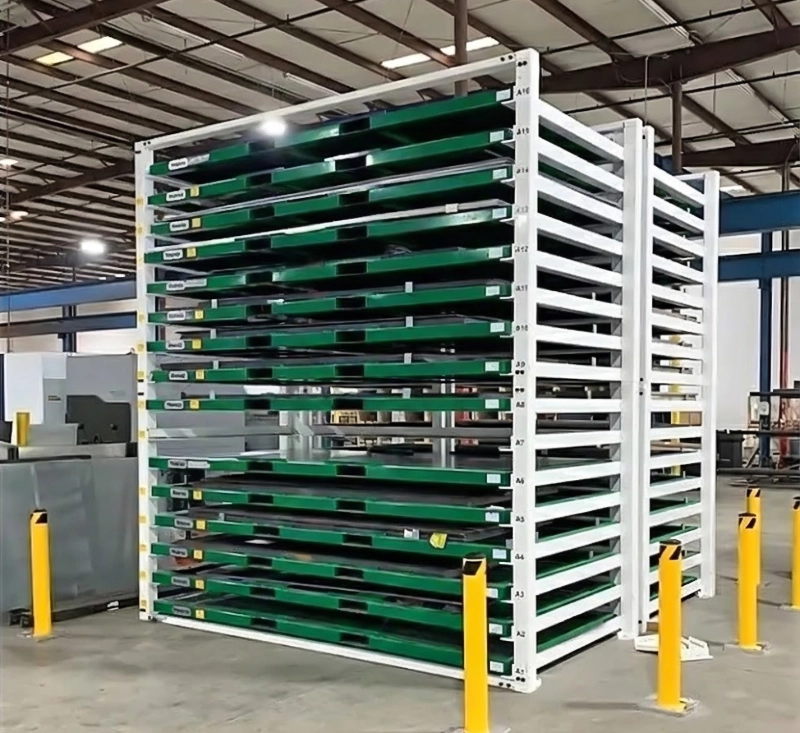
Vertical density: Store dozens of SKUs in a compact footprint, freeing up valuable shop floor space.
Ergonomics and Safety: The Crank-Out Advantage
Handling 5×10 steel plates that weigh over 3,000 lbs is inherently risky. Manual prying and rigging are leading causes of back injuries and crushed fingers in the industry. For heavier gauges, we recommend 鋼板製ラック equipped with a crank-out mechanism.
The mechanical advantage of the crank system allows a single operator to extend a drawer loaded with 5,000 lbs of steel using minimal physical effort. This eliminates the need for “cowboy engineering” to get plates out of a rack and standardizes the loading process, making it safer and more predictable.

The crank-out handle provides mechanical advantage, allowing safe, single-person operation of heavy loads.
ROI Analysis: Traditional vs. Horizontal Drawer Storage
The following comparison highlights why leading fabricators are switching to drawer-based systems:
| メートル | カンチレバー(cantilever)カンチレバーのこと | 水平引き出し棚 |
|---|---|---|
| Retrieval Time | 15-30 Minutes (Requires Forklift & Moving Stacks) | 2-3 Minutes (Single Operator Access) |
| 物的損害 | High (Scratching from sliding/restacking) | Near Zero (Vertical lift, no friction) |
| スペース利用 | Poor (Large footprint, limited verticality) | Excellent (High density, small footprint) |
| 安全リスク | High (Falling stacks, pinch points) | Low (Controlled mechanical movement) |
よくある質問(FAQ)
Q1: Can these racks accommodate standard 5′ x 10′ or 6′ x 12′ laser sheets?
Yes. Our racks are engineered specifically for the fabrication industry. We offer standard models for 4’x8′, 5’x10′, and 6’x12′ sheets, and can custom build for oversized plates used in heavy structural fabrication.
Q2: What is the weight capacity per drawer?
We understand that steel plate is dense. Our standard crank-out and roll-out units typically handle between 3,000 lbs to 10,000 lbs per drawer, depending on the model. We can engineer heavy-duty solutions for even thicker plate storage.
Q3: How do I load the material onto the rack?
Loading is flexible. You can use a forklift to load the drawers (especially with our “Full Forklift” models designed with fork pockets), or use an overhead crane/jib crane with a sheet lifter or vacuum cups to load from the top when the drawer is fully extended.
Q4: My shop has low ceilings. Can the height be customized?
Absolutely. While we maximize vertical space, we can customize the rack height to fit under your specific bridge crane or mezzanine clearance. We also ensure the top shelf is accessible for your specific lifting equipment.
Q5: Can I store remnant/skeleton sheets in these racks?
Yes. The solid drawer bottom design makes it ideal for storing partial sheets or remnants that often get lost or damaged in cantilever systems. This helps in maximizing material yield and reducing waste.

 EN
EN  DE
DE  RU
RU  NL
NL  PT
PT  JA
JA  ES
ES  IT
IT