
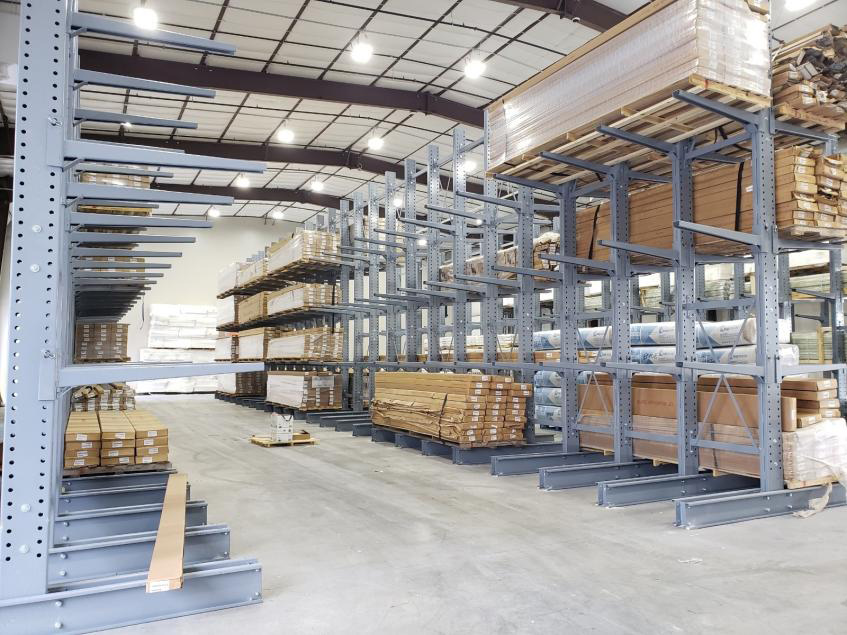
Does your warehouse feel like it’s shrinking? Every month, the rent invoice arrives, a stark reminder of the cost of every square meter. Yet, you look out at your long materials section and see chaos—piles of steel, lumber, or pipe that, while covering the floor, leave vast, empty space stretching up to the ceiling.
This feeling of being cramped isn’t just a feeling; it’s a financial reality. There is a silent theft happening in your facility every single day. The culprit? Wasted vertical space. You are paying for a three-dimensional volume but are only using a one-dimensional floor plan.
Let’s stop thinking in square meters and start thinking in cubic meters. This is the first step to uncovering a massive, hidden cost and an equally massive opportunity.
The Illusion of “Full”
When a 200-square-meter area is covered with materials stacked 1.5 meters high, we perceive it as “full.” But if your warehouse has an 8-meter clear ceiling height, the reality is stark. You are actively using only 300 cubic meters (200 m² x 1.5 m) of the 1,600 cubic meters (200 m² x 8 m) available to you.
This means 1,300 cubic meters—or over 80% of the volume you pay for—is empty air. It is an unproductive, expensive void.
Putting a Price Tag on Empty Air
Let’s perform a simple, conservative calculation to quantify this loss.
| Step 1: Calculate Your Per-Cubic-Meter Rent | Take your monthly rent and divide it by the total cubic meters of your facility (Floor Area x Ceiling Height). Let’s say your 2,000 m² facility with an 8m height costs $20,000/month. Total Volume: 16,000 m³ Cost per m³: $20,000 / 16,000 m³ = $1.25 per cubic meter per month. |
| Step 2: Calculate the Cost of Your Wasted Space | Now, apply this to the 1,300 cubic meters of wasted air in our example. 1,300 m³ x $1.25/m³ = $1,625 per month. |
This is $19,500 per year. This isn’t a hypothetical number; it is the real, tangible cost you are paying for the privilege of storing air. This is the budget you could be using for a new machine, higher salaries, or increased profit margins. It’s being stolen by an inefficient storage philosophy.
The problem is even more significant if you are considering expansion. Before you sign a lease on a new facility or approve a costly construction project, ask yourself: have I fully utilized the assets I already own? Often, the answer is no. The capital required for a new building could be entirely avoided by simply claiming the vertical territory you already control.
The Principle of Vertical Conversion
To stop this theft, a new approach is required. An ideal system must be based on a single, powerful principle: The Principle of Vertical Conversion.
This principle states that your storage system’s primary job is to safely and accessibly convert vertical space from an unproductive liability into a high-density storage asset. It means going up, not out. It means transforming your floor plan into a multi-level structure where every level is as accessible as the ground floor.
A system built on this principle doesn’t just store your materials; it fundamentally changes your facility’s financial equation. It maximizes your “Return on Rent” and defers massive capital expenditures on expansion.
The solution, therefore, isn’t just about finding a “better rack.” It’s about adopting an engineered system specifically designed for vertical conversion while maintaining the critical accessibility we discussed previously. The structure that embodies this principle is the cantilever rack. It is a tool designed not just to hold things, but to reclaim the value of the space you already pay for.

 EN
EN  DE
DE  RU
RU  NL
NL  PT
PT  JA
JA  ES
ES  IT
IT