
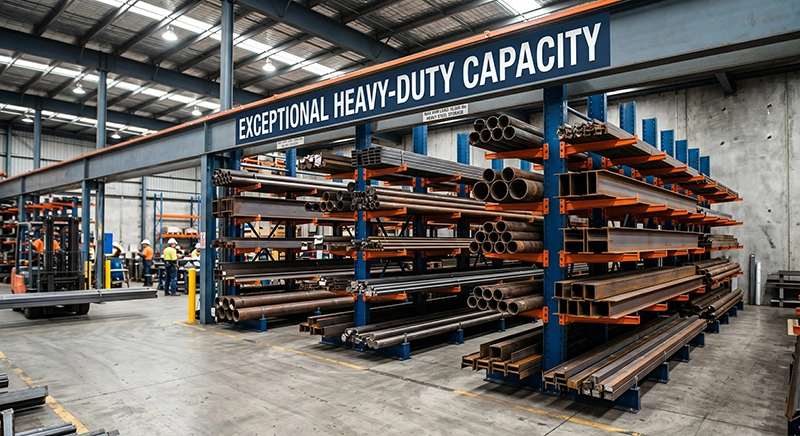
Buyers often compare cantilever rack pricing to ordinary beam rack pricing and assume the quote is inflated. In reality, the cost difference usually reflects the mechanics of the structure. A cantilever system carries load through projecting arms, which means bending control, anti-tip behavior, and reinforcement all matter much more than in a two-sided beam frame.
Why Heavy-Duty Cantilever Uses So Much Steel
Because the load projects away from the upright, the system fights deflection differently from a standard shelf beam. That is why true heavy-duty designs often move toward thick H-beams, reinforced bases, and stronger connection details. The extra steel is not decoration. It is what stops the rack from behaving like a long lever under heavy load.

Where the Cost Actually Goes
The quote is usually driven by structural sections, welding or fabrication difficulty, anchoring requirements, and the need for proper bracing. For serious projects, it may also include engineering verification such as load calculation or finite element review. That is why the rack can look visually simple but still cost far more than general warehouse shelving.

Why That Cost Can Still Make Sense
- Prevents dangerous deflection and structural failure
- Protects valuable long-stock inventory
- Supports real high-load use instead of decorative capacity claims
- Improves long-term warehouse reliability
Reviewing a High Cantilever Quote?
Send us the target load, arm length, and layout plan. We can help you see whether the price reflects real heavy-duty engineering or unnecessary overspecification.

 EN
EN  DE
DE  RU
RU  NL
NL  PT
PT  JA
JA  ES
ES  IT
IT