

Long plastic tube is starting to bow again. The span is too wide. The support is too thin. Somebody says it will be fine until the pack is pulled a month later and the middle has a permanent sag in it.
Plastic Does Not Need Force. It Needs Support.
That is the first thing a supply chain manager or warehouse supervisor learns after a few bad storage decisions. Nylon, PTFE, acrylic, and other industrial plastics are not steel. They do not like long unsupported spans. Leave them sitting wrong and they start to bow, creep, and lose shape.
You know the floor talk. “It is only plastic.” “We can stack that tube over there.” “The sheet will relax back later.” No, it will not. If the support is wrong, the shape stays wrong. That is how premium stock gets downgraded before it ever gets cut or shipped.
The material is not the problem. The storage method is. If the bay keeps leaving plastic hanging in the air, the damage bill shows up later in the quality report.

Why Wide Spans Cause Sagging
Cantilever racks for plastic sheets are not there to make the bay look tidy. They are there to stop the wrong physics. When the arm spacing is too wide, the load starts to sag between support points. Over time, that sag can become a permanent bow.
- Long tubes creep under their own weight.
- Plastic sheet edges droop between support points.
- Loose stacking causes hidden pressure marks.
- Re-handling a bowed pack makes the problem worse.
That is why continuous decking matters. A continuous support surface gives the stock a flatter base and spreads the load across more area.
What Better Support Actually Does
A proper industrial plastic cantilever rack gives the crew a place where the stock can stay flat and separated. The arm spacing can be tightened. The deck can be continuous. The material stops acting like it is sitting on a hammock.
That is the practical way to handle plastic rod and tube storage. Less bowing. Less sagging. Less re-stacking. Less time explaining why a premium plastic pack no longer fits the customer spec.
It sounds plain because it is plain. Support the full length and the shape stays where it should.
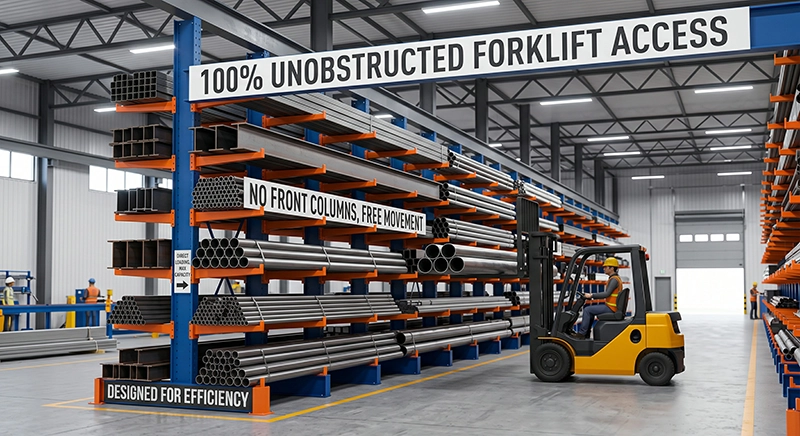
Cosa cambia una volta che la baia è riparata
When the rack plan is right, the bay stops acting like a deformation zone.
- Less bowing on long plastic tube.
- Less sag on sheets and bars.
- Less rework from shape loss.
- Less time spent re-stacking to reach the right pack.
That is where the value shows up. Not in slogans. In fewer rejected packs, fewer complaints, and fewer headaches when QC checks the lot.
Controllo reale
This is not a magic fix. There are still hard limits.
1) Span and load still matter
Heavier or softer plastics need tighter support spacing and a real load plan. If the stock mix is sloppy, the rack will only organize the mess.
2) materiale di carico
La bramma deve prendere il peso. Il cemento debole o irregolare è un cattivo punto di partenza.
3) la disciplina di gestione è ancora importante
No shortcut pulls. No tossing sheets on top. No “it will flatten out later” nonsense. That is how the shape gets ruined.
4) non è per ogni schema
If the site is trying to run ultra-tight automation with tiny loose parts, a plastic cantilever may need trays or a different storage format.
Cosa la squadra dovrebbe controllare dopo
- Which plastic grades are bowing or sagging most often?
- Where are the long-support gaps?
- Which packs are being re-handled the most?
- Where is the floor stack turning into a shape-loss problem?
If those answers are ugly, the layout needs a proper review, not another round of temporary stacking.
Passo successivo
Download the anti-sag layout guide, then submit your main plastic type and company email to get the 3D rack configuration and quote. That gives you a straight answer on how to keep plastic stock flat, supported, and within spec.
Need the Whitepaper or a Quote?
Send your plastic type and company email. We will review the layout and send back practical advice.

 EN
EN  DE
DE  RU
RU  NL
NL  PT
PT  JA
JA  ES
ES  IT
IT