
If you’re looking for ways to handle molds safely in a factory, you’re likely facing a serious concern: heavy molds slipping, tipping, or falling. These incidents put your workers at risk and can cost you thousands in damages and downtime. In small to medium-sized factories, where molds can weigh 800 lbs or more, unsafe handling isn’t just a safety issue—it’s a major financial liability. Having spoken with factory managers across the United States who’ve dealt with this exact problem, I understand how stressful it can be.
Take the case of a factory manager at a small metalworking plant in Cleveland, Ohio. Her team handled dozens of heavy molds daily, each weighing up to 1,000 lbs. One day, while moving a mold, it slipped from an unstable stack, narrowly missing a worker and damaging equipment worth over $2,500. The incident not only endangered a team member but also caused two days of production downtime. This scenario highlights the urgent need for a reliable mold storage rack system to prevent such costly and dangerous situations.
If this sounds familiar, you’re not alone. Unsafe mold handling leads to injuries, equipment damage, and lost productivity. The costs add up quickly, but you don’t have to accept this risk. Here are practical, cost-effective ways to keep your team safe and your factory running smoothly, with real numbers to show the impact.
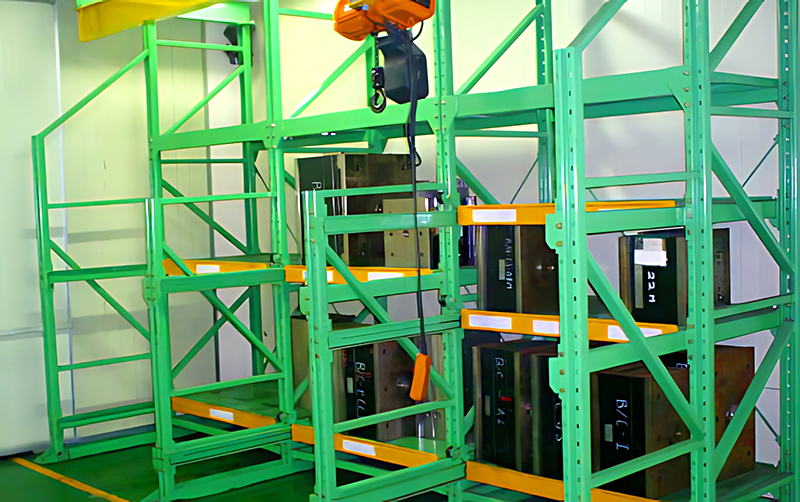
Step 1: Secure Molds During Handling with Locking Mechanisms
One of the biggest risks when handling heavy molds is unexpected movement—either the mold slipping or a storage shelf sliding out. This often happens when molds are stored on basic racks without locking features. A simple yet effective solution is to use a mold storage rack with layers that have locking mechanisms, like pins or latches, to hold them steady during access.
The Numbers: A single accident involving a falling mold can be incredibly costly. A minor injury could lead to a worker missing five days, costing approximately $960 in wages (at $24/hour) plus $800 in medical expenses, totaling $1,760. If a locking mechanism prevents just one accident per year, the savings are immediate. Furthermore, avoiding a safety violation fine, which can be $7,000 or more, adds significantly to these savings.
Step 2: Use a Sturdy Storage System to Prevent Tipping
Heavy molds place immense stress on storage systems. A flimsy rack can tip or collapse, creating a domino effect that endangers workers and destroys valuable equipment. It’s crucial to invest in a storage system built with sturdy materials, like reinforced steel, and designed to distribute weight evenly. This ensures stability even when the mold storage rack is fully loaded.
The Numbers: If a rack collapses and damages a $5,000 machine, the loss is substantial. Add two days of downtime, which could cost around $3,840 in lost production ($24/hour x 8 hours x 10 workers x 2 days), and the total comes to $8,840 for a single incident. A sturdy storage system might cost $3,000 upfront, but it saves you $5,840 in the first incident alone—not to mention the prevention of potential lawsuits.
Step 3: Lift Molds Safely with a Hoist in Tight Spaces
In many factories, narrow aisles make it difficult to use forklifts. This often leads to workers lifting heavy molds manually—a practice that is both exhausting and dangerous, especially on slippery floors. A hand-operated hoist mounted above your storage area allows for the safe lifting of heavy molds, significantly reducing the risk of drops and injuries.
The Numbers: Manual lifting dramatically increases the risk of back injuries. If an injury from lifting a mold causes a worker to miss 10 days, that’s $1,920 in wages plus another $1,500 in medical costs, totaling $3,420. A hoist might cost $800 to install, saving you over $2,600 per incident. It also reduces worker fatigue, which can lead to fewer sick days and improved productivity.
Step 4: Organize Molds to Reduce Unnecessary Handling
The more you handle molds, the higher the risk of an accident. When molds are scattered or poorly organized, workers must move multiple items to access the one they need. By organizing your molds so the most frequently used ones are easily accessible and labeling each location, you can minimize unnecessary handling and associated risks.
The Numbers: Imagine moving five molds to access one. If you do this 10 times a day, you’re moving 50 molds. With better organization, you only move the 10 you need—an 80% reduction. If each move takes 2 minutes with 2 workers (4 worker-minutes), you save 160 worker-minutes (about 2.67 hours) daily. At $24/hour per worker, that’s over $64 saved per day, amounting to more than $16,000 annually in labor costs.
Achieve a Safer, More Profitable Factory
By implementing these changes, the Cleveland factory transformed its operations. Molds are now secured with locking mechanisms, stored on a sturdy system, lifted safely with a hoist, and organized efficiently. They haven’t had a single incident in over six months, saving thousands of dollars in potential downtime and damages. Most importantly, the team feels safer, and with improved efficiency, they are delivering orders on time and attracting more clients.
Take Action to Protect Your Team and Your Bottom Line
You don’t have to continue risking accidents with unsafe mold handling. Start by securing molds with locking mechanisms, using a robust storage system, lifting safely with a hoist, and organizing your inventory. These steps will protect your workers, safeguard your equipment, and save you thousands in unnecessary costs.

 EN
EN  DE
DE  RU
RU  NL
NL  PT
PT  JA
JA  ES
ES  IT
IT