

|
Is the fear of a rack collapse keeping your safety manager up at night? When tons of steel pipe are stacked on a flimsy frame, it’s not a storage solution—it’s a ticking time bomb. The bent, rusted, and damaged pipes at the bottom of the pile aren’t just inventory loss; they are a direct hit to your bottom line and a constant threat to your crew’s safety. It’s time to stop accepting this as a cost of doing business. |
Tough steel pipe storage rack that won’t break?
For any metal service center or fabrication shop, the question isn’t if you need a scaffale per lo stoccaggio dei tubi, but if the one you have is an asset or a liability. A “good enough” rack, often sourced based on the lowest price, inevitably leads to catastrophic failures—bent frames, snapped welds, and worst of all, a collapsed stack that endangers personnel and destroys thousands of dollars in material. The promise of a tough Caserma per tubi di acciaio that won’t break isn’t about over-engineering; it’s about understanding the fundamental physics of storing long, heavy, and unruly materials.
The Real Cost of “Saving Money” on Pipe Racks
Walk through most yards and you’ll see the same story: a chaotic landscape of pipes and tubes. Bundles of HSS steel and Schedule 40 pipes are often stacked in precarious pyramids on the floor, supported by scrap wood. This “solution” creates a cascade of operational and financial problems:
- Material Damage: The bottom layer of pipe bears the weight of the entire stack, leading to crushing, warping, and irreversible “banana-ing” in PVC or thinner-walled tubes. This 2-5% material deformation rate is a hidden cost that eats directly into your profit margins.
- Operational Gridlock: Retrieving a specific bundle from the bottom of the pile becomes a time-consuming game of Jenga. A forklift operator might spend 20-30 minutes moving several tons of material just to access one order, bringing productivity to a halt and starving your laser cutters or CNC machines of raw stock.
- Safety Hazards: Unsecured pipes are notorious for rolling. This poses a constant, serious risk to your material handlers and anyone walking through the yard. A single rolling pipe can cause a severe injury, leading to downtime, insurance claims, and potential OSHA violations.
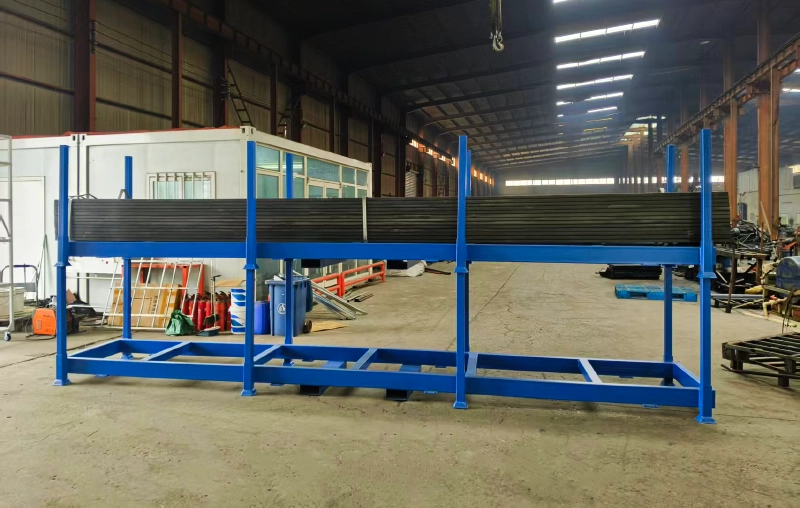
Bpirack safely handles heavy metal square tubing, stacked two layers high in a busy workshop.
Deconstructing a Rack That Refuses to Fail: The Bpirack Difference
A truly tough rack isn’t just about using more steel; it’s about smarter engineering. The Bpirack pluggable system is designed from the ground up to counteract the forces that cause other racks to fail.
The Foundation: Q235 Steel and a Rigid Frame
It starts with the material. We use industrial-grade Q235 carbon steel, a material with predictable tensile strength and rigidity. Unlike cheaper racks made from recycled or non-standard steel, a Bpirack frame resists plastic deformation under its maximum rated load. The base is constructed from heavy-gauge channel steel, providing superior resistance to bending under vertical pressure. All joints feature full, AWS-compliant welds, not just tack welds that can snap under the shock of a minor forklift bump.
The Principle: Load Transfer, Not Load Bearing
The core design genius lies in how the load is managed. When you stack Bpirack units, the specialized stacking feet on the bottom of one rack lock into the tops of the vertical posts of the rack below. This “mortise and tenon” engagement creates a solid, unified column. The entire static load of 4.5 tons (over 9,900 lbs) is transferred directly through the steel posts to the ground. Your valuable pipe isn’t supporting anything but its own weight. This completely eliminates pressure-related damage, protecting your inventory whether it’s heavy seamless carbon steel pipe or delicate 6063 aluminum extrusions.

Even outdoors, the vertical posts bear all the weight, ensuring zero crushing of the bottom-layer PVC pipes.
From a Cost Center to a Profit Multiplier
Implementing a proper heavy duty pipe storage racks system like Bpirack transforms your storage area from a chaotic cost center into an efficient, profit-generating asset.
- 400% Storage Density: By safely stacking up to 4 or 5 layers high, you can store four times the material in the same footprint. This allows you to delay or cancel expensive warehouse expansions and frees up valuable floor space for more production machinery.
- 90% Recupero più rapido: With each bundle in its own dedicated rack, you achieve 100% selectivity. Your forklift operator can pinpoint and retrieve any specific order in under 2 minutes. This dramatic increase in efficiency keeps your entire operation flowing smoothly.
- Unmatched Flexibility: These are portable pipe storage racks. When demand fluctuates or you need to reconfigure your layout, simply remove the pluggable posts. The empty bases nest together, recovering up to 80% of their footprint. Compare that to static cantilever racks bolted to the floor.

When not in use, Bpirack bases nest together, dramatically reducing their storage footprint.
Ultimately, a “tough” rack is one that delivers a tangible return on investment within 12-18 months. By eliminating material damage, slashing labor costs associated with material handling, and maximizing your existing square footage, the Bpirack system pays for itself. It’s not just a place to put your pipes; it’s a strategic tool for building a safer, more efficient, and more profitable operation.
Domande frequenti
1. What is the real-world load capacity of these racks?
Each Bpirack unit is engineered for a dynamic load of 1.5 tons (3,300 lbs) while being moved by a forklift, and a static load of 4.5 tons (9,900 lbs) when stationary. We recommend a maximum safe stacking height of 4 layers for most applications.
2. How do these stackable racks compare to traditional cantilever racks?
While cantilever racks are good for static, long-term storage, Bpirack excels in flexibility and space utilization. They don’t require wide aisles for forklift rotation and can be easily moved or stored when not in use. They are ideal for high-turnover inventory and dynamic production environments where layout changes are common.
3. Can the Bpirack system be used for outdoor pipe storage?
Absolutely. The racks are finished with an industrial-grade powder coating that creates a durable barrier against moisture and UV rays, preventing rust and corrosion. This makes them a reliable solution for outdoor pipe yards.
4. What is the main material and why is it important?
We exclusively use Q235 carbon structural steel. Unlike lower-grade or recycled metals, Q235 has certified strength and ductility, ensuring the rack will not bend, deform, or fail under its specified load. This is the key to preventing catastrophic collapses.
5. How much space do they actually save when they are empty?
Thanks to the detachable post design, the empty bases can be nested together. This configuration reduces the space required for storing the empty racks by up to 80%, freeing up significant floor space for other operations.

 EN
EN  DE
DE  RU
RU  NL
NL  PT
PT  JA
JA  ES
ES  IT
IT