

Your multi-million dollar laser cutter is sitting idle, bottlenecked by inefficient material handling. Cluttered floors, forklift traffic jams, and damaged sheets are eroding your profits. It’s time to transform your workshop from a storage space into a high-velocity production hub.
How Can Laser Shops Eliminate Forklift Delays & Boost IATF 16949 Compliance?
In today’s precision metal fabrication landscape, the speed of your Fiber Laser Cutting Machine dictates your profitability. Yet, for many shops, this high-speed asset is consistently starved for materials, held hostage by outdated storage methods. The core issue isn’t the cutter’s capability; it’s the logistical chaos in the ten meters surrounding it. Traditional floor stacking and static racking create bottlenecks that directly translate to lost revenue, quality issues, and safety risks—challenges that are unacceptable for any facility, especially those adhering to IATF 16949 or ISO 9001 standards.
The Hidden Costs of Inefficient Sheet Metal Storage
The true expense of poor material management extends far beyond wasted floor space. It manifests in operational friction that silently drains your workshop’s potential. Understanding these specific pain points is the first step toward a more streamlined, profitable operation.
The “Machine is Waiting” Bottleneck
Every minute your laser isn’t cutting, you’re losing money. The process of locating the correct material, using a forklift to move multiple heavy stacks to access the one needed, and then transporting it to the machine can take 15-20 minutes. For a high-volume shop, this process repeated multiple times a day results in hours of non-productive time for your most valuable equipment.
Logistical Gridlock: Forklift vs. Overhead Crane
A common scenario in a busy Laser Cutting Workshop is a conflict of movement. A forklift is trying to restock the raw material area from one aisle, while an operator needs to use an Overhead Crane with a vacuum lifter to load a sheet onto the machine from another. These paths cross, leading to one process waiting for the other. This logistical “traffic jam” creates delays and introduces significant safety hazards.

Quality Degradation: When a Scratch Becomes Scrap
For manufacturers of Electronic Enclosures or automotive components, surface finish is non-negotiable. Stacking sheets directly on top of each other, especially valuable materials like 304 Stainless Steel Plate or brushed aluminum, guarantees scratches from dragging and shifting. A single deep scratch can cause an entire sheet to be rejected, turning valuable inventory into costly scrap.
A Strategic Shift: From Storage to a Production Hub
The solution lies in re-imagining your storage rack not as a passive container, but as an active, integrated part of your production workflow. By implementing a system designed for flow and accessibility, you can directly address the core bottlenecks and unlock your workshop’s true capacity.
From Static Storage to a Dynamic Flow-Through System
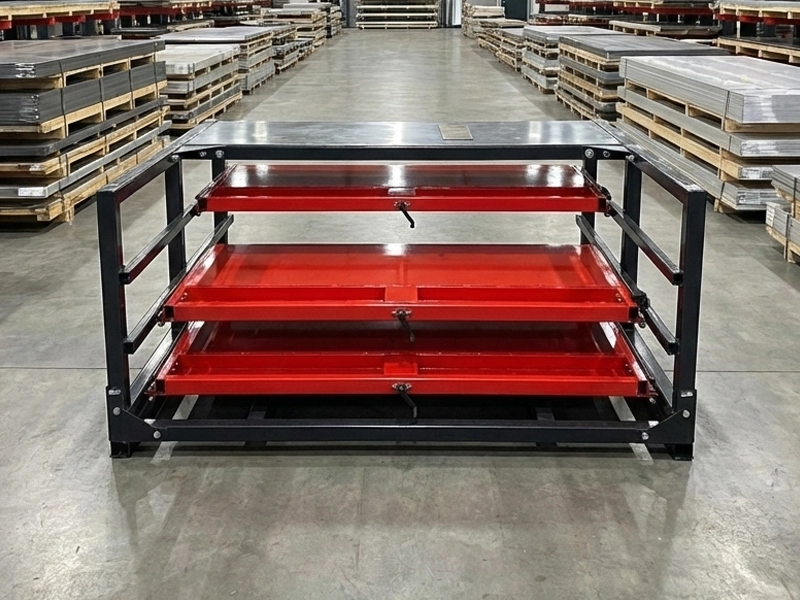
The most significant leap in efficiency comes from eliminating logistical conflicts. A Dual Access Sheet Rack creates a physical “tunnel” between your logistics area and your production area. Raw materials are loaded by forklift into the back of a drawer from the main aisle. Simultaneously and without interference, a machine operator can slide the same drawer out the front, directly next to the laser cutter, for immediate Crane Loading. This pass-through design completely separates restocking and production workflows, ensuring the laser never has to wait.
The Power of Mechanical Advantage: Single-Operator Control
Moving a 3-ton stack of steel should not require a forklift. By integrating a gear and rack mechanism with a 1:1.5 reduction ratio, a Crank-out Sheet Rack empowers a single operator to safely extend a fully loaded drawer with minimal physical effort. This system, built from high-strength Q235 Carbon Steel, transforms a dangerous, multi-person task into a safe, two-minute, one-person job. This frees up your skilled forklift operators for more value-added tasks.
Asset Protection: Every Sheet in its Own Vault
To eliminate surface damage, each material type must have its own dedicated, protected space. A drawer-based system provides this separation. Each layer functions as an independent storage unit, preventing the metal-on-metal friction that causes scratches. The 100% full extension capability allows a vacuum lifter to vertically access any sheet without dragging it across another, preserving the pristine finish of your most expensive materials and ensuring a Scratch-Free Storage environment.

The Quantifiable Impact on Your Bottom Line
Transitioning to an optimized storage system delivers a clear and rapid return on investment. The table below illustrates a typical scenario for a shop performing 10 material changes per day.
| Metrico | Traditional Method (Floor Stack & Forklift) | Dplarack System |
| Time per Material Change | 15 minuti | 2 minuti |
| Required Personnel | 2 (Operator + Forklift Driver) | 1 (Operator) |
| Total Daily Labor Minutes | 10 changes x 15 min x 2 people = 300 min | 10 changes x 2 min x 1 person = 20 min |
| Daily Labor Cost (at $25/hour) | 5 hours x $25 = $125 | 0.33 hours x $25 = $8.25 |
| Annual Direct Labor Savings (250 days) | $29,187.50 | |
| Intangible Gains | Increased machine uptime, reduced material scrap, improved safety, enhanced 5S compliance for IATF audits. | |
Conclusion: Your Storage Is a Tool, Not Just a Box
For modern metal fabricators, investing in a Heavy Duty Sheet Metal Rack is not an overhead expense; it is a strategic investment in productivity. By solving the fundamental challenges of accessibility, safety, and material flow, you directly increase the output of your primary production assets. This transforms your storage area from a cost center into a competitive advantage, creating a safer, more organized, and significantly more profitable workshop that is always ready for the next high-value job.
Domande frequenti
1. What is the typical load capacity of these crank-out drawers?
Standard configurations support loads from 1,000kg to 3,000kg (2,200 lbs to 6,600 lbs) per drawer. For applications involving extremely thick plates, such as in heavy equipment manufacturing, custom heavy-duty versions are available with capacities up to 5,000kg (11,000 lbs) per level.
2. How does the dual-access feature work in a real workshop?
The rack is placed between a main logistics aisle and the machine’s work area. The drawers can be fully extended in either direction. A forklift operator stocks the drawers from the back in the main aisle. The machine operator then pulls the required drawer out from the front, directly beside the laser cutter or press brake, allowing for seamless material flow without operational conflict.
3. What are the foundation requirements for installing such a heavy-duty rack?
Installation must be on a solid concrete floor, typically C30 grade or higher, with a recommended thickness of at least 200mm (8 inches). Each vertical column must be securely fastened to the foundation using heavy-duty chemical or mechanical anchor bolts to counteract the overturning force when a drawer is fully loaded and extended.
4. Is it possible to pull out more than one drawer at a time?
No. For safety, these systems are equipped with an interlock mechanism that physically prevents more than one drawer from being opened at a time. This is a critical safety feature that eliminates the risk of the unit tipping over due to a shifted center of gravity.
5. How do you protect delicate materials like polished stainless steel from scratches?
The fundamental design of providing each stack of material with its own drawer is the first line of defense. For an extra layer of protection, the steel surface of the drawer can be lined with non-abrasive materials like UHMW (Ultra-High-Molecular-Weight) polyethylene or durable wood planking, ensuring your most valuable sheets remain in perfect condition.

 EN
EN  DE
DE  RU
RU  NL
NL  PT
PT  JA
JA  ES
ES  IT
IT