

In today’s competitive industrial landscape, optimizing warehouse operations is no longer optional—it’s essential for survival. As companies grapple with rising labor costs, shrinking facility footprints, and the relentless demand for faster fulfillment, automation has emerged as the definitive solution. Two dominant technologies are at the forefront of this revolution: AGV Compatible Pallet Racking and Automated Storage and Retrieval Systems (AS/RS). While both promise to enhance efficiency, they represent fundamentally different philosophies in warehouse automation. Understanding their core distinctions is the first step toward making a transformative investment that aligns with your specific operational goals.
What is AGV Compatible Pallet Racking? The Flexible Path to Automation
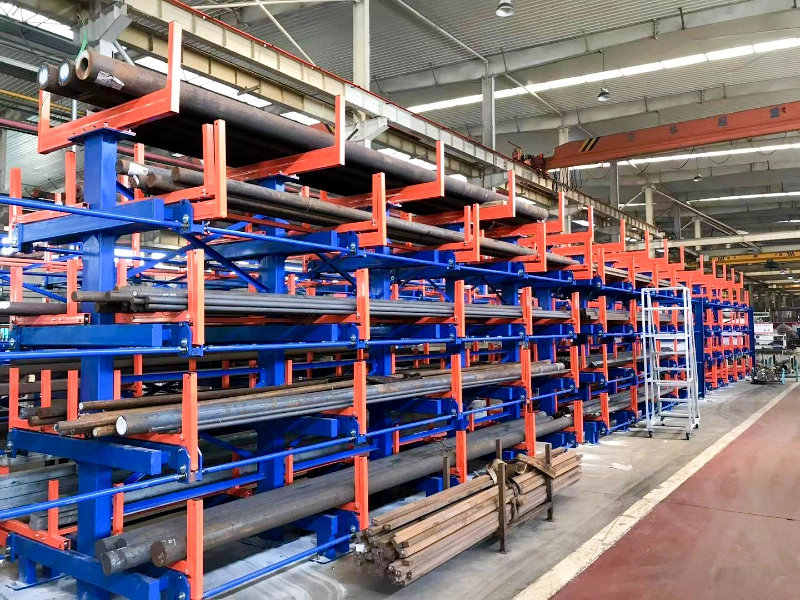
AGV Compatible Pallet Racking is not a new type of rack but rather an adaptation of conventional storage systems—like selective pallet racking or cantilever racking—to work seamlessly with Automated Guided Vehicles (AGVs) or Autonomous Mobile Robots (AMRs). The core principle is to automate the horizontal movement of goods, replacing human-operated forklifts with intelligent, self-navigating vehicles.
The “compatibility” involves specific design considerations. Aisles must be sufficiently wide and consistently clear for AGV navigation. The racking itself often requires reinforced base plates to withstand the repetitive, precise loading of robotic systems, and floor surfaces must be smooth and level. The system relies on a Warehouse Management System (WMS) to direct AGVs to specific pick-up and drop-off locations, automating tasks that were once labor-intensive and prone to human error.

Core Value & Operational Impact
The primary value of an AGV-based system is its flexibility and scalability. It allows a facility, such as a busy Officina di fabbricazione dei metalli or a steel distributor, to introduce automation incrementally. You can start with a few AGVs handling the most repetitive routes—for instance, moving finished components from a saw cutting machine to the shipping area—and expand the fleet as demand grows. This approach minimizes upfront capital investment and operational disruption.
- Phased Implementation: Businesses can automate one section or process at a time, integrating AGVs into existing workflows alongside human workers.
- Reduced Labor Dependency: It directly addresses the challenge of finding and retaining certified forklift operators by automating point-to-point material transport.
- Sicurezza migliorata: AGVs are equipped with advanced sensors and follow predictable paths, significantly reducing the risk of collisions and accidents common in busy, forklift-dominated environments.
What is an Automated Storage and Retrieval System (AS/RS)? The High-Density Powerhouse
An Automated Storage and Retrieval System (AS/RS) is a far more integrated and transformative technology. It’s not just about automating transport; it’s about automating the entire storage ecosystem. An AS/RS combines a high-density racking structure with automated machinery—such as stacker cranes or robotic shuttles—that operates within the racks to store and retrieve goods.
In an AS/RS, the “goods-to-person” principle is paramount. Instead of a vehicle traveling to a rack, the system delivers the required item directly to a stationary operator at an ergonomic workstation. These systems are characterized by their immense height and density, often reaching the full ceiling height of a warehouse and eliminating nearly all aisle space. They are complex, computer-controlled machines designed for maximum throughput and space efficiency.
Core Value & Operational Impact
The defining value of an AS/RS is its unparalleled density and speed within a controlled environment. For operations where every square foot is critical, such as cold storage facilities or urban distribution centers, an AS/RS can increase storage capacity by up to 85% compared to conventional racking. The knowledge base for advanced storage highlights that while systems like an AS/RS have a high initial cost, their value is realized in scenarios demanding extreme speed, accuracy, and space optimization.
- Utilizzo massimo dello spazio: By minimizing aisles and leveraging vertical height, ASRS offers the highest possible storage density, fundamentally changing how a facility’s footprint is used.
- Unmatched Throughput and Accuracy: Computer-controlled retrieval ensures near-perfect inventory accuracy and delivers goods at a speed and consistency unattainable by human operators.
- Secure and Controlled Environment: The enclosed nature of most ASRS solutions provides excellent security for high-value inventory and protects items from damage and contamination.
Key Differences: A Head-to-Head Comparison
Choosing between these two powerful technologies requires a clear understanding of their fundamental trade-offs. The decision hinges on your specific operational needs, budget, and long-term strategic goals.
| Dimensione | AGV Compatible Pallet Racking | Sistema automatico di archiviazione e recupero (AS/RS) |
|---|---|---|
| Core Principle | Automating horizontal transport; bringing the vehicle to the goods. | Automating the entire storage cube; bringing the goods to the person. |
| Utilizzo dello spazio | Moderate. Still requires wide aisles for vehicle navigation. | Extremely high. Eliminates most aisles and maximizes vertical space. |
| Flexibility & Scalability | High. Can be introduced in phases and easily expanded by adding more vehicles. Works with various rack types. | Low. A large, monolithic system that is difficult and costly to modify or expand once installed. |
| Implementation Cost | Lower initial investment. Can be built upon existing infrastructure. | Very high capital expenditure. Often requires a purpose-built facility or major renovation. |
| Throughput | Good for point-to-point transport but limited by travel distances and rack access times. | Exceptional. Designed for high-velocity, continuous operations with hundreds of transactions per hour. |
| Inventory Handling | Versatile. Can handle pallets, bins, and even custom carriers for items like bar stock or heavy components. | Typically requires standardized totes, bins, or pallets for consistent handling by the machinery. |
| Ideal Environment | Existing warehouses, manufacturing facilities, and distribution centers looking for incremental automation and flexibility. | New construction (greenfield projects), high-volume distribution centers, cold storage, and operations where space is the primary constraint. |
Making the Right Choice for Your Operation
The decision between AGV racking and ASRS is not about which is “better,” but which is “right” for your unique challenges. Your choice should be driven by a careful analysis of your inventory profile, order velocity, facility layout, and capital strategy.
Choose AGV Compatible Racking If:
- You need a flexible, scalable solution that can grow with your business.
- You want to automate material transport within an existing facility without a complete overhaul.
- Your primary bottleneck is the movement of goods between receiving, storage, production, and shipping.
- You handle a variety of load sizes and need a system that can adapt.
Choose an Automated Storage and Retrieval System (AS/RS) If:
- You are designing a new facility and can dedicate a significant portion of it to a high-density system.
- Maximizing storage capacity in a limited footprint is your absolute top priority.
- You require extremely high throughput and order accuracy for a relatively standardized set of SKUs.
- You have the capital for a major, transformative infrastructure project with a long-term ROI horizon.
Ultimately, both AGV compatible racking and ASRS are powerful tools for building the warehouse of the future. By moving beyond manual, forklift-dependent processes, they create safer, more efficient, and more productive environments. The key is to match the technology’s strengths to your operational reality, ensuring your investment delivers not just automation, but a true competitive advantage.
Domande frequenti (FAQ)
1. Can I use AGVs with my existing pallet racking?
In many cases, yes, but modifications are often necessary. You must ensure your aisles are wide and clear enough, your floor is in good condition, and the bottom rack level provides adequate clearance and support for the AGV’s lifting mechanism. A professional assessment is crucial to confirm compatibility and identify necessary upgrades for safe and efficient operation.
2. Qual è il rendimento tipico degli investimenti (ROI) per un rvi?
L’ utile sul capitale investito per un rvi è molto variabile, ma è generalmente calcolato su un periodo di 5-10 anni. I fattori chiave alla base del ROI includono i risparmi derivanti dalla riduzione dei costi del lavoro, dai forti aumenti della densità di stoccaggio (evitando il costo di un nuovo edificio), da una migliore accuratezza delle scorte (riducendo le cancellazioni) e da una maggiore produttività. L’elevato investimento iniziale significa che il caso aziendale deve essere costruito su profitti operativi significativi a lungo termine.
3. I sistemi AGV sostituiscono completamente la necessità di elevatori a forca?
Non sempre. Agv eccelle per compiti ripetitivi di trasporto orizzontale preprogrammati. Tuttavia, gli elevatori a forca gestiti dall’uomo sono spesso ancora necessari per attività più complesse, come il carico/scarico di autocarri con carichi vari, la movimentazione di carichi sovradimensionati o non standard e la gestione di eccezioni. I sistemi AGV sono visti meglio come un modo per automatizzare la maggior parte dei movimenti prevedibili, liberando gli operatori qualificati per attività di maggior valore.
4. In che modo un rvi tratta prodotti di dimensioni diverse?
La maggior parte dei asr è concepita intorno a portarinfuse standard come totes, bidoni o pallet. Per trattare una varietà di prodotti, le merci sono generalmente collocate in questi supporti standard presso una stazione di alimentazione prima di entrare nel sistema. I DRR basati su uno “shuttle” più avanzato possono offrire una certa flessibilità con una pendenza dinamica, ma l’efficienza di base del sistema si basa su dimensioni di carico unitario coerenti.
5. Quale sistema è più sicuro, AGV Racking o asr?
Entrambi i sistemi migliorano significativamente la sicurezza rispetto alle tradizionali operazioni di sollevamento di forche. Il DRMR è senza dubbio il più sicuro, in quanto generalmente opera in un’area completamente chiusa e ad accesso limitato, eliminando quasi tutte le interazioni uomo-macchina. I sistemi AGV riducono drasticamente gli incidenti legati al sollevamento delle forche utilizzando sensori avanzati di navigazione e sicurezza, ma poiché spesso operano in aree condivise con pedoni e altre attrezzature, richiedono protocolli di sicurezza rigorosi e una gestione del traffico ben progettata.

 EN
EN  DE
DE  RU
RU  NL
NL  PT
PT  JA
JA  ES
ES  IT
IT