
 |
Handling heavy steel plates in a fabrication shop for construction equipment or aerospace components presents constant challenges. The process is often slow, space-intensive, and carries significant safety risks for personnel using overhead cranes. Optimizing the storage and retrieval of these massive materials is not just about tidiness; it’s a critical step in enhancing operational safety and production throughput. |
Heavy Plate Storage: Boost Safety & Crane Efficiency
In industries like heavy equipment manufacturing and shipbuilding, the raw material itself is a logistical challenge. Stacks of thick, hot-rolled steel plates dominate floor space, creating both a bottleneck and a safety hazard. The conventional method of floor stacking requires prying plates apart to attach lifting gear, a practice that exposes workers to crush and slip hazards. This process is not only dangerous but also incredibly inefficient, often forcing expensive machinery and skilled operators to wait. The solution lies in shifting from a static, horizontal storage model to a dynamic, vertically integrated system designed for heavy loads.
Transforming Floor Hazards into Organized Assets
The first step toward a safer and more efficient workshop is to reclaim the floor. By transitioning from sprawling stacks to a high-density vertical system, you fundamentally change your material handling workflow. This isn’t just about saving space; it’s about creating a predictable, organized, and accessible inventory system.
Engineered for Extreme Loads
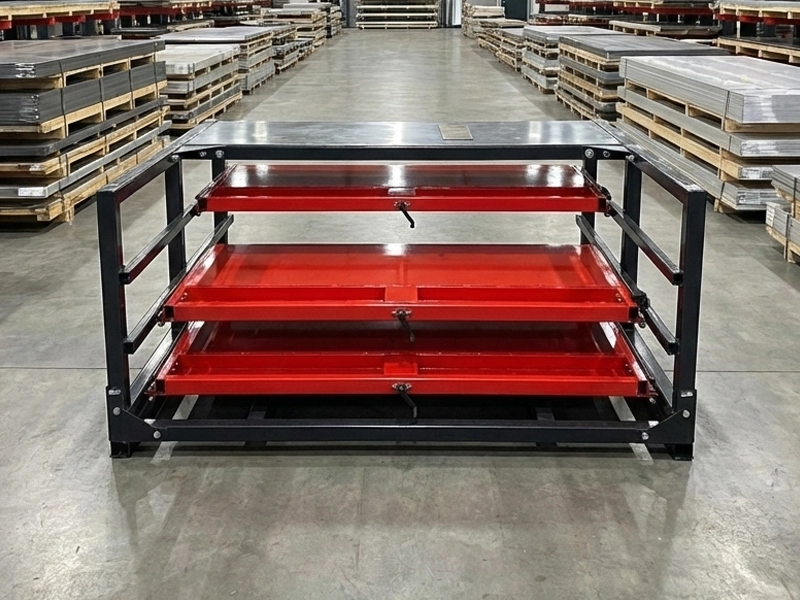
A system built from high-strength Q235 carbon steel and a reinforced base is essential for handling the immense weight of full-size steel plates. Racks engineered with a high capacity plate rack design can safely support 3 to 5 tons (up to 5000 lbs) per individual drawer. This structural integrity means that what once occupied a vast and chaotic area of your facility can now be condensed into a small, secure footprint, with each plate grade or thickness assigned to its own accessible level. This immediately improves inventory management and reduces the risk of material damage.
Achieving True Crane-Loading Safety
The most critical interaction in heavy plate handling is the moment of lifting. A properly designed storage system should facilitate this process, not complicate it. The goal is to create a workflow where the crane operator and the material can interact without putting any personnel in harm’s way.
100% Drawer Extension: The Key to Safe Lifts
The defining feature of a truly safe system is the ability for each drawer to extend fully from the main frame. This 100% extension moves the entire multi-ton stack of plates out into an open area, clear of any overhead rack structure. This provides the Overhead Crane Loading operator with unobstructed vertical access. The lifting magnets or clamps can be lowered directly onto the material without the need for a worker to manually guide them or stand near the load. This single feature eliminates the most common cause of accidents in heavy plate handling, aligning the workshop with strict EHS and OSHA safety standards.
Mechanical Advantage for Single-Operator Control
Moving a 5-ton load should not require a forklift or excessive physical force. A Crank-out sheet rack utilizes a gear and pinion mechanism with a calculated gear ratio (e.g., 1:1.5) to multiply the operator’s effort. This simple yet powerful mechanical system allows a single worker to smoothly and safely roll out a fully loaded drawer with minimal effort using a hand crank. This removes the reliance on powered equipment for retrieval, reducing traffic, noise, and maintenance costs within the production cell while dramatically speeding up the material selection process.

By rethinking the fundamental approach to heavy plate storage, fabrication shops can achieve more than just a cleaner workspace. They can create an inherently safer environment, improve the efficiency of their most valuable capital equipment (the overhead crane), and empower a single operator to do the work that previously required a team, transforming a dangerous chore into a streamlined, value-adding part of the production process.
Domande frequenti
What is the maximum weight a single drawer can typically hold?
Heavy-duty models are specifically engineered to handle extreme loads. Standard high-capacity drawers are rated for 3,000 to 5,000 lbs (approximately 1.5 to 2.5 tons), with custom solutions available for even heavier applications required in sectors like shipbuilding or large-scale equipment manufacturing.
How does this type of rack improve safety for crane operators?
The 100% full extension feature is the primary safety enhancement. It moves the entire plate stack clear of the rack structure, giving the crane operator direct, unobstructed vertical access. This eliminates the need for workers to be near the load to attach rigging, drastically reducing the risk of crush or pinch-point injuries.
Can these heavy-duty racks be installed on a standard concrete floor?
Installation requires a solid foundation, typically a reinforced concrete floor of C30 grade or higher, with a recommended thickness of at least 200mm (approx. 8 inches). The rack must be securely fastened to the floor using heavy-duty chemical or expansion anchor bolts to counteract the tipping force when a heavy drawer is extended.
How can a manual crank system move a multi-ton load?
The system uses the principle of mechanical advantage. A precision gear and pinion system with a specific reduction ratio (e.g., 1:1.5) multiplies the force applied by the operator. This allows a small input force on the hand crank to generate enough torque to smoothly move a drawer weighing several tons.
Is it possible to accidentally pull out more than one drawer at a time?
No, safe designs incorporate an interlocking mechanism. This is a critical safety feature that physically prevents more than one drawer from being extended at a time. This ensures the rack’s center of gravity remains stable and eliminates the risk of tipping caused by multiple extended loads.

 EN
EN  DE
DE  RU
RU  NL
NL  PT
PT  JA
JA  ES
ES  IT
IT