
Glasstech Europe × Aplarack
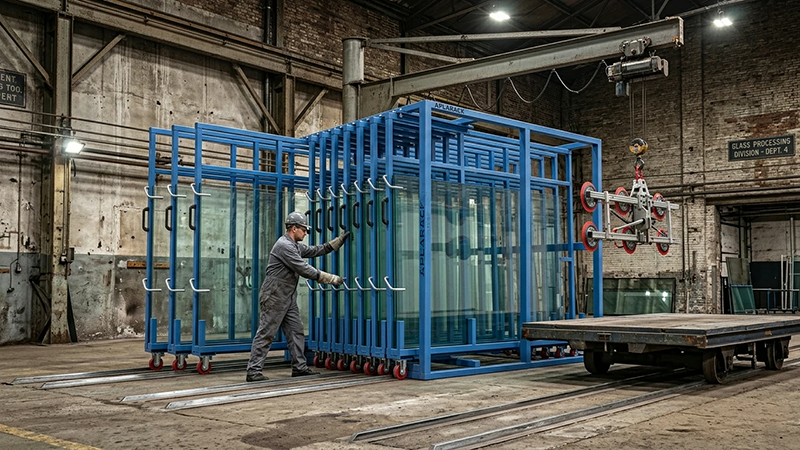
When glass panels need to stay vertical, separated, and ready for overhead handling, Aplarack gives Glasstech Europe a full-extension storage layout with open-top access, guided roll-out drawers, and a heavy-duty Q235 steel frame.
The problem before the new rack
Glass sheet handling does not forgive tight aisles, mixed stacking, or closed storage. If panels share the same bay, teams spend more time rehandling material, edge damage risk rises, and the workshop loses usable floor space. Glasstech Europe needed a storage method that would keep each sheet vertical, make every panel accessible without disturbing the rest, and still leave room for safe overhead pickup.
Why Aplarack fits the job
Independent full-extension bays
Each drawer module rolls out on its own path, so operators can access one sheet stack at a time instead of pulling an entire rack apart. That keeps adjacent panels stable and the workflow controlled.
Open top for overhead handling
The top stays fully open, which matches crane or vacuum lifter handling. Glass can move vertically without fighting a roof, lid, or closed cabinet frame.
Q235 steel frame with guided mobility
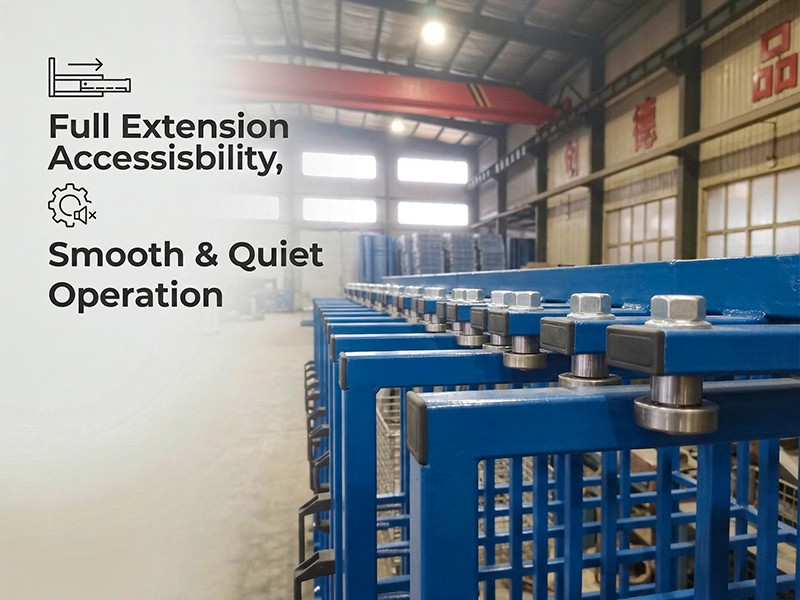
The product structure shown in the image index uses a welded Q235 steel frame, roller guidance, and heavy-duty casters. That gives the rack the rigidity needed for sheet storage and the mobility needed inside a workshop.
What the structure proves
The selected images show the same logic from two angles: an open-top rack for vertical handling, and a bolted roller-guided base for controlled drawer travel. That combination is exactly what glass storage needs when the goal is to reduce rehandling, keep access clear, and move panels without forcing a full rack reset.
Result after implementation
Lower handling risk
Separating sheets into dedicated bays reduces contact points and helps protect edges during storage and retrieval.
Cleaner workflow
Operators can access the needed bay directly, and the overhead opening keeps the handling path simple for crane-based moves.

 EN
EN  DE
DE  RU
RU  NL
NL  PT
PT  JA
JA  ES
ES  IT
IT