

|
Your workshop’s “remnant graveyard” is costing more than just space. It’s a daily drain on your laser cutter’s uptime, a safety hazard for your team, and a black hole for valuable material. Stop the 20-minute scavenger hunt for off-cuts. It’s time to turn that chaotic pile into a high-density, instantly accessible asset. |
The Remnant Graveyard: How Disorganized Off-Cuts Are Killing Your Fab Shop’s Efficiency
Walk into almost any sheet metal fabrication shop, and you’ll find it: the “remnant pile.” It’s a chaotic stack of off-cuts, partial sheets, and leftover pieces from previous jobs. For your production manager, it’s a constant source of frustration. For your laser operator, it’s a time-consuming and often dangerous scavenger hunt. This isn’t just clutter; it’s a critical bottleneck that directly impacts the uptime of your most valuable asset—your fiber laser cutting machine.
The old method of “floor stacking” (地堆) remnants means that the exact piece you need is almost always buried under five other heavy, sharp-edged sheets. The process involves:
- Waiting for a forklift or a material handler to become available.
- Painstakingly moving multiple heavy sheets (“倒垛” or reshuffling) just to access the one at the bottom.
- Risking scratches and dings on high-value materials like stainless steel or aluminum sheets.
- Creating a serious safety hazard from unstable, sliding piles of metal.
This “20-minute hunt” for a usable remnant directly translates to your multi-million dollar laser cutter sitting idle, waiting for material. It’s a hidden cost that silently erodes your shop’s profitability, one delayed job at a time.
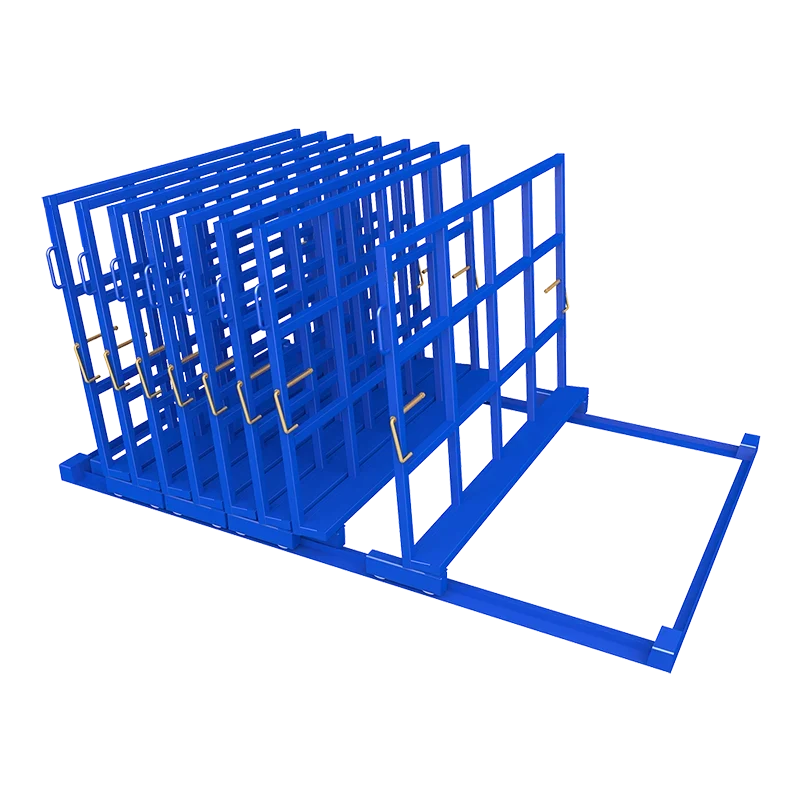
From Chaotic Pile to Organized Asset: The Cplarack Logic
The Cplarack Manual Mobile-Aisle Vertical Sheet Rack System is engineered specifically to solve the remnant problem. It transforms your off-cuts from a liability into an organized, immediately accessible part of your inventory. The logic is simple but powerful:
1. Vertical Density & Compartmentalization: Instead of sprawling across valuable floor space, remnants are stored vertically in individual, heavy-duty drawers (Drawer). Each drawer acts as a dedicated slot, giving every remnant—no matter how irregular its shape—a specific, identifiable home. This ends the “pile” for good and provides a clear overview of your available stock.
2. The Mobile Aisle—Reclaim Your Floor: The system’s core innovation is eliminating fixed aisles. Multiple rows of drawers are mounted on a single track (Track) system. Using a simple hand crank (Hand Crank), a single operator can effortlessly move drawers weighing up to 3,000 kg (over 6,600 lbs) to create an access aisle exactly where it’s needed. This Compact sheet metal storage design can reduce the footprint of your remnant storage by over 70%, freeing up critical space for another press brake or a new deburring station.
3. 100% Selectivity for Crane Access: Once the aisle is open, your overhead crane or vacuum lifter has unobstructed, top-down access to 100% of the material in the selected drawer. There is no more digging. Your laser operator can identify the required remnant, create an aisle, and have the piece lifted and on the cutting table in under two minutes. This is the essence of efficient Sheet metal storage for laser cutting.

The “After” Scenario: A Streamlined Workflow
Implementing a dedicated Sheet metal remnants storage rack isn’t just about tidying up; it’s a strategic upgrade to your entire production flow.
| Metric | Before: Floor Stacking | After: Cplarack System |
|---|---|---|
| Material Retrieval Time | ~20-30 minutes of searching and reshuffling. | < 2 minutes for direct, 100% selective access. |
| Floor Space Utilization | Large, sprawling footprint with multiple wasted access areas. | Up to 70% Floor space reduction due to mobile aisle design. |
| Material Damage | High risk of scratches and edge damage from stacking and dragging. | Near-zero damage with vertical, non-contact storage. |
| Safety & Ergonomics | High risk of cuts, strains, and accidents from unstable piles. | Engineered safety with anti-tilt wheels (Limit Wheel) and ergonomic one-person sheet metal handling. |
Engineered for the Realities of a Fab Shop
This system is built from heavy-duty structural steel to withstand the demanding environment of a metal fabrication workshop. The robust gear and rack (Gear Rack) drive mechanism ensures smooth and reliable movement even when fully loaded with heavy steel plate. Integrated safety features like the anti-tilt limit wheels and end-of-track limit devices (Limit Device) provide peace of mind, eliminating the risk of catastrophic failure associated with makeshift storage solutions. Stop letting a disorganized remnant pile dictate your production schedule. It’s time to reclaim your space, boost your efficiency, and turn your off-cuts into a ready-to-use asset.

Frequently Asked Questions
1. How does this system handle the irregular shapes and sizes typical of sheet metal remnants?
Each drawer provides a large, open vertical bay. You can store multiple smaller remnants or one large off-cut within a single drawer. The vertical orientation means that shape is less of an issue than with horizontal stacking, as pieces rest against the sturdy frame, not on top of each other.
2. Can a single operator really move a drawer loaded with thousands of pounds of steel?
Yes. The system uses a gear reduction mechanism via the hand crank and chain drive. This multiplies the operator’s force, making it surprisingly easy for one person to smoothly roll a fully loaded drawer (up to 3,000 kg / 6,600 lbs) with minimal effort.
3. How does this integrate with my laser cutter or press brake workflow?
The rack is designed to be placed near your processing equipment. An operator can retrieve the required remnant with an overhead crane in under two minutes and place it directly onto the machine’s shuttle table. This creates a seamless, just-in-time (JIT) flow of material, maximizing machine uptime.
4. What is the typical ROI for a rack used just for remnants?
The ROI is calculated based on three factors: 1) Reclaimed floor space and its value (potentially delaying a costly expansion). 2) Increased machine uptime from drastically reduced material search times. 3) Reduced material waste from preventing damage to valuable remnants. Most shops see a return on investment in 7-18 months.
5. What are the floor requirements for installing the Cplarack system?
The system requires a flat, solid concrete floor capable of supporting the total weight of the rack and its contents. The track system is securely anchored to the floor using expansion bolts (Expansion Bolt) or chemical anchors to ensure stability and precise alignment for smooth operation.

 EN
EN  DE
DE  RU
RU  NL
NL  PT
PT  JA
JA  ES
ES  IT
IT