

|
Is your CNC tube laser cutter—the most expensive machine in your workshop—constantly waiting for material? The daily battle with forklifts blocking narrow aisles and the time wasted untangling piles of steel tubing is a direct drain on your machine’s uptime and your profits. If your staging area looks more like a scrap yard than a lean production line, it’s time to stop moving individual pipes and start moving the entire workflow. |
The Chaos of the “Before”: Why Your Laser Cutter Is Starving
For any fabrication shop, the area around the laser cutting machine is a critical production hub. Yet, it’s often the most chaotic. The typical workflow is a recipe for inefficiency: a forklift drops a large, heavy bundle of HSS steel or DOM tubing onto the floor. When the machine operator needs a different size, the “华容道” (Chinese Sliding Block Puzzle) begins. A forklift must be called to move several tons of material just to access the required stock, a process that can easily take 20-30 minutes. This isn’t just a delay; it’s a direct hit to your output.
This “chaotic floor storage” method creates a cluster of expensive problems:
- Machine Downtime: Every minute your laser isn’t cutting, you’re losing money. Waiting for material is the most common—and most preventable—cause of this downtime.
- Safety Hazards: Long pipes and tubes stored directly on the floor are a notorious rolling hazard, leading to serious leg and foot injuries and potential OSHA violations.
- Material Damage: Tubes get scratched, dented, or contaminated from direct contact with the concrete floor, leading to waste and rejected parts.
- Wasted Floorspace: Spreading material across the floor consumes valuable square footage that could be used for another machine or a WIP staging area.
The Bpirack Logic: From a Static Rack to a Mobile “Unit Load”
The solution isn’t a better way to stack pipes on the floor; it’s to eliminate floor stacking entirely. A portable pipe storage racks system transforms your raw material into a mobile “unit load.” Instead of moving pipes, you move the rack itself—a single, self-contained, and highly mobile unit.
This is achieved through a specific engineering design: a robust Q235 carbon steel base with detachable posts, which can be customized with heavy-duty, bolt-on castors. This isn’t just a pipe rack storage solution; it’s a material flow tool. In the main storage area, a forklift loads a specific job’s worth of material onto a Bpirack. This rack, now holding up to 3,300 lbs (1.5 tons) of material, can be pushed by a single operator directly to the laser cutter’s automatic feeding zone. You’ve just bypassed the forklift bottleneck at the point of use.

When not needed for transport, these same racks function as a high-density storage system. By removing the castors, the racks can be safely stacked 4 to 5 layers high, multiplying your storage capacity on the same footprint by 400%. During slow seasons or after a project is complete, the posts can be removed and the bases nested together, reclaiming up to 80% of the storage space.

The “After”: A Lean, Safe, and Productive Workflow
Implementing rolling pipe storage racks is about more than just organization; it’s about measurable performance gains. A California-based furniture manufacturer faced this exact challenge: their laser cutter was idle for 15 minutes every hour waiting for a forklift to navigate the congested area. By switching to Bpirack units with castors, they created a “point-of-use” inventory system.
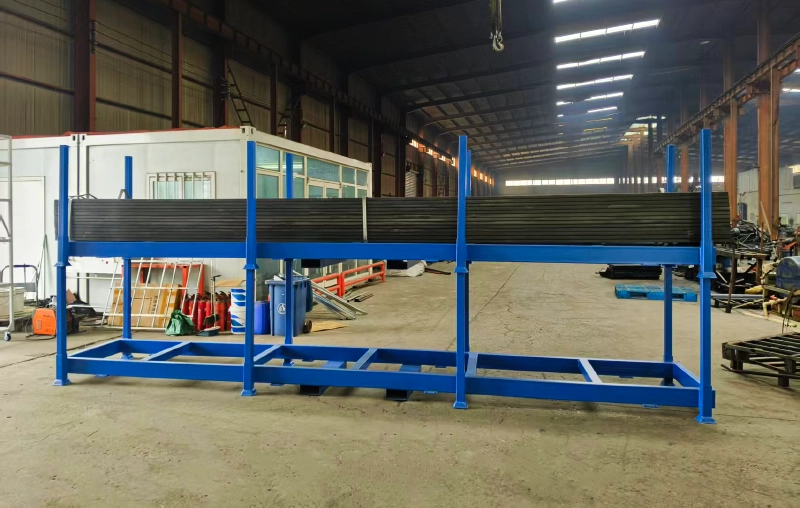
The results were immediate and quantifiable:
- 18% Increase in Output: By eliminating forklift dependency for machine feeding, the laser cutter’s daily effective output increased by 18%.
- 90% Faster Material Retrieval: Finding and moving the correct material went from a 20-minute ordeal to a 2-minute task.
- Zero Material Damage: The industrial powder-coated steel pipe storage rack protected expensive stainless steel tubes from floor damage, reducing the scrap rate to near zero.
- A Safer Workshop: The aisles became clear and walkable. The risk of rolling pipes was completely eliminated, satisfying the HSE Manager and ensuring a safer environment for operators.
Stop letting inefficient material handling dictate the productivity of your most valuable equipment. It’s time to empower your operators with a system that makes moving pipes easier, faster, and safer.
Frequently Asked Questions
1. Can these portable racks handle heavy-wall rectangular steel tubing?
Absolutely. Each rack is engineered from Q235 structural steel and is rated for a dynamic load capacity of 3,300 lbs (1,500 kg) and a static load of 9,900 lbs (4,500 kg). This is more than sufficient for full bundles of most common HSS and structural tubes.
2. What type of castors are used for the mobile customization?
We use heavy-duty, industrial-grade swivel castors with brakes, typically 4 or 5 inches in diameter. They are bolted directly to a reinforced plate pre-welded onto the base, ensuring a secure connection that can withstand the rigors of a busy workshop floor.
3. Is it safe to stack the racks with the wheels attached?
No. This is a critical safety instruction. The castors are designed for ground-level mobility only. For safe vertical stacking, the castors must be removed to allow the specialized stacking feet to properly engage with the post tops, creating a stable, interlocked structure.
4. How do these racks help with OSHA compliance in our pipe yard?
By unitizing loose pipes, these racks fundamentally solve the “rolling hazard” problem, which is a major focus of OSHA inspections in facilities that handle long materials. Keeping pipes contained within a rigid steel frame prevents accidental movement and makes the entire storage area safer for pedestrian and forklift traffic.
5. Will a mobile rack fit in the narrow aisle next to our band saw or laser cutter?
Yes. The racks have a standard width of approximately 44 to 52 inches (1115mm to 1315mm), making them significantly more maneuverable in tight spaces than a standard forklift, which often requires a turning radius of 10 feet or more. This allows you to bring materials directly to the point of use without disrupting other operations.

 EN
EN  DE
DE  RU
RU  NL
NL  PT
PT  JA
JA  ES
ES  IT
IT