
 |
Is ground moisture turning your valuable steel pipe inventory into a pile of rust? Every spot of corrosion is a direct hit to your bottom line, leading to rejected shipments and costly rework. It’s time to stop storing assets on the floor and start protecting them. |
For any pipe yard supervisor or warehouse manager in the steel distribution industry, rust is more than a cosmetic nuisance—it’s a direct financial drain. A shipment of seamless carbon steel pipe rejected for surface corrosion or a bundle of HSS tubing downgraded to scrap value represents a tangible loss. The common practice of stacking pipes on wooden dunnage or directly on a concrete floor is a primary contributor to this degradation, creating a perfect environment for moisture to attack your assets.
This article moves beyond temporary fixes and explores a systematic approach to rust prevention, focusing on how the design of your steel pipe storage rack is your first and most critical line of defense.
Why Floor Stacking Is a Recipe for Corrosion
Storing bundles of steel pipe on the ground, even when elevated slightly by wood blocks, invites disaster. Concrete floors are porous and prone to “sweating” with temperature changes, wicking moisture directly to your product. Wooden dunnage acts like a sponge, trapping rainwater and humidity against the metal surface, accelerating the oxidation process. This environment not only causes rust but also makes your pipe yard look unprofessional and disorganized, a red flag for any visiting high-value client.
A Two-Pronged Strategy: Elevate and Isolate Your Steel Pipes
Effective rust prevention isn’t about sprays or tarps; it’s about engineering a storage environment that actively combats moisture. An industrial-grade racking system achieves this through a two-layer defense mechanism: a physical barrier and a chemical shield.
Defense Layer 1: The Physical Barrier of an Engineered Steel Base
The most fundamental step in rust prevention is to break the direct contact between your steel pipes and the ground. Bpirack’s pipe stacking racks are built on a robust Q235 structural steel base. This design elevates the entire load—up to 4.5 tons statically—clear of ground moisture, puddles, and dirt.
This elevation creates a crucial air gap underneath the pipe bundle, promoting constant airflow that dissipates humidity and allows the material to dry quickly after rain. Unlike dunnage that traps moisture, this open design ensures that your inventory remains isolated from the primary source of corrosion.
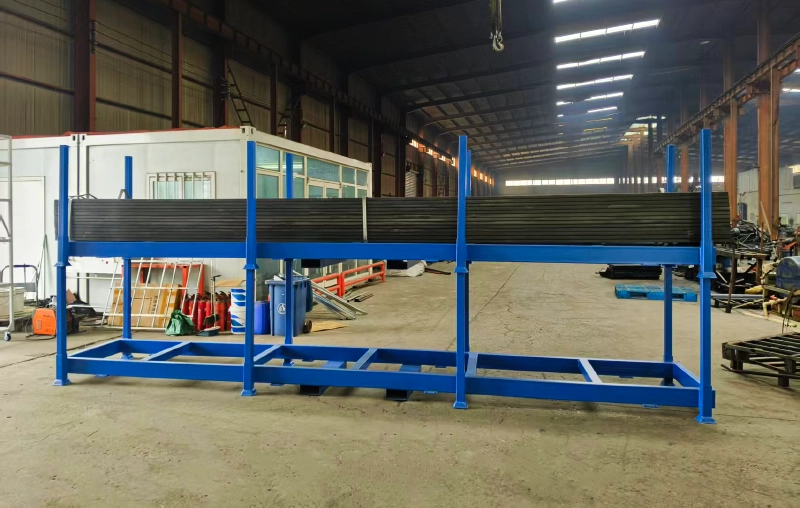
Defense Layer 2: The Chemical Shield of Industrial Powder Coating
The rack itself must be impervious to the very elements it’s protecting your pipes from. This is where the surface finish becomes critical. Cheaply painted racks will quickly scratch, chip, and begin to rust, potentially contaminating the materials they hold. Bpirack employs an industrial powder-coated finish. This is not simply paint; it’s a thermoset polymer that is electrostatically applied and then cured under high heat.
The result is a hard, non-porous, and uniform barrier that bonds directly to the steel. This finish is engineered to resist the scratches, dings, and abrasion common in a busy yard with heavy forklift traffic. By preventing the rack’s own steel from being exposed, it ensures a long, corrosion-free service life, even in an outdoor pipe storage rack application.
From Rust Prevention to Operational Excellence
Eliminating rust is just the beginning. Implementing a proper racking system transforms your entire operation. A yard full of neatly stacked, easily accessible pipes is inherently safer and more efficient.
- Reduced Material Handling Time: With stackable pipe racks, a forklift operator can retrieve a specific bundle in minutes without having to move several other bundles on the ground. This “100% accessibility” dramatically reduces load/unload times.
- Enhanced Safety: Systematized stacking eliminates the risk of pipes rolling off unstable piles, a major safety concern that is heavily scrutinized by OSHA inspectors.
- Improved Inventory Control: When each rack holds a specific type or grade of pipe, inventory counts become faster and more accurate, reducing shipping errors.
- Maximized Yard Capacity: By stacking 4-5 layers high, you can increase your storage density by up to 400% on the same footprint, delaying or eliminating the need for costly yard expansion.
Ultimately, preventing rust on your storage rack is about protecting the multi-thousand-dollar asset it holds. Investing in a properly engineered pipe storage solution is a direct investment in preserving the quality of your inventory, improving operational efficiency, and enhancing your company’s professional image.
Frequently Asked Questions
1. How does a powder-coated finish compare to a hot-dip galvanized finish for outdoor use?
Both are excellent for corrosion resistance. Hot-dip galvanizing provides a metallurgical bond that offers superior protection if the surface is subject to deep gouges. However, powder coating provides a smoother, more uniform finish that is less likely to abrade the surface of the pipes it stores. For most pipe yard applications, a high-quality industrial powder coat offers the optimal balance of durability, protection, and cost-effectiveness.
2. Can these racks handle the weight of heavy-wall Schedule 80 carbon steel pipes?
Absolutely. The Bpirack system is engineered from Q235 structural steel and rated for a static load of 4,500 kg (approx. 9,900 lbs) per rack. This is more than sufficient for full bundles of most standard Schedule 40 and Schedule 80 pipe sizes.
3. What maintenance is required to ensure the anti-corrosion coating lasts?
Maintenance is minimal. We recommend periodic visual inspections for any deep scratches or impacts from forklifts that have penetrated the coating down to the bare metal. If found, these small areas can be touched up with a suitable industrial enamel to seal the steel and prevent rust from starting.
4. Will the rack itself rust if the powder coating gets heavily scratched?
Yes, if a scratch is deep enough to expose the underlying Q235 steel, that specific area can develop surface rust. However, because the powder coating creates a strong bond, the rust will typically be localized to the damaged spot and will not “creep” under the surrounding coating, making spot repairs simple and effective.
5. Are these racks suitable for storing galvanized square tubing without causing surface damage?
Yes. The smooth, non-abrasive surface of the powder-coated steel base is ideal for storing materials with their own protective coatings, like galvanized tubing. Unlike rough wooden dunnage or rusty steel, our racks will not scratch or compromise the galvanized layer on your products.

 EN
EN  DE
DE  RU
RU  NL
NL  PT
PT  JA
JA  ES
ES  IT
IT