

|
Your laser cutting machine is waiting, but the 6-meter (20-foot) steel tubes it needs are buried under a chaotic pile on the floor. Every minute your operator spends untangling this mess is a minute of lost production and mounting frustration. This isn’t a storage problem; it’s a workflow bottleneck that’s costing you money. There’s a more streamlined, safer, and profitable way to manage your long materials. |
Can a metal pipe storage rack hold 6-meter tubes?
Yes, absolutely. But the critical question isn’t just *if* a rack can hold 6-meter (approx. 20-foot) tubes, but *how* it manages them to boost your operational efficiency and protect your bottom line. For metal service centers, steel pipe distributors, and fabrication shops running CNC tube laser cutters, simply preventing a pile-up on the floor is the lowest bar. The real challenge is transforming your long-stock storage from a chaotic cost center into a streamlined, high-density asset.
The reality is that traditional ground-stacking or flimsy A-frames create more problems than they solve. They lead to material damage, excruciatingly slow retrieval times, and significant safety hazards for your team.
The Daily Grind: Why Floor Stacking 6-Meter Tubes Cripples Your Workshop
Imagine this common scenario: your laser cutting machine needs a specific bundle of seamless carbon steel pipe. It’s currently at the bottom of a 5-ton stack. Your forklift operator has to carefully move several other bundles, one by one, just to access it. This “material shuffle” can take 20-30 minutes, during which your expensive machine sits idle. This is the hidden cost of inadequate pipe storage solutions.
- Material Damage: Tubes on the bottom of the pile bear the weight of everything above, leading to compression damage, warping, and scratches. For high-value materials like stainless or aluminum, this means direct financial loss.
- Operational Bottlenecks: The “华容道” (Sliding Puzzle) effect of retrieving buried stock creates massive delays, directly impacting production output and your ability to meet deadlines.
- Safety Hazards: Unsecured long pipes are notorious for rolling, posing a serious risk to personnel. This is a major concern for any HSE Manager aiming to meet OSHA guidelines.
Engineered for Length and Load: The Structural Answer
A purpose-built metal pipe storage rack like the Bpirack system is designed specifically to overcome these challenges. The solution starts with robust engineering that directly addresses the physics of storing long, heavy materials.
Constructed from industrial-grade Q235 carbon steel, the system’s foundation is a channel steel base, not a weaker closed tube. This design provides exceptional rigidity against vertical pressure, ensuring it can handle a dynamic load of 1.5 tons (3,300 lbs) and a static load of 4.5 tons (9,900 lbs) without deflection. The four pluggable uprights create a protective cradle, meaning the load is transferred to the ground through the steel frame, not through the tubes themselves. This completely eliminates compression damage, even when stacked multiple levels high.
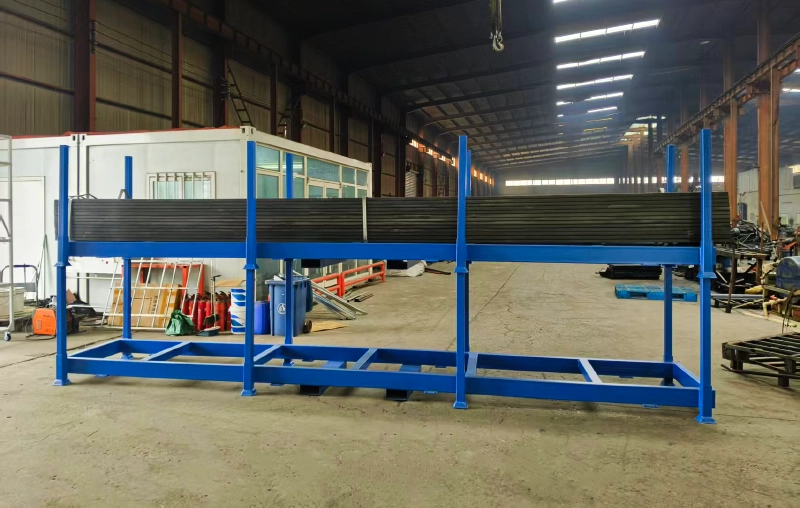
From Static Rack to Dynamic Workflow System
Holding 6-meter tubes securely is just the beginning. The true value lies in how a modular system transforms your entire material handling process.
1. Multiply Your Floor Space by 400%
By leveraging vertical space, you can safely stack these racks 4 to 5 levels high. The specialized stacking feet and receiving holes on the uprights create a secure, interlocking structure. This means a 500-square-foot area that previously held one layer of tubes can now hold four times the inventory, freeing up valuable floor space for new production lines or safer, wider aisles.

2. Achieve “Point-of-Use” Material Delivery
For operations centered around a laser cutter or band saw, the optional mobile customization is a game-changer. By adding heavy-duty castors, the portable pipe storage racks become mobile material carts. A single worker can manually move a full rack of tubes directly to the machine’s infeed station, eliminating the need for a forklift in tight spaces. This decouples production from the availability of a forklift and driver, slashing downtime and boosting machine output by as much as 18%.

3. Reclaim 80% of Your Space When Idle
Unlike welded, fixed racks that become permanent obstacles, the Bpirack’s uprights are removable. When not in use, the posts can be stored and the bases can be nested together. This “space magic” reduces the footprint of empty racks by 80%, giving you ultimate flexibility in your floor layout, especially for businesses with seasonal inventory fluctuations.

The Quantifiable ROI of an Optimized System
Switching from chaotic floor stacking to an engineered pipe stacking racks system delivers measurable results. It’s an investment in efficiency that typically pays for itself within 12-18 months.
| Comparison Dimension | Traditional Ground Stacking | Bpirack Pluggable Racks |
|---|---|---|
| Space Utilization | 100% (Baseline) | 400% (With 4-layer stacking) |
| Material Retrieval Time | 20-30 Minutes / Bundle | 2-3 Minutes / Bundle |
| Material Damage Rate | 2-5% (Due to pressure) | <0.1% (Protected by rigid frame) |
| Workflow Efficiency | Low (High forklift dependency) | High (Unitized, mobile handling) |
So, can a metal pipe storage rack hold 6-meter tubes? The Bpirack system proves it can do much more. It securely contains them, multiplies your storage capacity, and integrates them into a lean, efficient material flow that directly feeds your production and profitability.
Frequently Asked Questions
1. What is the maximum length of pipe or tube the rack can safely support?
The standard Bpirack is engineered and optimized for common stock lengths up to 6 meters (or 20 feet). The channel steel base provides the necessary structural support to prevent sagging for materials like HSS steel, Schedule 40 pipes, and aluminum extrusions within the specified load capacity. For lengths exceeding this, we can discuss custom-engineered solutions.
2. Can these racks be used with an overhead crane?
The standard design features four-way forklift entry points for easy handling with forklifts or side loaders. While not designed for direct lifting by crane slings (which could create unsafe side-loading on the posts), they can be integrated into a crane-serviced workflow where the crane loads/unloads bundles onto the racks while they are on the ground.
3. Is it safe to stack the racks if they have the optional castor wheels installed?
Absolutely not. This is a critical safety protocol. The castor wheels are designed for ground-level mobility only. Before any rack is lifted by a forklift for stacking, the castor wheels *must* be removed. The system’s safe stacking capability relies on the direct, stable connection between the stacking feet of one rack and the uprights of the one below it.
4. How do these stackable racks compare to traditional cantilever racks for storing 6-meter tubes?
While cantilever racks are a common solution, Bpirack offers key advantages in flexibility and density. Cantilever racks are bolted to the floor, making your warehouse layout permanent. They also require very wide aisles for forklift maneuverability. Bpirack is modular, requiring no installation, and allows you to change your layout at any time. Furthermore, Bpirack’s ability to handle an entire bundle as a single unit (a “unitized load”) is far more efficient for high-frequency movement than picking individual tubes from a cantilever arm.
5. What kind of surface is needed to safely stack these racks 4 or 5 levels high?
These are heavy duty pipe storage racks and require a solid, level surface. A standard reinforced concrete industrial warehouse floor is sufficient. It is crucial to ensure the ground is level to maintain the stability and safety of the vertical stack. Stacking on uneven surfaces like asphalt or gravel is not recommended.

 EN
EN  DE
DE  RU
RU  NL
NL  PT
PT  JA
JA  ES
ES  IT
IT