

Your multi-million dollar laser cutter only makes money when it’s cutting. But how much time does it waste every day, sitting idle, while your team hunts for the right steel sheet buried under a five-ton stack? This operational bottleneck is costing you more than just time; it’s eroding your OEE and delaying critical client deliveries. This isn’t just inefficient—it’s unsafe.
In today’s competitive metal fabrication landscape, the speed and efficiency of your machinery—from laser cutters to press brakes—define your profitability. Yet, many shops invest heavily in state-of-the-art processing equipment while overlooking the archaic, chaotic, and dangerous system feeding it: raw material storage. The traditional method of stacking metal sheets on pallets on the floor creates an “efficiency black hole” that silently drains your resources, compromises safety, and puts your production schedule at risk.

The High Cost of Disorganization: Beyond Wasted Floor Space
The real cost of floor-stacking isn’t the price of pallets; it’s the cascading negative effects that ripple through your entire operation. Every production order that requires a sheet from the bottom of a stack initiates a wasteful and hazardous sequence of events.
The True Cost of “Digging for Steel”
Imagine the scenario: a rush job requires a specific 10-gauge stainless steel sheet, but it’s buried under five other bundles of material. Your operator must stop production, locate a forklift or call for the overhead crane, and begin the tedious process of “倒垛” (re-stacking). The top bundles are moved one by one to a temporary, often crowded, space. This process doesn’t just waste 30-60 minutes of labor; it directly halts your most valuable asset. The laser cutter sits idle, your OEE plummets, and the risk of scratching a high-value, cosmetic-grade aluminum or stainless steel sheet increases with every move, potentially scrapping expensive material.
The Unseen Hazard: Safety Compliance in Material Handling
Maneuvering heavy, awkward stacks of steel with a forklift or crane is one of the most high-risk activities in any fabrication shop. The potential for pinch-point injuries, unstable loads shifting, or catastrophic drops is ever-present. A single incident can lead to devastating injuries, OSHA violations, and crippling downtime. This is where the structural integrity of your storage equipment becomes non-negotiable. Investing in an ANSI/AISC compliant racks system isn’t just about organization; it’s a fundamental commitment to a safer workplace and a critical defense against liability.

Engineered for Uptime: How ANSI/AISC Compliant Racks Revolutionize Your Workflow
A modern storage solution directly attacks these core problems by transforming material handling from a chaotic, multi-person task into a streamlined, safe, one-person process. It’s about engineering a system that keeps your expensive machinery running.
100% Selectivity: From Hours to Minutes
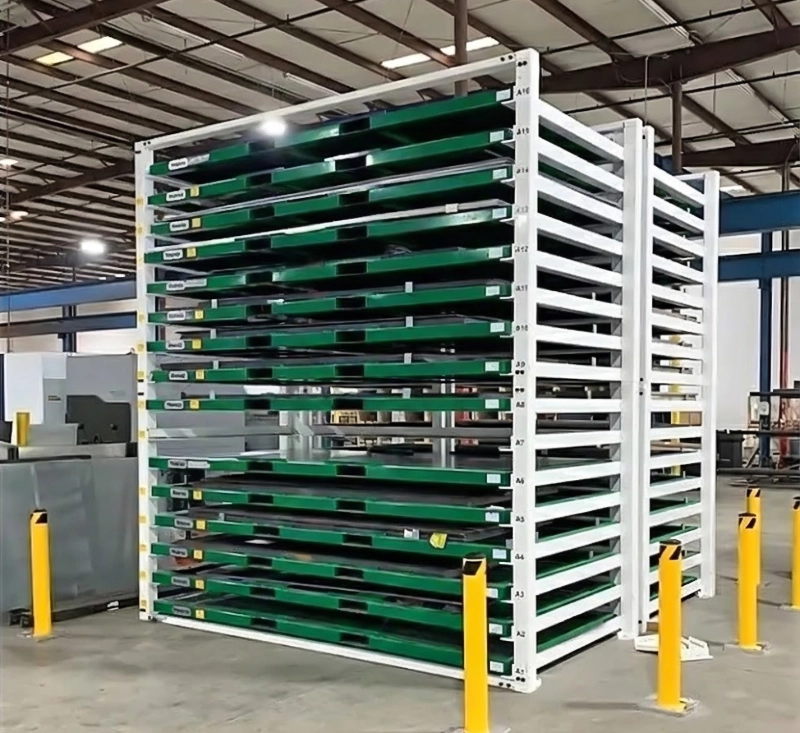
The core of the system is its drawer-style design. Each shelf is an independent, fully extendable drawer that rolls out 100%, providing immediate, unobstructed overhead access to every single sheet it holds. There is no more “digging.” The exact gauge, grade, and size of material you need is accessible in seconds. This principle of 100% selectivity means the journey from rack to laser bed is reduced from an unpredictable hour to a repeatable 5-minute process, maximizing machine uptime and production throughput.

Structural Integrity You Can Trust (ANSI/AISC Certified)
ANSI/AISC compliance is your assurance of safety and durability. It signifies that the rack is not just welded steel but a professionally engineered structure, verified to meet the stringent standards of the American National Standards Institute and the American Institute of Steel Construction. Built from heavy-duty Q235 structural steel with precision welding, these racks are rated for their specified capacity, typically up to 9,900 lbs (4.5 tons) per drawer. This means you can confidently store full bundles of heavy plate without fear of structural fatigue, warping, or failure. For heavier loads, the hand-crank mechanism uses mechanical advantage to allow a single operator to safely roll out a multi-ton drawer with minimal effort.

Reclaim Your Floor, Expand Your Capacity
By utilizing vertical space, a horizontal sheet metal storage system can store the same amount of material in up to 80% less floor space. For a growing fabrication shop, this reclaimed space is invaluable. It’s not just empty space; it’s the potential for a new press brake, a dedicated welding cell, an expanded assembly area, or simply a safer, more organized workflow for your team. You can increase your facility’s production capacity without the massive expense of an expansion.
Real-World Results in Metal Fabrication
The theoretical benefits translate into tangible, measurable improvements on the shop floor.
One mid-sized job shop, previously plagued by a chaotic floor and constant production delays, implemented a series of our roll-out racks next to their two laser cutters. The results were immediate. They reclaimed nearly 70% of their material storage footprint. More importantly, their average material retrieval time dropped from over 45 minutes to under 5. This virtually eliminated machine downtime due to material waiting, boosting their total output by over 15% in the first month and fundamentally improving workplace safety.
Similarly, a large OEM manufacturer with a central warehouse supplying multiple production lines adopted our full-forklift-accessible steel plate storage racks. Each drawer functions as a heavy-duty pallet. Forklift operators can now retrieve an entire drawer with the required material and transport it directly to a specific production cell. This has eliminated picking errors, streamlined their internal logistics, and created a highly visible, accurate inventory system that feeds their entire manufacturing process with unmatched efficiency.
Frequently Asked Questions
1. Our shop uses an overhead crane with a vacuum lifter. How does this system work with it?Our system is designed for perfect integration with overhead cranes. The 100% roll-out drawers provide complete, unobstructed top-down access for your crane, vacuum lifter, or plate clamps. This allows your operator to safely and easily lift the exact sheet needed without any interference from the rack structure itself. |
2. What’s the maximum weight per drawer? We handle full skids of 1/2″ steel plate.Our standard drawers are engineered with capacities up to 9,900 lbs (4.5 tons). For heavy loads like full bundles of 1/2″ plate, we strongly recommend our hand-cranked or forklift-accessible models. The hand-crank mechanism makes moving these heavy loads safe and effortless for a single operator. We can also custom-engineer solutions for even greater weight requirements. |
3. What does ANSI/AISC compliance actually mean for my shop?It means peace of mind. ANSI/AISC compliance certifies that the rack’s design, materials, and load ratings have been verified by third-party engineering standards for safety and structural integrity. For your shop, this translates to a reduced risk of catastrophic failure, a safer environment for your employees, and robust equipment that can stand up to the rigors of a demanding industrial environment, which can also be a positive factor for insurance and liability purposes. |
4. We use non-standard sheet sizes (e.g., 6′ x 12′). Can you build a custom rack?Absolutely. Customization is one of our core strengths. We will design a rack system tailored to your specific needs, including custom drawer widths and depths to match your material sizes, adjustable layer heights, and specific load capacities. Our goal is to provide a solution that fits your workflow perfectly. |
5. How difficult is the installation? Do we need a specialized crew?The racks are designed with a modular, bolt-together construction for straightforward assembly. Most of our clients’ maintenance teams can handle the installation with the detailed instructions we provide. For larger or more complex systems, we can offer on-site installation guidance or remote video support to ensure a smooth and correct setup. |
|

 EN
EN  DE
DE  RU
RU  NL
NL  PT
PT  JA
JA  ES
ES  IT
IT