

Unlock Uninterrupted Production
Stop letting material retrieval bottlenecks dictate your workshop’s efficiency. A Roll Out Sheet Metal Rack’s drawer extension mechanism is engineered to eliminate search time and feed your high-value machines, like laser cutters and press brakes, without delay. Discover how the right mechanism can transform your raw material handling from a cost center into a competitive advantage.
The Core Challenge: Accessing Buried Value
In any sheet metal fabrication workshop, the most significant hidden cost is often time—specifically, the time wasted searching for and retrieving the correct raw material. Traditional ground-stacking methods turn your valuable inventory into a physical puzzle. To get the one sheet of stainless steel you need at the bottom of a stack, your team must first move the five sheets on top. This process, known as “shuffling” or “double-handling,” is not just inefficient; it’s a direct drain on productivity and a major source of safety risks and material damage.
The innovation that solves this fundamental problem lies within the drawer extension mechanism of a Roll Out Sheet Metal Rack. By converting horizontal stacks into vertically organized, individually accessible drawers, the system grants 100% selectivity. The key to unlocking this efficiency is understanding how these drawers move and choosing the right mechanism for your specific material weight and workflow.
The Foundation of Smooth Extension: Structural Integrity
Before exploring the different types of mechanisms, it’s crucial to understand the foundation that makes them possible. The entire rack system is built on a robust frame, typically constructed from high-strength Q235 structural steel. This rigid, heavy-duty framework guarantees that the unit remains stable and secure, even when a multi-ton drawer is fully extended. Each drawer glides on high-quality industrial rollers or bearings set within precision-engineered guide rails. This combination minimizes friction and ensures a smooth, consistent travel path, preventing jamming and making the movement of heavy loads predictable and safe.
A Deep Dive into the Three Core Drawer Extension Mechanisms
The “how” of the drawer extension is determined by the mechanism that applies force to move the drawer. The choice of mechanism directly impacts operational efficiency, safety, and the load capacity that a single operator can handle.
1. Hand-Pull Mechanism: For Speed and Lighter Loads
The most straightforward design, the hand-pull mechanism, relies on direct manual force. The operator simply grips a handle and pulls the drawer out. Its effectiveness hinges entirely on the quality of the rollers and the precision of the guide rails, which are designed to minimize rolling resistance.
- How it Works: Simple physics. An operator’s pull overcomes the inertia and minimal friction of the drawer.
- Ideal Application: Best suited for lighter materials, typically where a single drawer load does not exceed 1.5 tons (approx. 3,300 lbs). It’s perfect for workshops that frequently access thinner gauge aluminum, mild steel, or stainless steel sheets.
- Operational Value: This mechanism offers the fastest access time for lighter materials, providing an immediate and cost-effective solution for improving organization and retrieval speed.

2. Hand-Cranked Mechanism: Mechanical Advantage for Heavy-Duty Tasks
When sheet metal weight exceeds what one person can safely and comfortably pull, the hand-cranked mechanism provides the solution. This system introduces a mechanical advantage through a gear reduction system.
- How it Works: The operator turns a crank handle located on the side of the drawer. This handle is connected to a set of bevel gears, which transfer the rotational motion to a drive shaft running the length of the drawer. The gears multiply the operator’s input force (torque), allowing them to effortlessly roll out drawers carrying loads between 1.5 and 3 tons (approx. 3,300 to 6,600 lbs).
- Ideal Application: This is the go-to solution for workshops handling medium to heavy plates of steel or thick stacks of sheet metal. It’s essential for ensuring safe, single-person operation without physical strain.
- Operational Value: The hand-cranked mechanism is a game-changer for safety and labor efficiency. It transforms a potentially dangerous, multi-person task into a controlled, standardized, one-person job. This directly reduces labor costs and dramatically lowers the risk of strain-related injuries.
3. Full Forklift Mechanism: Integrating Storage and Logistics
For the heaviest loads and most integrated workflows, the drawer itself evolves into an independent, movable pallet. The rack becomes a docking station for these heavy-duty pallets.
- How it Works: The “drawer” is a robust steel pallet with built-in forklift pockets. The forklift operator drives the forks directly into the pallet, lifts it slightly, and pulls the entire unit out of the rack frame. The forklift itself acts as the extension and retrieval mechanism.
- Ideal Application: Designed for the heaviest loads, from 3 tons up to 4.5 tons (approx. 6,600 to 10,000 lbs) or more, and for large facilities where materials need to be transported from a central warehouse to distant processing stations.
- Operational Value: This system erases the line between storage and material transport. Each drawer becomes a mobile material station. It enables a “centralized storage, decentralized use” model, where a single, highly organized raw material warehouse can efficiently supply multiple production lines. This maximizes both storage density and logistical speed, significantly boosting the overall plant throughput.
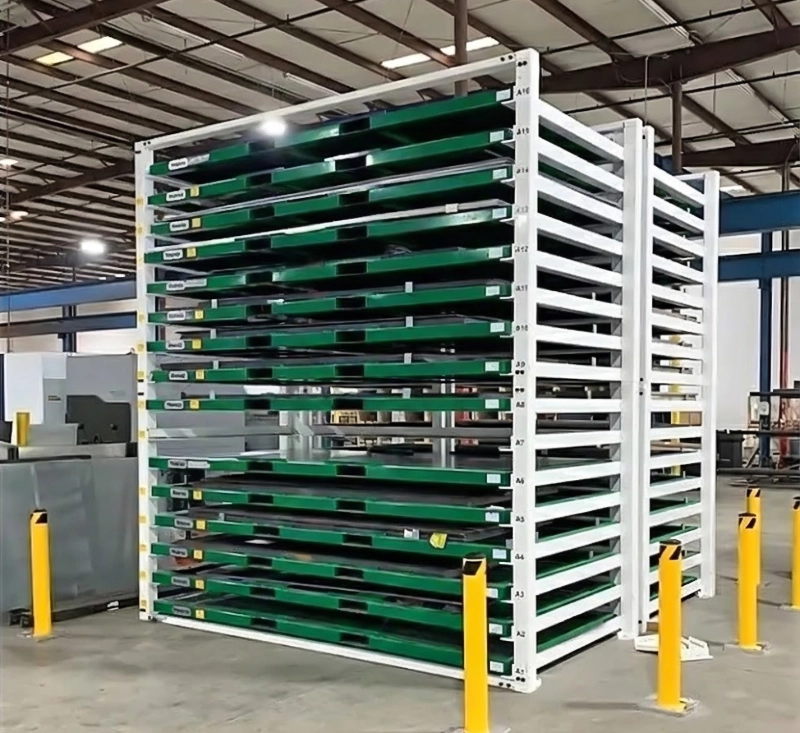
The Result: A Revolution in Workshop Workflow
Regardless of the specific mechanism, the ability to fully extend any drawer on demand fundamentally changes your operation. It eliminates the non-value-added time of shuffling stacks, ensuring your expensive machinery, like a laser cutting machine, is always cutting, not waiting. By enabling safe, single-person access to every piece of inventory, a Roll Out Sheet Metal Rack turns your storage area from a chaotic bottleneck into a streamlined, efficient, and safe component of your production line.
Frequently Asked Questions
1. What is the maximum weight each drawer can hold?
Our standard drawers are designed for various load capacities, typically ranging from 1.5 tons, 3 tons, to 4.5 tons per level. We can also provide custom-engineered solutions for even higher load requirements based on a specific structural analysis.
2. Can a single worker really operate a drawer with a 5,000 lb (approx. 2.2 ton) load?
Absolutely. For loads of this weight, we strongly recommend the hand-cranked mechanism. The gear reduction system makes it easy and safe for one person to extend and retract the drawer without excessive physical effort.
3. What supporting equipment is needed to use the rack?
This depends on the rack type. Hand-pull and hand-cranked models are typically used with overhead cranes or jib cranes equipped with vacuum lifters or plate clamps. The full forklift model is designed to be operated exclusively with a forklift.
4. Can the rack dimensions and number of levels be customized?
Yes, all our racks are fully customizable. We can tailor the height, width, depth, number of drawers, and the spacing between them to perfectly match your sheet metal dimensions, warehouse height, and lifting equipment capabilities.
5. How do we load new sheets from a delivery truck onto the rack’s drawers?
We offer a complete workflow solution. The most common method is using a forklift in combination with our specialized “Depalletizer” accessory, which safely separates the metal sheets from their wooden shipping pallet and transfers them onto our steel drawer pallet.

 EN
EN  DE
DE  RU
RU  NL
NL  PT
PT  JA
JA  ES
ES  IT
IT