
 |
Stop wasting floor space and time. Your pipe yard or warehouse is a hidden profit center, not a logistical nightmare. The endless cycle of shifting, stacking, and searching for the right bundle of pipe ends now. It’s time to unlock your vertical potential and streamline your workflow from receiving to the cutting machine. |
Where to buy heavy duty pipe storage racks?
If you’re searching for heavy duty pipe storage racks, you’re not just looking for a piece of steel. You’re looking for an end to the daily chaos. You know the scene: a forklift operator playing a high-stakes game of Tetris, trying to access a bundle of Schedule 40 pipe buried under tons of HSS tubing. Every move is a risk—to the material, to the equipment, and to your team’s safety. Pipes scattered on the ground get damaged by moisture and ground contact, and the constant shuffling wastes valuable man-hours that kill your bottom line.
The real question isn’t just “where to buy,” but “how to buy the *right* system” that solves these core operational problems. The solution lies in moving from chaotic floor stacking to an engineered, vertical storage system.
Transform Wasted Airspace into Active Storage with Stackable Racks
The most significant drain on a warehouse’s profitability is underutilized vertical space. Laying pipes on the floor means your storage capacity is limited to your square footage. A proper Стеллажи для штабелирования труб system fundamentally changes this equation.
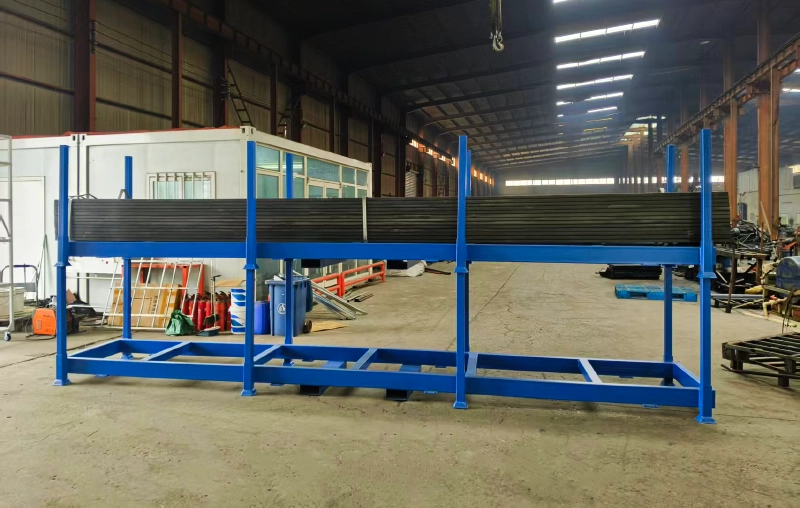
Bpirack pluggable racks are engineered from industrial-grade Q235 carbon steel to handle immense loads. With a static capacity of 4.5 tons (9,920 lbs), you can safely stack them 4 to 5 layers high. This isn’t just piling—it’s a structured system. The weight is transferred through the steel columns to the ground, not onto the pipes below. This completely eliminates compression damage and “banana-ing” of PVC or thinner-walled tubing. The result? A 400% increase in storage density on the same footprint, turning your overhead space into a profitable asset.
Reclaim 80% of Your Floor Space with a Pluggable Design
What happens with traditional, welded racks during your slow season or when a project clears out? They become costly, static roadblocks. Bpirack’s intelligent pluggable design addresses this directly. The four vertical posts can be quickly removed from the channel steel base without tools. Once the posts are removed, the bases nest perfectly into one another.
This “space magic” reduces the footprint of empty racks by up to 80%. Instead of a yard full of empty, cumbersome racks, you get a neat, condensed stack that frees up valuable floor space for staging, assembly, or other revenue-generating activities. This asset flexibility means your storage system adapts to the rhythm of your business, not the other way around.

Bridge the Gap Between Bulk Storage and Production with Mobile Racks
The journey of a pipe doesn’t end in the storage yard. The most critical—and often most inefficient—step is getting the right material to your CNC tube laser cutter, band saw, or welding station. Waiting for a forklift to navigate tight spaces creates production bottlenecks that silently erode your daily output.
Наш сайт portable pipe storage racks are designed with this “last-mile” logistics in mind. The base is pre-engineered to accept heavy-duty casters, transforming a static rack into a mobile material cart. Your team can now stage the next job on a dedicated rack and simply roll the entire 1.5-ton load to the machine when ready. This eliminates forklift dependency for point-of-use delivery, increases machine uptime, and creates a safer, more fluid workflow in congested production areas.

Where to Buy Racks Engineered for the Real World: Bpirack
When you invest in a Вешалка для хранения стальных труб, you’re investing in operational efficiency and safety. Unlike cheap imitations that use inferior steel or poor welds, Bpirack systems are built for industrial environments. The durable powder-coated finish resists rust and corrosion, protecting both the rack and your valuable materials, whether you’re storing them indoors or in an outdoor yard.
Stop searching for a simple rack. Start a conversation about a complete storage solution. Contact our experts to discuss your specific pipe types, warehouse layout, and workflow challenges. We’ll help you configure a system that delivers a measurable return on investment, often within 12-18 months.
Часто задаваемые вопросы
1. How much weight can these heavy-duty racks actually hold?
Each Bpirack unit is engineered with a dynamic (moving) load capacity of 1.5 tons (3,300 lbs) and a static (stationary and stacked) load capacity of 4.5 tons (9,920 lbs). This ensures stability both during forklift transport and when stacked up to 4 or 5 layers high.
2. Are these racks suitable for outdoor pipe storage?
Absolutely. Our racks feature an industrial-grade powder-coated finish. This process creates a durable, corrosion-resistant barrier that protects the Q235 steel from rust and weathering, making them ideal for outdoor pipe yards and harsh industrial environments.
3. How do these stackable racks compare to traditional cantilever racks?
While cantilever racks are a good static solution, they are bolted to the floor, offering zero layout flexibility. They also require very wide aisles for forklift maneuvering. Our pluggable трубные стеллажи для склада use are modular, can be moved and reconfigured at will, and allow for much higher storage density in the same footprint. Plus, they can be nested when empty to reclaim floor space.
4. How difficult is the assembly process?
Assembly is fast and requires no special tools. The four upright posts simply slot into the corner pockets of the base. This plug-and-play design allows a single worker to set up or dismantle a rack in minutes, making it easy to adapt your storage layout on the fly.
5. Can we move the racks with a forklift when they are fully loaded?
Yes, the base is designed with four-way or two-way forklift entry for safe and efficient handling of a fully loaded (up to 1.5 tons) single unit. For customized mobile versions with casters, you can manually push them. However, as a critical safety rule, casters must always be removed before you begin stacking the racks vertically.

 EN
EN  DE
DE  RU
RU  NL
NL  PT
PT  JA
JA  ES
ES  IT
IT