

In a Steel Service Center, “sturdy” isn’t just a buzzword—it’s a matter of life and death. When you are racking 20-foot bundles of solid stainless steel bar stock or delicate 316L hygienic tubing, you cannot afford a rack that wobbles, leans, or jams under load. You need a system engineered to handle the dynamic stress of moving 6,000 lbs per arm without flinching.
The Engineering Reality: Why “Moving” Parts Doesn’t Mean Weak
A common misconception in the heavy metal fabrication industry is that a static rack (welded solid) is inherently stronger than a dynamic one. When facility managers first see a Подвинься под вешалку, their immediate concern is often: *“Will these moving arms sag or snap when I load them with 3 tons of steel?”*
The answer lies in the **Transmission Shaft Technology**. Unlike cheap drawer systems that rely on simple drawer slides (which fail under heavy side-loads), the Tcrack system utilizes a solid steel transmission shaft that connects every upright in the row.

The heart of stability: A solid transmission shaft and heavy-duty bearing housing ensure synchronized movement without jamming.
When an operator turns the crank, the force is distributed evenly across the entire length of the rack via a rack-and-pinion mechanism. This ensures that a 20-foot (6-meter) arm extends perfectly parallel, without the “racking” or skewing that causes lesser systems to bind. The **bearing housings** are sealed and designed for high-load radial stress, meaning the heavier you load it (up to rated capacity), the smoother it often rolls due to the momentum.
Material Science: Q235 Carbon Steel vs. The World
Sturdiness starts at the molecular level. In the steel distribution business, you know that not all steel is created equal. Many light-duty storage racks are made from roll-formed thin-gauge steel to save on shipping weight.
However, for a Подвинься под вешалку intended to store heavy bar stock or mold dies, we utilize **Q235 Carbon Steel** or H-beam structural steel for the columns and base.

Pre-assembly showing the massive Q235 steel columns and heavy-duty base anchors designed to withstand dynamic loads.
The base is anchored to your concrete floor (minimum 6 inches/150mm concrete depth recommended) using chemical or heavy-duty expansion bolts. This creates a center of gravity that remains low and centered, even when the arms are fully extended into the aisle. The structural integrity is calculated to handle not just the static weight, but the **dynamic moment arm** created when the load is cantilevered out 100% into the aisle for overhead crane access.
Defeating Deflection in Long Stock Storage
One of the biggest headaches for metal service centers is storing 40-foot (12-meter) bundles of tubing or aluminum profiles. On standard racks with uprights spaced too far apart, the material sags (deflects) in the middle. This isn’t just ugly; it permanently warps the product, turning prime inventory into scrap.
Is the crank-out system sturdy enough for these lengths? **Yes, because it is modular.**
We don’t just stretch the arms; we add columns. For 12-meter loads, we deploy an **8-column configuration**. This reduces the unsupported span of your material, ensuring that your precision ground bars or hygienic tubes remain perfectly straight.
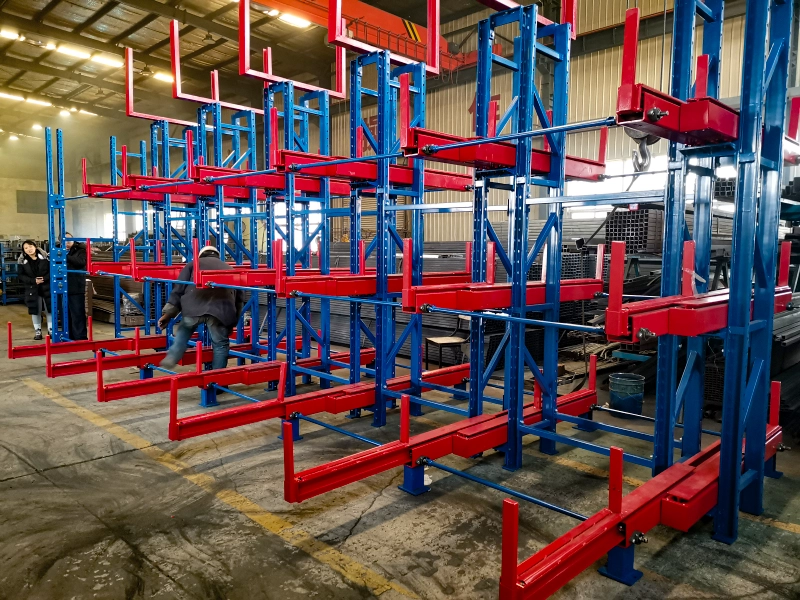
An 8-upright system designed specifically for 12-meter loads, eliminating material sagging and ensuring structural rigidity.
Safety Mechanisms: The “Stop Block” Assurance
Sturdiness also means safety. A rack is only “sturdy” if it prevents operator error. In a busy fabrication shop, you cannot risk an arm rolling off its track or tipping over.
The Tcrack system integrates physical **Stop Blocks** and limiters. These are solid steel components welded or bolted into the track that physically prevent the arm from over-extending. Furthermore, the gear ratio is designed to be non-reversible under load without input—meaning gravity won’t simply pull the drawer open; it requires deliberate action from the operator.

Close-up of the loaded arm showing the Stop Block mechanism that guarantees the arm stays securely on track.
Comparative Analysis: Static vs. Crank Out Stability
| Характеристика | Standard Static Cantilever | Tcrack Crank Out Cantilever |
|---|---|---|
| Load Capacity | High (Static) | High (Dynamic & Static) – Up to 13,000 lbs per arm |
| Метод загрузки | Forklift “Stabbing” (Risk of hitting uprights) | Overhead Crane (Zero contact with uprights) |
| Structural Risk | High risk of forklift collision damage to columns | Low risk (Forklifts are removed from the equation) |
| Deflection Control | Dependent on arm spacing | Superior (Synchronized multi-column support) |
Conclusion: Sturdiness Meets Efficiency
The question isn’t just “is it sturdy?”—it is “is it engineered for the modern metal supply chain?” The Подвинься под вешалку offers a level of structural integrity that matches or exceeds traditional static racking, while unlocking the ability to use overhead cranes. This eliminates the “forklift rodeo” in your aisles, protecting both your rack structure and your high-value inventory from collision damage.
—
Frequently Asked Questions (Metal Service Centers)
1. Can this rack handle the point-loading of solid round bar stock?
Yes. Unlike sheet metal which distributes weight, bar stock creates high point loads. Our arms are engineered with specific structural reinforcements to handle high-density loads like solid steel or copper bars without bending.
2. We store 316L Stainless Steel. Will the rack scratch the material?
We offer specialized polymer or wood-lined arms specifically for hygienic and aerospace-grade materials. Because you load vertically with a crane using straps (instead of sliding forks in), scratch risks are virtually eliminated.
3. How much floor concrete do I need for installation?
For heavy-duty models (5,000+ lbs per arm), we typically require a reinforced concrete floor with a minimum thickness of 6 to 8 inches (150-200mm) and a PSI rating of 3,000+ to ensure the anchors hold against the cantilever moment.
4. What happens if the gears get dirty in a dusty cutting shop?
The transmission system is designed for industrial environments. The critical bearings are sealed. However, we recommend a quarterly inspection and greasing of the rack and pinion gears to ensure smooth operation, especially in shops with high metal dust.
5. Can I store mixed lengths (e.g., 10ft and 20ft) on the same rack?
Absolutely. The continuous arm surface allows for random placement. However, for the 20ft loads, you must engage all supporting columns to prevent overhang deflection. We can design the column spacing to optimize for your specific mix of SKUs.

 EN
EN  DE
DE  RU
RU  NL
NL  PT
PT  JA
JA  ES
ES  IT
IT