
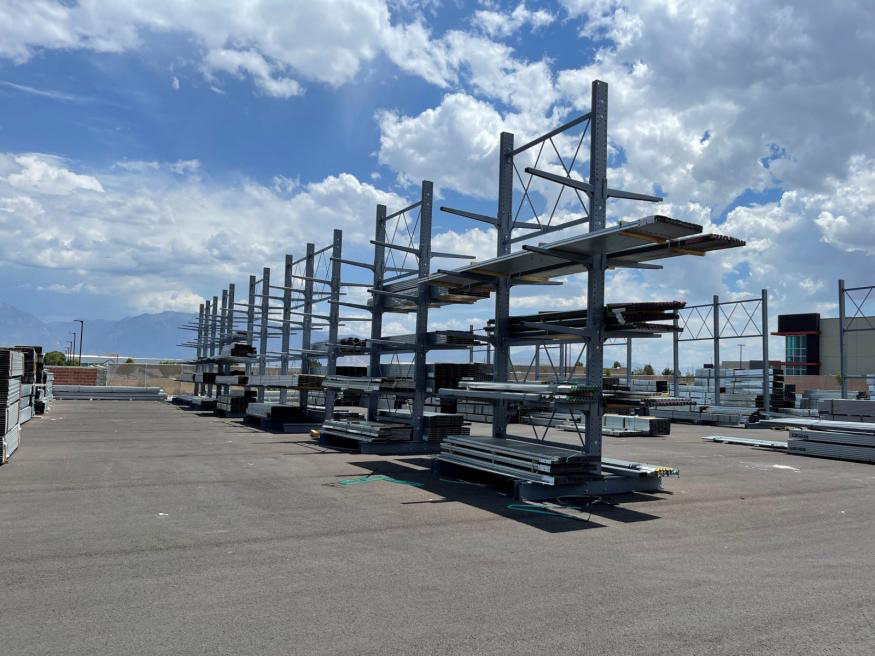
It’s 4:00 PM. A truck is waiting at the loading dock. And the phone call you’ve been dreading finally comes in from the sales department: “The customer added an urgent item to their order. They need that specific bundle of 6-meter channel steel. Can you get it out in the next 30 minutes?”
You look out at the yard or the corner of your warehouse where the long materials are kept. You know exactly which bundle they mean. And you also know it’s sitting at the bottom of a pile, buried under tons of other steel, pipe, and lumber that arrived more recently.
That simple “yes” gets stuck in your throat. You know what has to happen next: a chaotic, time-consuming scramble. It will take a forklift operator and at least one or two other team members to carefully lift and move the materials stacked on top, one by one. The entire process is a symphony of shouted instructions, clanging metal, and the pervasive feeling of time slipping away. Every minute that truck waits is a minute that erodes your profit margin and your customer’s confidence.
If this scene feels painfully familiar, you are not alone. And the root of this recurring frustration is not a failure of your team or your management. It is the inevitable, mathematical result of a fundamental conflict within your storage system itself.
The Inevitable Conflict: Stacking vs. Selecting
Давай разберёмся с этим.Традиционный способ хранения тяжелых материалов — это 3. Штабелирование- да.Кажется логичным-так мы всегда делали.Мы ставим их на Пол, на стеллажи для A-frame, или друг на друга в пирамидах.
Штабелирование, по своей природе, создает систему Последний вход, первый выход (LIFO)- да.Последний пакет вы получили сверху, легко доступны.Первый пакет, который вы получили, находится внизу, функционально недоступен.Физическая реальность гравитации и массы диктует этот порядок.
Тем не менее, ваш бизнес не работает на жизненной основе.Ваши клиенты нуждаются в конкретном пункте, в определенное время, независимо от того, когда он прибыл.Ваши требования к бизнесу Специальный элемент, доступ по запросу.
В этом заключается конфликт: физическая система LIFO вынуждена поддерживать бизнес-потребности по требованию.
Every time you “rummage” through a pile, you are fighting this conflict. You are using expensive labor, valuable machine time, and taking safety risks to manually override a system that is fundamentally not designed for how you need to work. It’s like trying to find a specific file in a stack of papers on a desk instead of opening a labeled drawer in a filing cabinet. The outcome is always the same: inefficiency, frustration, and cost.
Calculating the True, Hidden Costs of “The Pile”
Because this process is so common, we often accept it as a “cost of doing business.” But have you ever truly calculated the cost? Let’s put some numbers to the pain.
| Категория затрат | Описание скрытых расходов |
| Wasted Labor Costs | Вспомни, когда это случилось в последний раз.У вас был оператор вилочного погрузчика (скажем, в $30/ час) и два складских работника (по $20/ час каждый), которые тратили час только на то, чтобы раскопать одну связку.Это прямые затраты на рабочую силу $70 ($30 + $20 + $20) для деятельности без добавленной стоимости.Если это случится всего два раза в неделю, ты потратишь больше $560 в месяц, или почти $7000 в годТолько о затратах на поиск. |
| Operational Bottleneck Costs | Цена выходит далеко за рамки прямых трудовых затрат.Ожидающий грузовик может заплатить за простой.Задержка заказа может привести к отсутствию критически важного окна поставки, в результате чего штраф или потерянный клиент.Этот час обыска мог бы быть потрачен на загрузку трех других грузовиков, что означает, что вся ваша работа замедляется, создавая узкое место, которое проходит через вашу цепочку поставок. |
| Wasted Space Costs (The Cost of Air) | Штабелирование полов крайне неэффективно с точки зрения пространства.Стопка стали может быть 1,5 метра в высоту на складе с 8 метров вертикального просвета.Вы платите за аренду, отопление и освещение 6,5 метров пустого воздуха над этой кучей.Если ваша складская площадь стоит $10 за квадратный метр в месяц, а ваши длинные материалы занимают 200 квадратных метров, вы эффективно платите $2,000 per month Для системы, которая использует только часть кубического объема, который вы контролируете. |
| Safety & Damage Costs | Каждый раз, когда многотонная упаковка перемещается без необходимости, риск аварии возрастает.Сброшенная нагрузка может повредить продукт (стоимость материала) или, что гораздо хуже, нанести вред члену команды (стоимость, которая неизмерима).Этот скрытый риск является ответственностью, встроенной непосредственно в хаотический характер штабелированных хранения. |
A Shift in Thinking: Defining the Principles of an Ideal System
Как только мы видим истинные затраты, становится ясно, что мы должны изменить саму систему.Так что давайте на мгновение забудем о продуктах и подумаем о первых принципах.Какова будет идеальная система хранения длинных материалов У нас есть Чтобы решить эту проблему?
It would need to adhere to three non-negotiable principles:
- Unit Independence: Every single bundle, pipe, or unit must be individually supported and accessible. Retrieving one unit cannot require the movement of any other unit.
- Unobstructed Access: The path for a forklift to approach and handle any specific unit must be completely clear, with no structural barriers (like a front-facing rack column) in the way.
- Engineered Verticality: The system must safely and efficiently use the full vertical height of the warehouse, turning that expensive “air” into usable, high-density storage space.
Any system that meets these three principles would, by definition, eliminate the conflict between stacking and selecting. It would make every single item, from the top to the bottom, equally and instantly accessible.
From Searching Faster to Eliminating Searching Altogether
In the world of industrial storage, a system built on these principles of independence, access, and verticality does exist. It is the physical embodiment of this logical solution. It is called a консольная стойка.
We mention its name not as a sales pitch, but as the conclusion of a diagnostic process. It is the industry-standard term for the system that solves the fundamental problem.
Поэтому, в следующий раз, когда вы столкнетесь с телефонным звонком в 16:00, критически важный вопрос не: "как моя команда может быстрее искать?"По-настоящему стратегический вопрос:"Как мы можем создать систему, которая сделает поиск полностью устаревшим?”
That shift in thinking is the first step toward transforming your warehouse from a source of frustration and hidden costs into a powerful, agile asset for your business.

 EN
EN  DE
DE  RU
RU  NL
NL  PT
PT  JA
JA  ES
ES  IT
IT