
The Chaos You’re Probably Wrestling With
Step into your workshop right now, and what do you see? Short metal bars scattered everywhere—some 6 inches, some 12, different diameters, maybe steel, maybe aluminum. They’re all over the floor, stacked in shaky piles, or shoved into random corners. You tell your crew to grab a specific piece, and they’re gone for 20 minutes, rooting through the mess like it’s a junkyard. By the time they’re back, you’re behind schedule, and the pile is somehow worse than before.
If that hits close to home, you’re not alone. I’ve walked into shops where the variety of short bar stock—high-value material that’s supposed to keep the business humming—turns into a nightmare. It’s not just clutter; it’s a slow bleed on your time, your materials, and your sanity. Too many types, no system, and a workshop that feels like it’s fighting you every step of the way.
Why Variety Turns Into a Problem
Here’s the rub: short bar stock isn’t like big, uniform sheets you can stack and forget. Every job needs a different length or thickness, and that means dozens of variations lying around. Without a proper system to keep them straight:
- Finding anything takes forever: Your crew is flipping through piles, guessing which bar is which.
- Mistakes pile up: Grab the wrong size, and you’re recutting or scrapping—wasting time and money.
- Space shrinks: Every odd length eats up floor room, leaving no space to move or work.
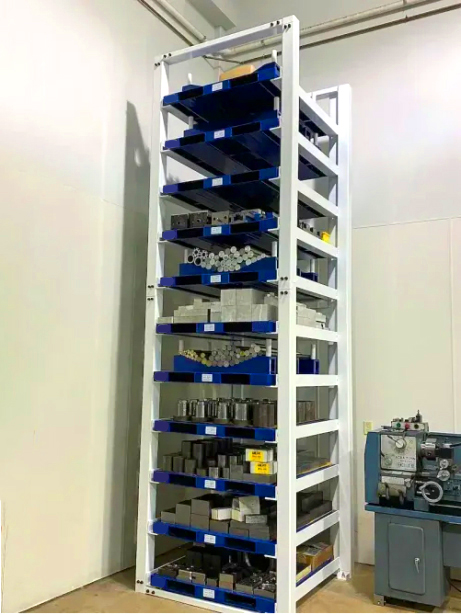
I talked to Mike, a shop owner in Texas, who said he’d stopped counting how many times a day his guys came back empty-handed, shrugging, “Couldn’t find it.” Another told me he’d lost a rush job because the right bar was buried somewhere in the chaos. Too many types don’t just make a mess—they make your whole operation stumble.
Let’s Add Up What This Really Costs
This isn’t just a nuisance—it’s hitting your wallet harder than you might think. Let’s run the numbers for a small shop with, say, 20 different short bar stock types—500 pounds total, all high-value metal:
- Time: If each search takes 15 minutes, and you’ve got 8 pulls a day, that’s 2 hours lost. At $25/hour labor, you’re out $50 daily—$12,000 a year down the drain.
- Errors: Pick the wrong bar twice a week, and you’re scrapping $20 worth of stock each time. That’s over $2,000 annually, plus the rework time.
- Lost jobs: Miss one $300 order a month because you can’t deliver fast enough—that’s another $3,600 gone yearly.
Add it up: that’s potentially over $17,600 a year, minimum, just because the variety is out of control. And that’s not counting the aggravation—workers grumbling, customers waiting, and you wondering why nothing is running smoothly. It’s a mess that’s quietly killing your margins.
A Way to Cut Through the Clutter
I’ve seen shops claw their way out of this, and it’s not about some magic fix—it’s about getting a grip on the variety with a proper storage solution. Picture this: instead of a free-for-all, every type of bar has its own spot. An efficient стеллажи для хранения прутков system with shallow trays, each holding a specific length or diameter—6-inch steel here, 12-inch aluminum there. Your crew walks up, spots what they need in 30 seconds, and gets back to work. No digging, no guessing, no mess.
One shop in California had 30 different bar types clogging their floor. They switched to a dedicated стеллажи для хранения прутков setup with labeled trays. The owner said it was like flipping a switch: “We went from hunting to grabbing. Jobs that took an hour to prep are now done in 20 minutes.” The chaos didn’t vanish—it got tamed.
What Actually Works Here
You could try sorting by hand every day, but that’s a losing battle. Stacking on the floor or in bins presents the same problem: no visibility, no order. Here’s what I’ve seen hold up in shops like yours:
- Shallow trays per shelf: Shelves with 8-inch-high trays keep bars separated—each type gets its own home.
- Heavy-duty construction: Steel that handles 2,000 pounds per level, because flimsy racks buckle under real weight.
- Quick access: Trays you can pull out or lift with a forklift, so no one is wrestling metal out of a pile.
A client of mine wasted $1,200 on a tall, fancy rack that didn’t sort anything—it was the same mess, just vertical. Then he invested in a simple, effective стеллажи для хранения прутков system with low shelves, trays, and clear labels. It was half the cost and gave him twice the result.
What Changes When You Get This Right
Sort out the variety, and your shop feels different. Your crew isn’t wasting half their shift searching—jobs start and finish faster. Say that 15-minute hunt drops to 1 minute: you’re saving nearly 2 hours a day, putting $12,000 a year back in your pocket. Errors? Cut in half—that’s $1,000 less in scrap. Floor space clears up, maybe enough for a new cutting station.
One shop owner told me his scrap rate fell 15% once he could see every bar type at a glance—no more “close enough” mistakes. Customers noticed too. “You guys are on it now,” one said after a same-day turnaround. It’s not just organization—it’s a tighter, sharper operation.
How to Test This Yourself
Don’t take my word for it—run your own numbers. How many bar types are you juggling? How long does it take to find one? If it’s more than a minute or two, count the hours that adds up to in a week. Then think: What if every type had its own spot, easy to see and easy to grab? Start small—set up one shelf with trays for your trickiest bars and see if it cuts the chaos. You’ll feel the difference fast.
Still scratching your head? Tell me how many types you’ve got and how bad the mess is—I’ll throw you some ideas. This isn’t about pushing gear; it’s about getting your workshop back under control.

 EN
EN  DE
DE  RU
RU  NL
NL  PT
PT  JA
JA  ES
ES  IT
IT