
I’ll never forget that Wednesday last spring. It was barely 9 a.m., and our team was already behind schedule. A client in Houston needed six 26-foot steel pipes for a major construction project, and I watched my crew scramble as if it were their first day. The old cantilever system we had been using was a tangled mess of arms and metal. Every single retrieval required carefully maneuvering a hoist through a maze, dodging other materials, and praying nothing would get snagged. After twenty-five minutes of struggle, we had managed to get just one pipe out. My forklift operator, Mike, wiped the sweat from his brow and said, “This is killing me.” I knew exactly how he felt. If you’ve ever searched for a better way to handle oversized stock, you understand that frustration. We lived that reality daily until we found a solution that ended the chaos.
The Slow Grind We Couldn’t Ignore
That difficult morning wasn’t an exception; it was our daily routine. Our business handles long materials constantly: 20-foot pipes, 30-foot rods, and various flats. Retrieving them felt like navigating an obstacle course. The cantilever rack was supposed to streamline operations, but it did the opposite. Every move required two people—one operating the hoist and another guiding the load. Half the time, a pipe would catch on an arm or knock something else loose. A successful pull took 15 minutes, but a problematic one could easily stretch to 30. By lunchtime, we might have only eight pipes ready, with a growing backlog of unfulfilled orders.
The constant delays were more than just a drain on time; they were demoralizing for the entire team. Mike would often lean against the wall after a tough retrieval, complaining about his back. The mounting stress made me irritable, and I found myself getting frustrated over minor issues. Soon, customers started calling to ask about their orders, and I had no good answers. I knew the issue wasn’t my crew’s work ethic—they were giving it their all. The problem was our inadequate equipment. The rack was working against us, and I was determined to win that battle.
What We Needed in a Long Material Storage Rack
I started looking for a better solution, talking to other warehouse managers, trusted suppliers, and even striking up conversations at the hardware store. The feedback always pointed to the same core needs I had identified:
- A system that allowed one person to handle retrieval safely and efficiently.
- Direct access to any specific item without having to move other stock first.
- A way to stop wasting valuable hours on a task that should be straightforward.
The cantilever setup was a failure for our high-turnover operation because its arms created constant obstructions. We had tried floor stacking years ago, and it was a complete disaster—pipes would roll, and finding the right item was nearly impossible. I researched some advanced custom systems online, but they were either too flimsy for our 3-ton loads or their cost was prohibitive. All I wanted was a way to select a pipe and have it ready for shipment in minutes, not after a half-hour wrestling match. It didn’t seem like too much to ask.
The Day Everything Changed for the Better
My breakthrough came from a casual conversation. An acquaintance from another workshop mentioned he had switched to a “honeycomb rack” and it had cut his retrieval times in half. It sounded too good to be true, but I was desperate enough to investigate. I contacted CFS, the manufacturer, and explained my situation: “We handle pipes from 6 to 40 feet long all day, and the process is painfully slow.” Instead of a hard sales pitch, they asked detailed questions about my inventory and workflow. A week later, they presented a solution.
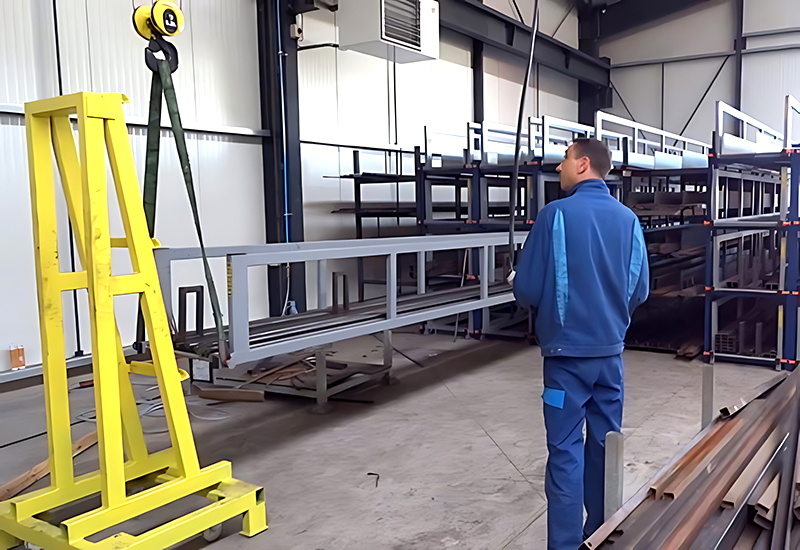
The system they proposed was not some futuristic gadget—it was a brilliantly simple and effective design. This new long material storage rack stood about 12 feet high and 21 feet long, featuring individual slots 24 inches wide. Each slot contained a cart that slid out effortlessly. Mike hooked the hoist to a 20-foot pipe, gave it a gentle pull, and had it out in three minutes flat. I was in disbelief. He did it again with the same result. We timed it: three successful pulls in less than 10 minutes. Previously, that would have taken us nearly an hour. By the end of the day, we had processed 20 pipes without anyone breaking a sweat.
Why It Felt Like a Weight Was Lifted
The impact was immediate and profound. Here’s what made the difference for us, and perhaps it’s what you’re looking for too:
- One-Person Operation: Mike no longer needs a spotter. He can hook, pull, and be done in minutes.
- Niet meer graven: Every pipe has its own designated slot. There’s no need to shuffle inventory to reach the item you need.
- Time Is Finally on Our Side: A 20-minute task now takes just 3 minutes. This isn’t just an improvement; it’s a complete transformation of our workflow.
The rack is built to last, with a 3-ton capacity per slot and a solid steel frame that doesn’t flex. It also includes safety guards that prevent the carts from being pulled out too far—a feature I didn’t know I needed until I saw how stable it kept the load. The system is also adaptable; if our inventory shifts to longer pipes, the rack can be adjusted. For the first time, the equipment was doing the hard work for us.
The Bottom Line That Adds Up
Let’s look at the numbers, because that’s where the real value becomes clear. With the old cantilever rack, a productive day meant completing 8 retrievals in 4 hours, averaging 30 minutes each when accounting for snags and resets. With the new honeycomb system, we now complete 20 retrievals in the same amount of time. That’s an average of just 12 minutes per pull, including travel time. We are saving 2.5 hours every single day. For my business, that translates to reduced overtime costs, more satisfied customers, and a crew that isn’t exhausted by the end of their shift. You don’t have to be a math whiz to see how quickly those savings add up.

 EN
EN  DE
DE  RU
RU  NL
NL  PT
PT  JA
JA  ES
ES  IT
IT