

A crank out cantilever rack’s weight capacity is not a single number but an engineered specification, ranging from 1,000 lbs for light-duty applications to over 13,000 lbs per arm for heavy-duty industrial storage. The precise capacity is determined by its structural design, material grade, and the specific dynamics of your heavy material handling needs, ensuring safe and efficient access with an overhead crane.
Understanding Weight Capacity: More Than Just a Number
When evaluating a telescoopgiek, the weight capacity per arm is the most critical safety and operational parameter. Unlike static storage, this capacity must be guaranteed when the arm is fully extended by 100%, creating significant dynamic loads. The capacity is not a one-size-fits-all figure; it is a result of meticulous engineering tailored to the specific materials being stored, from lightweight aluminum profiles to heavy bar stock and steel pipes.
The system’s integrity relies on a chain of load-bearing components working in concert. The final capacity rating is a direct function of the materials used, the precision of the manufacturing process, and a design philosophy that prioritizes safety under maximum stress. This ensures that a single operator can safely and smoothly handle multi-ton loads without risk of structural failure or material damage.
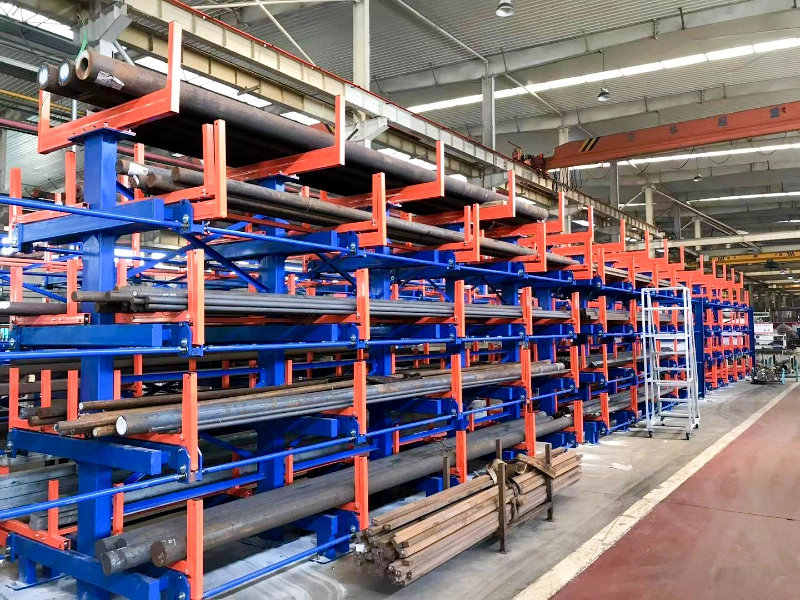
The Engineering Behind Heavy-Duty Load Ratings
A high weight capacity is not achieved by chance. It is the outcome of a robust engineering process that considers every component’s role in the load path, from the stored material down to the concrete floor.
The Foundation: Structural Steel and Precision Fabrication
The backbone of a heavy-duty roll out cantilever rack is its material and construction. The primary structure is built not from thin, roll-formed steel but from high-strength Q235 carbon steel and structural H-beams. This choice is deliberate:
- Structural H-Beams: The base and uprights often use H-beams (e.g., 250x150mm). Unlike lighter materials, H-beams offer superior resistance to bending and torsional forces, which is critical when a multi-ton load is fully extended away from the central column.
- Laser Cutting and Robotic Welding: Key components like the gear rack and connection plates are laser-cut for absolute precision. This ensures a perfect mesh between the gear and rack, facilitating smooth operation. Robotic welding provides consistent, high-penetration welds that are stronger and more reliable than manual alternatives, eliminating weak points in the structure.
Load Distribution: A System-Wide Approach
The stated capacity of a cantilever arm is supported by the entire rack system. The load from your Stalen buizen or bar stock is transferred systematically:
- Cantilever Arm: The first point of contact, designed to handle the load without deflection.
- Bearing Housing: The arm connects to high-load roller bearings, which manage the immense friction and allow the arm to roll out smoothly.
- Upright Column: The bearings are mounted to the vertical upright, transferring the load downwards.
- Base Structure: The uprights are welded to a massive H-beam base, which distributes the weight over a large footprint and provides the critical counterbalance to prevent tipping when arms are extended.
- Anchor Bolts: The entire structure is secured to a reinforced concrete floor (typically 6-8 inches thick) with heavy-duty expansion or chemical anchor bolts, making the floor the final component in the load-bearing system.

Factors That Influence Real-World Capacity and Safety
Achieving the rated capacity safely in your facility requires understanding how your specific application interacts with the rack’s design. The system must be configured to match the unique characteristics of your inventory.
Material Length and the Prevention of Deflection
For long materials, such as 20-foot or 40-foot structural steel sections, the number of uprights is as important as the capacity per arm. A system designed for a 6-ton load over 40 feet will use multiple uprights (e.g., 5 or 8 columns) spaced strategically. This design provides multiple support points along the length of the material, preventing sagging (deflection) which can permanently damage valuable stock like high-purity stainless steel tubing or precision-ground bar stock. Fewer supports would create excessive spans, leading to material bending under its own weight.
Dynamic Loads and the 100% Extension Rule
The most demanding state for the rack is when an arm is fully extended. In this position, the load’s center of gravity shifts forward, creating a powerful tipping force (moment). The rack’s engineering, particularly the size and weight of its base and the strength of its floor anchors, is calculated to safely counteract this force. This is why safety protocols strictly forbid extending more than one level at a time. High-quality systems often include a mechanical interlock mechanism to physically prevent this user error.
| Duty Level | Capacity Range per Arm | Common Stored Materials | Typical Industry |
|---|---|---|---|
| Light-Duty | 1,000 – 2,500 lbs (500 – 1,100 kg) | Aluminum Profiles, Light Tubing, Wood Trim | Architectural Manufacturing, Window & Door Fabricators |
| Medium-Duty | 2,500 – 6,000 lbs (1,100 – 2,700 kg) | Square Tube, Steel Pipe, Bar Stock | Metal Fabrication Shops, Machine Shops |
| Heavy-Duty | 6,000 – 13,000+ lbs (2,700 – 6,000+ kg) | Solid Steel Bars, Structural Beams, Injection Molds, Dies | Steel Service Centers, Aerospace, Heavy Manufacturing |
Ultimately, the weight capacity of a crank out cantilever arm is a promise of performance and safety. It reflects a system engineered from the ground up to handle the immense forces involved in storing and retrieving heavy, long materials. By choosing a system designed with robust materials, precision manufacturing, and a deep understanding of load dynamics, you ensure not only the protection of your inventory but also the safety of your operators.
Veelgestelde vragen
1. Can I temporarily overload a cantilever arm if I’m careful?
No. Exceeding the stated weight capacity is extremely dangerous and should never be attempted. Overloading can cause immediate catastrophic failure or, more insidiously, lead to metal fatigue and plastic deformation. This means the steel components can bend permanently, compromising their structural integrity for all future use, even at lower weights. Always adhere strictly to the load rating placard.
2. Does the weight capacity change for the arms on higher levels?
No, the weight capacity per arm is consistent for every level of the rack. Each extendable arm and its corresponding bearing assembly is engineered to the same load specification, regardless of its vertical position on the upright column. However, for overall stability, it is best practice to store the heaviest materials on the lowest levels.
3. What happens if an operator tries to extend two arms at the same time?
Extending two loaded arms simultaneously dramatically shifts the rack’s center of gravity forward, creating a severe risk of the entire structure tipping over. To prevent this critical safety hazard, reputable crank out cantilever systems are equipped with a mechanical or electrical interlock system that physically prevents more than one arm from being extended at any given time.
4. Is the capacity of a manual crank-operated rack lower than an electric motorized one?
No, the method of extension (manual crank or electric motor) does not affect the structural weight capacity of the arms. The drive mechanism is separate from the load-bearing structure. Both systems are built with the same heavy-duty steel frame, uprights, and arms. The choice between manual and electric is based on retrieval frequency, load weight (for operator ergonomics), and budget, not on the fundamental capacity.
5. How is the weight capacity of a rack system verified?
The capacity is verified through a multi-step process. It begins with professional engineering calculations, including Finite Element Analysis (FEA) computer modeling, to simulate stress under load. This is followed by rigorous physical load testing on prototypes, where arms are loaded beyond their rated capacity in a controlled environment to identify their failure point and confirm a sufficient safety factor. All production units are then built to these proven specifications.

 EN
EN  DE
DE  RU
RU  NL
NL  PT
PT  JA
JA  ES
ES  IT
IT