
In many pressure vessel cutting areas, the most expensive metal on the floor is not the new plate waiting by the machine. It is the reusable Q345R and 304 stainless offcut already buried in a dirty stack that nobody can identify fast enough to trust. That is how a material black hole starts.
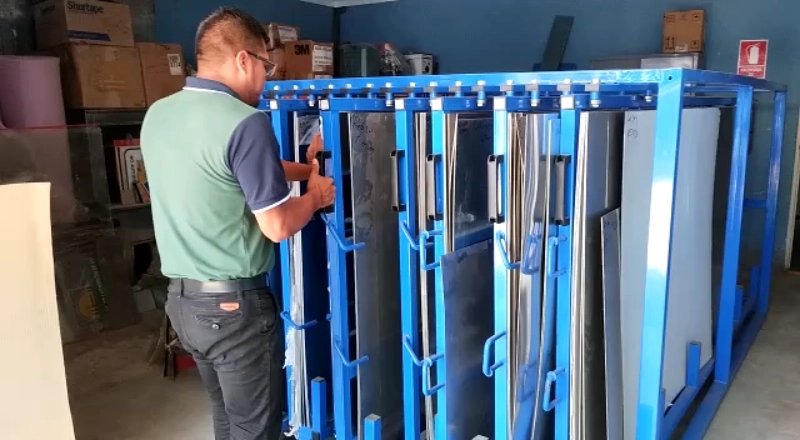
Een aplarack metal sheet rack vertical system changes the storage unit from one anonymous pile into one labeled drawer position. Instead of guessing what is inside a floor stack, the supervisor can assign every thickness and material family its own visible slot and nameplate.
If your cutting team handles heavy remnants every day, the storage problem is not simply weight. It is the combination of irregular size, repeated reuse, and zero visibility once plates are stacked flat. A floor pile looks cheap until the crew buys new stock because the usable plate they already own has disappeared into the bottom of the mess.
Why Flat Offcut Piles Create an Inventory Black Hole
Offcuts from pressure vessel fabrication do not behave like neat standard sheets. They are thick, heavy, irregular, and often still valuable enough to deserve controlled reuse.
- material tags disappear after a few handling cycles
- heavy pieces cover one another and hide usable stock
- crews hesitate to disturb a dangerous pile for one plate
- purchasing sees shortage while the shop floor is still holding reusable material
That is why a plaatmetaal vlak voorraad verticaal opslagrek works better in this scenario than unmanaged flat piling.

What This Roll Out Vertical Sheet Rack Does Differently
Een uitrolbaar verticaal platenrek isolates one group of material from the next. Each drawer becomes an individual storage address instead of one layer trapped inside a stack.
For a pressure vessel workshop, that means:
- Q345R and 304 offcuts can be separated by thickness or grade
- nameplate identification stays tied to the storage location
- the target piece can be exposed to the crane without disturbing unrelated stock
- the crew can treat remnants as managed assets rather than scrap-looking leftovers
Why 1100 kg Capacity Matters Here
Light drawer racks are irrelevant in heavy fabrication. A useful plaatstalen rek verticaal for this environment must be designed for serious drawer loading, not decorative sheet handling.
Where offcuts are thick and dense, buyers normally care about three things:
- whether one drawer can handle up to 1100 kg
- whether the frame stays stable under repeated crane-side use
- whether the rolling path remains controllable under heavy load
That is why Aplarack solutions in rougher heavy shops often move away from simple floor-contact wheels and into V-groove steel wheels with angle-iron guide tracks.

When V-Groove Track Guidance Becomes Necessary
Not every site can rely on smooth PU wheel travel. Many vessel shops have aged concrete, weld debris, scale, and heavy service traffic. Under those conditions, a drawer loaded with steel can become hard to control even if the frame itself is strong enough.
Een verticale metalen platenrekken layout with guided steel wheels helps because it transfers movement logic to the rail instead of gambling on floor perfection.
- better travel control for heavy drawers
- more stable path for repeated opening and return
- less dependence on imperfect floor condition
What Operations Leaders Should Confirm Before Buying
This is not a universal rack for every shop. It works when the physical conditions support it.
- Is there enough front clearance to pull a drawer out fully?
- Can the overhead crane reach the exposed drawer position directly?
- Does the heaviest plate group require track-guided travel?
- Will the team actually maintain drawer-by-drawer labeling discipline?
If the answer to those questions is yes, a Plaatwerk opslagrek verticaal system can turn hidden remnants into traceable, reusable stock.
Need a layout for heavy Q345R and stainless remnants?
Send your heaviest offcut size, target drawer load, and available crane zone. We will review whether a guided Aplarack configuration fits your fabrication area.

 EN
EN  DE
DE  RU
RU  NL
NL  PT
PT  JA
JA  ES
ES  IT
IT