
The Deadline Panic You’re Living In
Je hebt vast wel eens meegemaakt dat de telefoon rinkelde en een klant aan de telefoon riep: “waar is mijn bestelling?” In de tussentijd, uw bemanning is op zoek naar de juiste korte stokken - graven in de stapels, het dragen van zware stokken en niets te winnen. Wat oorspronkelijk slechts vijf minuten duurde, sleept nu 30 minuten in beslag. Nu ben je te laat en zwetend en belooft “morgen” als je “vandaag” zegt. Het gaat niet alleen om uitstel; Het is een klap voor je reputatie.
I’ve walked into shops where this is the daily grind. You’re not slow on purpose; you’re stuck with a setup that’s choking your pace. When bar stock takes forever to grab, the customer feels it, and you pay for it. Investing in proper ronde voorraadrekken can change that.
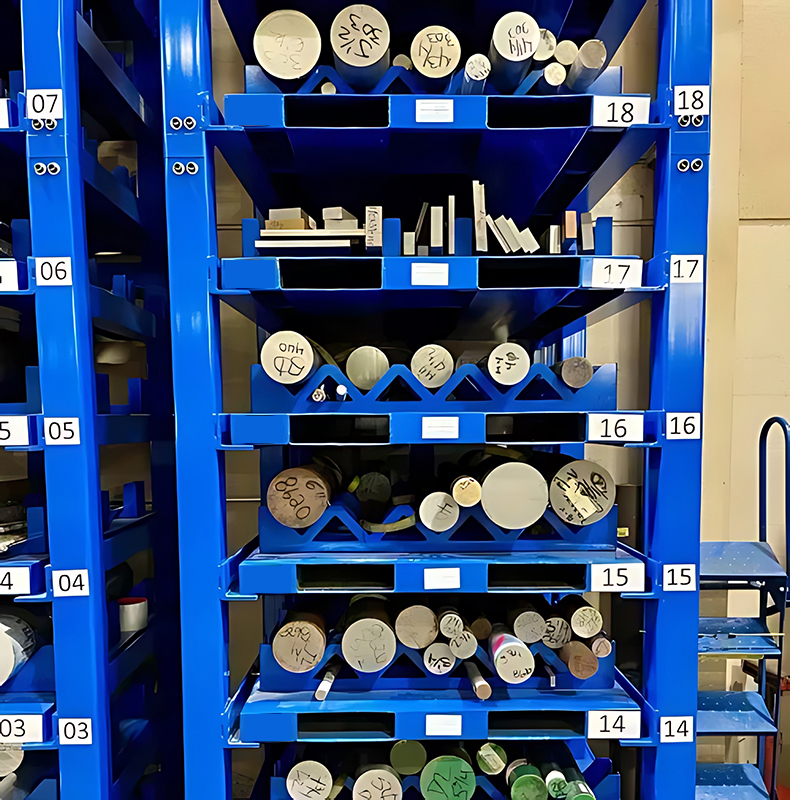
Why Slow Access Kills Your Flow
Short bar stock—those high-value, odd-sized pieces—doesn’t make it easy:
- It’s buried: Floor piles or jumbled racks hide what you need, making quick finds impossible.
- It’s a slog: Workers wrestle bars out, and forklifts fumble with loose stacks—every move is a fight.
- It snowballs: One delay stalls cutting, shipping, and everything else. Customers don’t wait.
A Georgia shop owner I know said he’d get three calls a day from the same client in a panic because his crew couldn’t pull bars fast enough. Another told me he lost a $2,000 order when a 10-minute job took an hour to start. If your stock is slow to access, you’re not just behind—you’re bleeding trust.
What These Delays Are Costing You
Let’s add it up. Say you’re handling 10 orders a day, needing 500 pounds of short bar stock:
- Lost time: If each pull takes 15 minutes, that’s 2.5 hours daily. At $25/hour, that costs you $15,625 a year.
- Late penalties: A $50 rush fee a week for delays costs $2,600 annually. A single $500 order lost monthly costs $6,000.
- Customer churn: One $1,000 client walking away quarterly costs you $4,000 yearly.
The total damage is between $20,000 and $26,000 a year. Efficient ronde voorraadrekken can put that money back in your pocket.
A Way to Speed Things Up
I’ve watched shops break this cycle, and it’s not about working harder—it’s about moving smarter. Imagine your bars are no longer in a heap. They’re on shelves, with trays holding each type and forklift slots ready to go. A worker spots the right stock, lifts it cleanly in a minute, and the job is rolling—no stalling, no swearing.
One shop I know was drowning in half-hour pulls that were killing deadlines. They switched to a ronde voorraadrekken system with forklift access, cut retrieval time to 2 minutes, and the owner said, “Customers stopped yelling—I can hear myself think now.”
What Gets You Moving Fast
More staff won’t help; they’ll just trip over each other. Floor stacks are still slow chaos. Here’s what works:
- Trays on shelves: Shallow bins sort bars so no digging is needed.
- Forklift-ready: Slots let you lift smoothly, turning a 20-minute job into a 2-minute one.
- Tough enough: 2,000 pounds per shelf capacity to handle stock without buckling.
It’s not complex. A business owner I know spent $1,500 on a “faster” crew but saw the same delays and higher payroll. Then he got trays and slots for $600, and orders shipped on time, saving the $5,000 he’d lost from clients walking away.
What You’d Gain If You Beat the Clock
Speed up access, and the shop hums. Pull times drop to 1 minute, saving 2.5 hours daily and putting $15,625 back in play. No penalties save you another $2,600, and retaining orders keeps $6,000. Clients stick around, saving you $4,000 more. One shop shaved 20 minutes off every job and landed a $3,000 rush order they would have otherwise missed.
A customer said, “You’re on it now,” after a same-day delivery. It’s not just faster—it’s a reputation that holds.
Run Your Own Clock
Time it: How long does a pull take now? 10 minutes? 20? Multiply that by jobs per day and your hourly rate. If it’s too long, test this: set one tray on a shelf, slot it for a forklift, and clock the next grab. If it’s quicker, you’ve found your fix.
Still racing against the phone? Tell us your pull times—we’ll offer some ideas. This isn’t about selling you speed; it’s about keeping your customers off your back.

 EN
EN  DE
DE  RU
RU  NL
NL  PT
PT  JA
JA  ES
ES  IT
IT