

Your laser cutter only makes money when it’s cutting. But how much time does it waste every day, waiting for your crew to dig out the right steel sheet from a disorganized stack? This downtime isn’t just a delay; it’s a direct drain on your profits and a bottleneck for your entire fabrication workflow, creating a frustrating alternative to the efficiency you need.
Is Your Shop Floor a Maze of Metal Sheets? The Hidden Costs of Disorganized Storage
Walk into many metal fabrication shops, and you’ll see a familiar scene: stacks of raw materials—mild steel, stainless, aluminum—piled directly on the floor or on pallets. When the laser cutting table or press brake needs a specific 10-gauge stainless steel sheet buried at the bottom of a 5,000 lb stack, the “sheet metal shuffle” begins. An operator ties up a forklift or an overhead crane, carefully lifting and moving multiple heavy sheets just to access one. This process is not just inefficient; it’s a productivity killer.

This daily struggle creates a domino effect of operational problems:
- Excessive Machine Downtime: Your most valuable assets, like CNC laser cutters and turret punches, sit idle, waiting for material. Every minute of non-cutting time is lost revenue.
- Material Damage: Frequent handling with forks and chains leads to scratches, dents, and bent corners, especially on expensive, surface-critical materials like polished stainless steel or aluminum. This results in costly scrap and rework.
- Wasted Labor: It often takes two or more people to perform the dangerous task of “digging out” a sheet, pulling them away from value-added tasks like programming, cutting, or bending.
- Safety Hazards: Shifting heavy, unstable stacks of steel is one of the most high-risk activities in a workshop, creating a constant threat of serious injury.
Beyond the Stack: A Smarter Alternative to Conventional Storage Systems
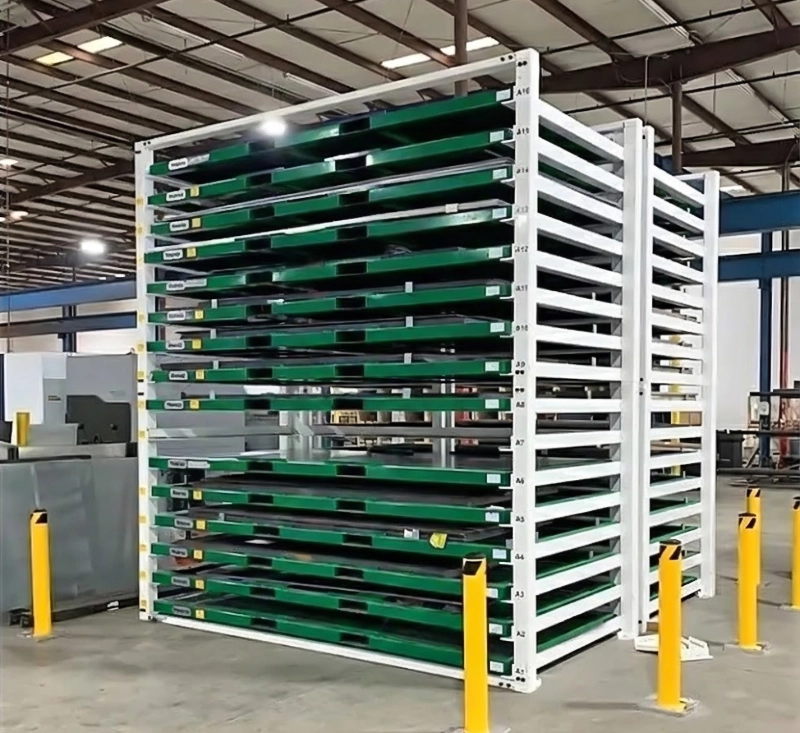
The core problem with floor stacking and even some basic racking is the lack of direct access. To overcome this, a modern metalen opbergrek operates on a simple yet revolutionary principle: transforming a vertical stack into a series of individually accessible horizontal drawers. This design provides a superior, high-efficiency alternative to outdated methods, including those from brands like Steak, by directly addressing the primary bottlenecks in a fabricator’s workflow.
Instant Access, Zero Shuffling: The Power of 100% Selectivity
Imagine needing any sheet, of any material or thickness, and having it accessible in under two minutes. That’s the power of a Uitrolbaar vellenrek. Each drawer extends 100%, presenting the entire contents for easy identification and handling by a crane or forklift. This completely eliminates the time-wasting “sheet metal shuffle.” The direct result is a dramatic reduction in material retrieval time, feeding your hungry machines faster and maximizing their Overall Equipment Effectiveness (OEE).

Reclaim Your Floor Space, Expand Your Capacity
Floor stacking consumes an enormous amount of valuable production space. A vertical, high-density Horizontale opslag van plaatwerk system can reduce the footprint required for your raw materials by up to 80%. This isn’t just about being tidy; it’s about unlocking potential. The reclaimed space can be used to add a new press brake, set up a dedicated welding station, or simply improve workflow and reduce congestion around your primary machines.
From Risky Team Lifts to Safe, One-Person Operations
Safety is paramount. Our system is engineered for safe, efficient handling by a single operator. Paired with an overhead crane and a vacuum lifter or plate clamp, one person can safely slide out a drawer, lift the required sheet, and send it to the cutting table. For heavier loads (up to 6,000 lbs or more), hand-cranked drawers with gear reduction mechanisms allow a single employee to move immense weight with minimal effort, transforming a dangerous team lift into a controlled, standard operating procedure.

The Result: A Streamlined Workflow from Receiving to Cutting
uitvoering rek van metaalplaat is more than an equipment purchase; it’s a process overhaul. Metal fabrication shops that make the switch report transformative results. One mid-sized shop, similar to Metaltex in Australia, saw a 15% increase in total output in the first month alone, simply by eliminating the material waiting time for their two main laser cutters. Their workshop floor became safer, more organized, and they could finally add the second deburring station they desperately needed in the space they reclaimed. This is the tangible ROI of moving beyond outdated storage methods to a system designed for modern, lean manufacturing.

Veelgestelde vragen
1. Can this rack handle our oversized 5′ x 10′ stainless steel sheets?
Absolutely. Our systems are fully customizable. We design the drawer dimensions (width and depth), number of levels, and load capacity specifically to match the sheet sizes and weights you work with, whether it’s standard 4’x8′ or larger custom plates.
2. Our heaviest plates are around 5,000 lbs. Can one person really handle that?
Yes. For loads exceeding 1.5 tons (3,000 lbs), we highly recommend our hand-cranked models. A mechanical gear system multiplies the operator’s force, allowing one person to safely and smoothly roll out a drawer weighing up to 6,000 lbs or more with minimal physical effort.
3. How does this system integrate with our overhead crane and vacuum lifter?
The system is designed for seamless integration. The 100% pull-out drawers provide clear, unobstructed overhead access for any crane, gantry, or jib system. This allows your vacuum lifter or plate clamp to get a secure grip on the material without any interference from the rack structure.
4. We’re tight on ceiling height. What’s the minimum vertical clearance needed?
We recommend a minimum clearance of 3-4 feet above the top of the rack to ensure your lifting equipment (like a forklift mast or crane hook) can operate safely without hitting lights, pipes, or ceiling beams. However, we can customize the overall height and number of levels to maximize storage within your facility’s specific vertical constraints.
5. How does this compare to a cantilever rack for storing sheet metal?
While cantilever racks can store sheets, they lack individual accessibility. To get a sheet at the bottom of a cantilever level, you must first remove everything on top of it—the same problem as floor stacking. Our drawer system offers 100% selectivity, making it far superior for operations that require frequent access to a variety of different materials, which is typical in a job shop or fabrication environment.

 EN
EN  DE
DE  RU
RU  NL
NL  PT
PT  JA
JA  ES
ES  IT
IT