

|
Your warehouse floor is not a storage system. Every bundle of HSS tubing or Schedule 40 pipe stacked on dunnage is a safety risk, a productivity bottleneck, and a hidden drain on your profits. Stop playing inventory Tetris just to retrieve a single order. It’s time to reclaim your floor space and streamline your operation. |
Clean up messy floors with pipe stacking racks?
For any Warehouse Operations Manager in a metal service center or steel pipe distribution facility, the answer is an emphatic yes. The seemingly simple act of moving pipes off the floor and into a dedicated system is not just about tidiness; it’s a fundamental operational upgrade. The traditional method of floor stacking is a legacy practice that actively costs your business money through inefficiency, material damage, and safety hazards.
The “Before” Scenario: The Daily Grind of a Disorganized Pipe Yard
If you’re managing a facility that handles long materials, this scene is likely all too familiar. Bundles of seamless carbon steel pipe and galvanized square tubing are spread across the concrete floor, separated only by precarious wooden blocks. This “system” creates a cascade of daily problems:
- Retrieval Nightmares: Accessing a specific bundle buried at the bottom of a pile requires a forklift operator to painstakingly move several tons of other material first. A task that should take minutes balloons into a 20-30 minute ordeal, killing productivity and delaying order fulfillment.
- Material Damage & Loss: Pipes at the bottom of the stack bear the weight of everything above, leading to potential deformation. Contact with the damp concrete floor can cause rust, and the constant shuffling with forklifts results in scratches and dings that can lead to customer rejection. This scrap rate of 2-5% is a direct hit to your bottom line.
- Safety Hazards: Unsecured pipes have a dangerous tendency to roll. This poses a constant threat to personnel and creates obstacles that violate OSHA guidelines, putting your facility at risk during an inspection.
- Wasted Vertical Space: With floor stacking, your most valuable asset—vertical warehouse space—is completely unused. You’re paying rent for cubic feet that contribute nothing to your storage capacity, forcing you to consider expensive expansions when your existing footprint is only 30% utilized.
The Solution: How Stackable Pipe Racks Engineer a New Workflow
A system of Houder voor heap buizen fundamentally changes the game by introducing a “unitized” storage philosophy. Instead of a chaotic pile, each bundle of pipe is housed in its own rigid, protective steel frame. This isn’t just a rack; it’s a modular, mobile, and vertically integrated storage container.
Here’s the engineering logic that makes it work:
1. Vertical Stacking & Density Multiplication: Constructed from high-grade Q235 steel, these racks are designed to be safely stacked 4 to 5 layers high. The load of up to 4,500 Lbs (2041 kg) per rack is transferred through the steel columns directly to the floor. The pipes themselves bear no weight other than their own. This immediately transforms your horizontal footprint, achieving up to a 400% increase in storage density in the same area.
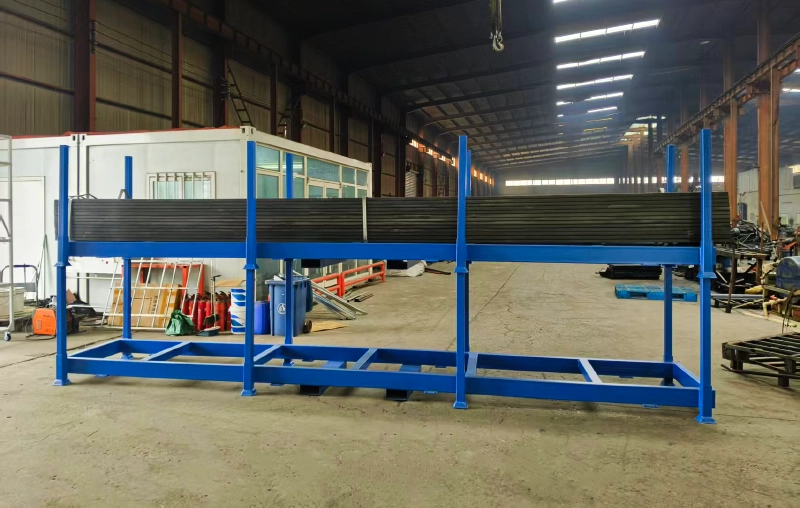
2. 100% Selectivity & Instant Access: Because each rack is an independent unit, a forklift can directly access any bundle, on any level, at any time. The 20-30 minute search-and-shuffle operation is eliminated. Retrieval time plummets to under 3 minutes, a 90% improvement in operational efficiency. Your team can pick orders faster and more accurately, directly impacting your shipping capacity.
3. Asset Flexibility with Pluggable Design: Unlike bulky, permanent cantilever racks, these portable pipe storage racks feature removable corner posts. During off-peak seasons or when a section of the warehouse needs to be cleared for a different task, the posts can be removed and the bases nested together. This “space magic” reduces the storage footprint of the empty racks by a staggering 80%, freeing up valuable floor space for other revenue-generating activities.

The “After” Scenario: A Clean, Safe, and Profitable Operation
Uitvoering van een steel pipe storage rack system is a direct investment in operational excellence. The transformation is immediate and measurable:
- Clean & Open Aisles: Floors are clear, allowing for safe and efficient movement of forklifts, personnel, and even automated guided vehicles (AGVs).
- Near-Zero Material Damage: Pipes are protected within a steel exoskeleton, shielded from ground moisture and compression damage. The material deformation rate drops to less than 0.1%.
- Enhanced Safety & Compliance: A structured, organized yard eliminates the risk of rolling pipes and makes it easy to maintain OSHA-compliant clearances.
- Improved Company Image: When a major client visits, they see a professional, efficient, and safe operation, not a cluttered “workshop.” This builds confidence and reinforces your brand’s commitment to quality.
Ultimately, cleaning up your messy floors with Houder voor heap buizen is not an expense; it’s a strategic move that pays for itself. With a typical investment return period of just 12-18 months, you’re not just buying steel—you’re buying efficiency, safety, and a higher profit margin per square foot.
Veelgestelde vragen
1. How do these stackable racks compare to traditional cantilever racks for pipe storage?
While cantilever racks are a good permanent solution, they lack flexibility. Once bolted down, your warehouse layout is fixed. Stackable racks are modular and portable, allowing you to reconfigure your storage layout as needs change. Furthermore, cantilever systems often require wider aisles for forklift maneuverability, whereas our system can create higher density in the same footprint.
2. What is the real-world load capacity when stacking 4 units high?
Each individual rack has a static load capacity of 4,500 Lbs (4.5 tons when stacked). When stacked 4 high, the total vertical load on the bottom rack’s posts is supported, but the rack itself should still only contain 4,500 Lbs of material. The system is engineered so that the weight is transferred through the frame, ensuring the structural integrity of the entire stack.
3. Can these racks be used outdoors for storing galvanized tubing?
Yes. Our buizenrekken voor magazijn and yard use feature an industrial-grade powder-coated finish. This provides a durable barrier against corrosion and rust, making them suitable for outdoor pipe yard applications. For extremely harsh or coastal environments, a hot-dip galvanized finish can also be specified.
4. How do they improve workflow for feeding a CNC tube laser cutting machine?
Custom models can be fitted with heavy-duty casters. This transforms the storage rack into a mobile material cart. A full rack of raw material can be manually pushed from the storage area directly to the laser cutter’s loading zone, even in narrow aisles where forklifts can’t easily operate. This creates a seamless “point-of-use” material flow, eliminating production downtime spent waiting for a forklift.
5. What is the process for disassembling and nesting the racks when they’re not in use?
The process is simple and requires no tools. The four vertical posts simply lift out of the sockets on the base. Once the posts are removed, the channel steel bases are designed to nest securely into one another, reducing their stored height and footprint by up to 80%.

 EN
EN  DE
DE  RU
RU  NL
NL  PT
PT  JA
JA  ES
ES  IT
IT