

Is your scrap bin filled with scratched anodized aluminum? Storing 20ft architectural extrusions on the floor or static racks is a recipe for surface damage and “banana” deflection. Switch to a system designed for zero-contact handling.
Handling aluminum profiles, especially architectural grades like 6063 with anodized or powder-coated finishes, is fundamentally different from handling structural steel. Steel is forgiving; aluminum is not. A single scratch from a forklift tine can turn a pristine 24-foot extrusion into scrap metal instantly.
For Metal Service Centers and Aluminum Fabricators, the challenge is twofold: preserving surface integrity en preventing deflection (sagging) in long-length inventory. The traditional method of “pigeonhole” racking or floor stacking fails on both counts.
The “Surface Quality” Crisis in Aluminum Storage
In a typical warehouse, retrieving a specific bundle of aluminum tube or bar often involves “digging.” Forklift operators must move the top three bundles to get to the bottom one. Every movement creates friction. Every friction point creates potential for scratches, abrasions, and cross-contamination (especially if carbon steel is stored nearby).
Furthermore, standard cantilever racks require wide aisles for forklift maneuvering. This forces operators to approach the rack with long loads at awkward angles, increasing the risk of the load striking the uprights.

Close-up of the stop-block mechanism ensuring safe retention of bundled profiles.
The Logic: Why “Roll Out” Means “Zero Scratch”
De telescoopgiek system (also known as Tcrack) fundamentally changes the retrieval process by eliminating the forklift from the extraction phase.
Instead of sliding forks under a bundle—risking damage to the material—the operator simply rotates a crank handle. The entire cantilever arm rolls out 100% into the aisle, fully exposing the aluminum bundle to the overhead space. This allows for Vertical Lifting via an overhead crane using soft nylon slings or a vacuum lifter.
Key Operational Advantages:
- No Friction: Material is lifted straight up, never dragged across other bundles.
- Single-Operator Workflow: One person can crank out a 6,000 lb drawer and operate the crane, bypassing the need for a dedicated forklift driver.
- Opslag met hoge dichtheid: Aisle widths are reduced from 15ft (forklift turning radius) to just 5ft (operator walking path), increasing storage capacity by up to 50%.

Overhead crane access eliminates the risk of forklift damage to sensitive aluminum surfaces.
Defeating Deflection in 24ft Extrusions
Aluminum has a lower modulus of elasticity compared to steel. A 24-foot (approx. 7.3m) extrusion supported only by 3 or 4 arms will sag over time, resulting in permanent deformation. This “banana effect” makes the material unusable for precision machining or automated feeding into CNC saws.
Our Tcrack system addresses this with a modular multi-column design. For long aluminum stock, we utilize 6 to 8 upright configurations. By reducing the span between support arms, we ensure the material remains perfectly straight. The synchronized transmission shaft ensures that all 8 arms roll out simultaneously without jamming, providing uniform support throughout the movement.
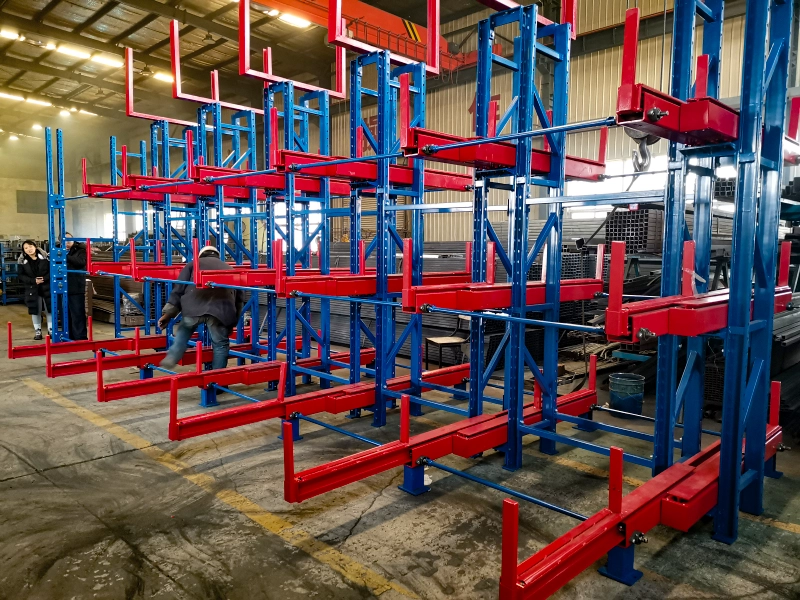
8-column configuration designed specifically to prevent sagging in long, flexible extrusions.
Technische specificaties
| Functie | Specificatie |
|---|---|
| Drive Mechanism | Manual Crank (Rack & Pinion) or Electric Drive |
| Extension | 100% Full Extension (Clear overhead access) |
| Laadvermogen | 1,000 lbs – 13,000 lbs per arm level (Customizable) |
| Material Length | 10ft, 20ft, 24ft, up to 40ft (Modular Design) |
| Bescherming van het oppervlak | Optional Rubber/Polyurethane Strips on Arms |
| Steel Grade | Q235 / Structural H-Beam Construction |
Veelgestelde vragen
1. How do you prevent the steel arms from scratching our aluminum products?
We offer optional protection packages where the cantilever arms are lined with industrial-grade rubber or polyurethane strips. This ensures there is no metal-on-metal contact, preserving the anodized or polished finish of your aluminum.
2. Can this system handle 40ft (12m) extrusions?
Yes. The system is modular. We can link multiple upright columns (e.g., 8 or 10 columns) with a synchronized transmission shaft. This allows extremely long loads to be rolled out smoothly by a single operator without the rack twisting or jamming.
3. We use vacuum lifters. Is there enough clearance?
Absolutely. Because the drawer extends 100% out of the rack structure, the overhead space is completely unobstructed. This is the ideal setup for vacuum lifters, which require vertical access to pick up sheets or rows of tubes.
4. Can we store mixed lengths (e.g., 10ft and 20ft) on the same rack?
Yes. By designing the rack with closer column spacing (e.g., every 1-1.5 meters), you create a continuous shelf effect. This allows you to place shorter off-cuts alongside full-length bundles on the same level without them falling through.
5. Is the system compatible with our existing Amada laser cutter loading system?
Many of our clients use the Roll Out rack as a “WIP” (Work In Progress) buffer directly next to their laser cutters or CNC saws. The crane can pick raw material from the rack and place it directly onto the machine’s in-feed table, streamlining the workflow.

 EN
EN  DE
DE  RU
RU  NL
NL  PT
PT  JA
JA  ES
ES  IT
IT