

Is your multi-million dollar laser cutter constantly idle, waiting for operators to “dig out” the right metal sheet from a hazardous, floor-stacked pile? Every minute it’s not cutting, you’re losing money. This operational bottleneck is silently eroding your shop’s profitability, creating safety risks, and wasting valuable floor space that could house your next big machine.
The Real Cost of a Disorganized Metal Fabrication Workshop
For medium-sized metal processing workshops, core profitability is often constrained by an inconspicuous link: searching for raw materials. When a laser cutting machine worth millions is forced to stop because workers spend two hours looking for materials, the company loses not only labor but also suffers a sharp decline in the Overall Equipment Effectiveness (OEE) of its core equipment. Traditional storage methods relying on wooden pallets stacked on the floor or cantilever racks turn every material retrieval into a high-risk “restacking” operation. The horizontal sheet metal rack is not a simple shelving unit; it is a strategic asset investment with a design life of over 10 years. Starting from mechanical structures and on-site action chains, this article breaks down the true advantages and application boundaries of this drawer-type storage solution.

This isn’t just a matter of being untidy. It’s a direct assault on your bottom line.
The Idle Laser Cutter: A Profit Center Turned Parking Lot
Your laser cutter or turret punch press is the heart of your operation, but it only makes money when it’s running. When your operator spends 30 minutes “digging” for the right 10-gauge stainless steel sheet, that machine sits idle. This “machine waiting for material” downtime destroys your Overall Equipment Effectiveness (OEE), delays job completion, and ultimately limits the number of projects you can take on.
Valuable Floor Space Held Hostage
Every square foot of your workshop costs money. When raw materials are spread across the floor, that’s space you can’t use for a new press brake, a welding station, or a larger assembly area. Your business growth is literally being blocked by inefficient storage. A cluttered shop floor also impedes workflow, creating bottlenecks for forklifts and personnel.
The Hidden Costs: Scratches, Dents, and Safety Hazards
In a floor stack, every sheet you move to get to the one you need is a chance for damage. Dragging a heavy steel plate across another can cause deep scratches, rendering expensive, surface-critical materials like polished stainless steel or anodized aluminum useless. Worse, the manual “restacking” process is a major safety risk. It’s a leading cause of back injuries, crushed fingers, and other serious accidents that lead to worker’s compensation claims, insurance hikes, and production shutdowns.
Structured Solution Logic: How to Eliminate the Efficiency Black Hole via Mechanical Design?
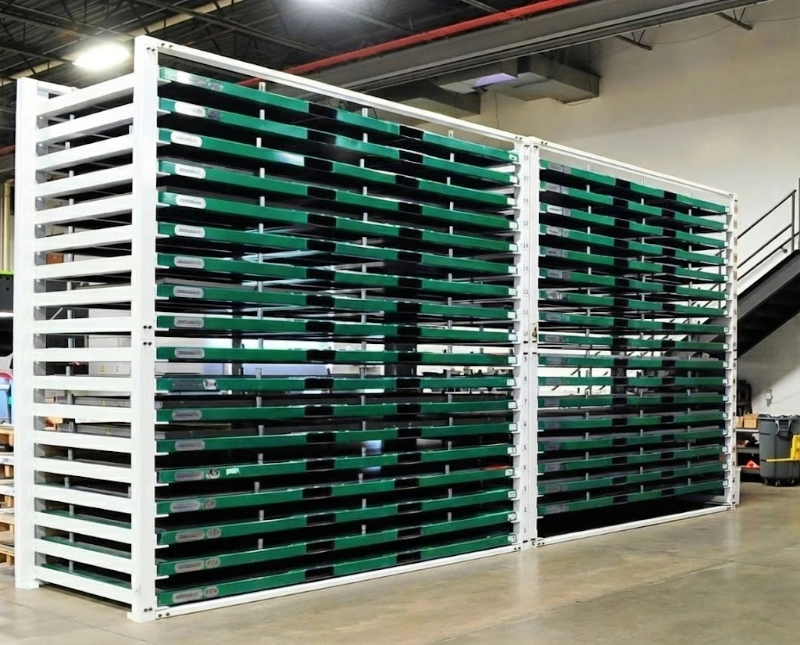
Horizontal sheet metal racks completely transform the logistics dynamics of the workshop through specific structural components and action chains:
100% Independent Selectivity, Eliminating “Restacking” Time
The rack utilizes a drawer-style design that can be 100% fully pulled out. This means operators can directly access single sheets without obstruction, completely eliminating the invalid waiting time. Consequently, material supply time is drastically shortened, and cutting machine uptime skyrockets.
Mechanical Transmission for Single-Person Heavy-Duty Operation
For thick plates weighing over 1.5 tons, the product is equipped with a hand-cranked drawer system. This system includes a mechanical transmission mechanism composed of a crank handle, bevel gears, and a drive shaft. Through speed reduction and torque multiplication, a single person can safely and easily crank out a drawer weighing up to 3 tons, significantly reducing the force required for handling.
Vertical High-Density Storage Releases Ultimate Space
By vertically extending the main frame made of Q235 carbon structural steel, materials that were originally spread flat on the floor are managed three-dimensionally. This can save up to 80% of warehouse floor space.

Engineered for Safety: One-Person, Injury-Free Operation
What once required two or three workers wrestling with a heavy, awkward load now becomes a safe, standardized procedure for a single operator. The smooth rollout mechanism, combined with an overhead crane and a vacuum or magnet lifter, creates a controlled, low-risk environment. This dramatically reduces the chance of injury, improves employee morale, and protects your business from the immense costs associated with workplace accidents.

Risks and Implementation Boundaries: Where is it NOT Suitable?
As a heavy asset investment, high-quality industrial solutions must clearly define their application boundaries. Introducing a horizontal sheet metal rack requires meeting the following prerequisites:
- Reliance on Lifting Equipment: The rack itself does not have a lifting function. Operations must be paired with an overhead crane or a jib crane (with suction cups or steel plate clamps) to extract single sheet metals from the drawers. A forklift of appropriate tonnage must also be available during unloading.
- Top Clearance Limitations: The site must reserve a safe distance of at least 1 meter between the top of the rack and the workshop ceiling (including pipes and beams) to prevent collisions with lifting gear.
- Cost and Turnover Rate Considerations: Compared to ordinary wooden pallets, its initial procurement cost is higher. It is not suitable for scenarios where material specifications are extremely uniform, the turnover rate is extremely low, and the warehouse is primarily a purely passive static dead storage with full stacks moving in and out.

Preguntas más frecuentes (FAQ)
Q: Is there a risk of derailment or overturning when pulling out drawers storing several tons of heavy sheet metal?
A: The bottom of the drawer is equipped with high-quality T-shaped rolling wheels with double bearings, and the frame has anti-derailment designs such as limit screws, ensuring the safety and stability of pulling under a full load.
Q: Multiple thin sheets tend to stick together during extraction. How is this resolved?
A: When encountering adhesion while extracting thin sheets, magnetic sheet separators can be used for magnetic steel plates to break the vacuum suction and separate the sheets. For aluminum or stainless steel plates, an impact chisel can be used manually to create a gap for separation.
Q: The sheet metal thicknesses we currently use vary. Can the level height be adjusted?
A: Yes. The rack is equipped with multi-hole support angle steel. The level height spacing and support angle steel hole positions can be fully customized and flexibly adjusted according to the thickness of the sheet metal.
Q: Can the rack be customized for our standard 4’x8′ or 5’x10′ sheet sizes?
A: Absolutely. Every rack system is engineered to order. We design the drawer dimensions, number of levels, and overall height to perfectly match your most commonly used sheet sizes and your facility’s ceiling height, ensuring a perfect fit for your workflow.
Q: What is the maximum weight capacity per drawer? We work with thick steel plates?
A: Our standard drawers are rated for capacities from 1.5 tons (~3,300 lbs) up to 4.5 tons (~9,900 lbs). For applications requiring even higher capacities, our engineering team can design a custom-reinforced structure to safely meet your specific heavy-plate storage needs.

WANT TO LEARN MORE
ABOUT OUR PRODUCTS?
Say goodbye to inefficient “restacking” operations and maximize the capacity of your laser cutting machines. If you are evaluating a workshop upgrade plan, please contact our engineering team and send your available workshop floor area drawings along with the dimensions and weight parameters of your regular sheet metal. We will provide you with a customized layout plan, including equipment docking feasibility and a Return on Investment (ROI) estimate.

 EN
EN  DE
DE  RU
RU  NL
NL  PT
PT  JA
JA  ES
ES  IT
IT