
As a production supervisor in a metal fabrication shop, you might face this frustrating scene every day: your multi-million-dollar laser cutter is forced to stop, and operators are not processing parts but searching for the next batch of raw materials in a chaotic pile of sheet metal. This “equipment waiting for material” phenomenon not only wastes 1-2 hours of prime production capacity daily but also deals a massive blow to the workshop’s Overall Equipment Effectiveness (OEE).
On-Site Pain Point Breakdown: Why Do Traditional Material Searching Methods Choke Production?
In workshops without a standardized material flow system, sheet metal is often unloaded in bulk and stacked mixed on the floor. When the production line needs a specific specification of sheet metal (such as carbon steel or stainless steel), the on-site action chain is usually as follows:
- Blind Searching: Workers face mountains of sheet metal and spend a large amount of time searching for the target material.
- Dangerous “Restacking”: The target sheet metal is often buried at the very bottom. Workers must call a crane to lift the excess obstructing sheet metal on top stack by stack and temporarily store them in an empty space nearby. This is an extremely inefficient and dangerous high-altitude moving action.
- Difficult Retrieval: Once the target sheet metal is finally exposed, it is transported to the laser cutter.
- Restoring the Site: Finally, the moved sheet metal must be lifted back to its original position.

This sequence of actions not only exhausts workers and causes equipment to sit idle waiting for materials for 1-2 hours a day, but more seriously, frequent hoisting is highly prone to sheet metal slipping accidents, bringing risks of work-related injuries that cannot be ignored. Furthermore, dragging materials back and forth can cause surface scratches on high-value sheet metal.
The Idle Laser Cutter: A Profit Center Turned Parking Lot
Your laser cutter or turret punch press is the heart of your operation, but it only makes money when it’s running. When your operator spends 30 minutes “digging” for the right 10-gauge stainless steel sheet, that machine sits idle. This “machine waiting for material” downtime destroys your Overall Equipment Effectiveness (OEE), delays job completion, and ultimately limits the number of projects you can take on.
Valuable Floor Space Held Hostage
Every square foot of your workshop costs money. When raw materials are spread across the floor, that’s space you can’t use for a new press brake, a welding station, or a larger assembly area. Your business growth is literally being blocked by inefficient storage. A cluttered shop floor also impedes workflow, creating bottlenecks for forklifts and personnel.
The Hidden Costs: Scratches, Dents, and Safety Hazards
In a floor stack, every sheet you move to get to the one you need is a chance for damage. Dragging a heavy steel plate across another can cause deep scratches, rendering expensive, surface-critical materials like polished stainless steel or anodized aluminum useless. Worse, the manual “restacking” process is a major safety risk. It’s a leading cause of back injuries, crushed fingers, and other serious accidents that lead to worker’s compensation claims, insurance hikes, and production shutdowns.
Structured Solution Logic: How to Break the Dilemma Through Physical Upgrading?
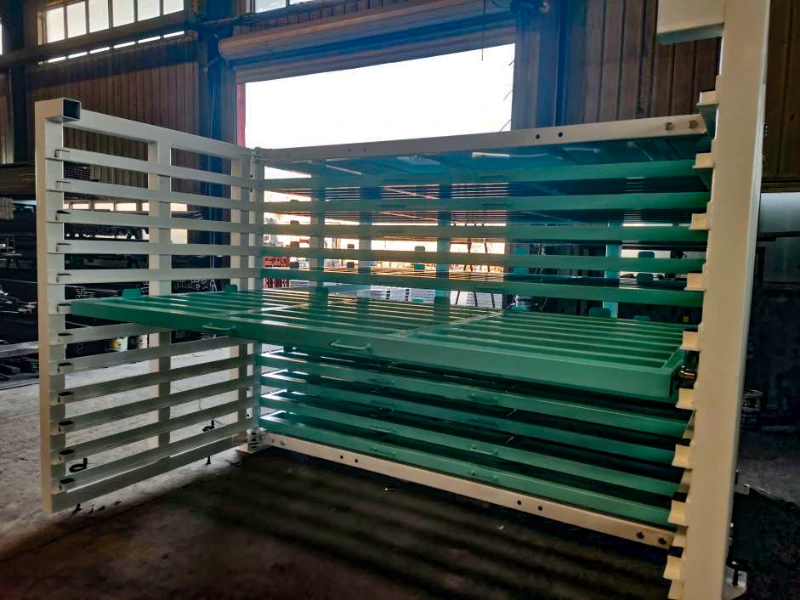
To thoroughly solve this problem, simply asking workers to “move faster” is ineffective. What companies need is a productivity system capable of systematically solving core operational bottlenecks—the horizontal sheet metal rack. It is not a simple shelving unit; it reshapes the on-site action chain through specific mechanical structures:
100% Fully Extendable Drawer-Style Design
The horizontal sheet metal rack utilizes a modular main frame and multi-hole support angle steel, housing drawers equipped with high-quality double-bearing T-shaped rolling wheels. Every drawer can be pulled out 100% independently. This means that no matter which level the sheet metal is stored on, operators can access single sheets directly without obstruction. This completely eliminates the “restacking” step, making the material waiting time for laser cutters approach zero.

Mechanical Transmission for Single-Person Heavy-Duty Operation
For heavy sheet metal that often weighs several tons, this system designs a hand-cranked mechanical transmission mechanism with bevel gears and a drive shaft for scenarios over 1.5 tons. Through speed reduction and torque multiplication, a single person can safely and easily crank out a drawer weighing up to 3 tons, bidding farewell to strenuous multi-person manual handling.
Vertical High-Density Storage Frees Up Space
By extending materials that were originally laid flat on the ground upwards, it can free up to 80% of the floor space, making the crowded workshop spacious and orderly again.

After deploying the sheet metal racks, the on-site action chain becomes extremely streamlined: workers walk to the corresponding storage location, a single person pulls or cranks out the target drawer, uses a jib crane to directly extract the target sheet metal and feed it into the cutter, and finally pushes or cranks the drawer closed.
Solution Implementation Boundaries: What Supporting Conditions Are Required?
As a strategic asset investment with a design life of over 10 years, horizontal sheet metal racks are not suitable for every situation. Before evaluating their introduction, you must understand their rigid implementation thresholds:
- Must Have Supporting Lifting Equipment: The rack itself does not possess lifting capabilities. Daily operations must be paired with an overhead crane or a jib crane (equipped with vacuum suction cups or steel plate clamps) to extract sheet metal from the drawers, and arrival unloading must also be equipped with an appropriately sized forklift and a depalletizer.
- Strict Overhead Clearance Requirements: You must ensure the workshop ceiling has sufficient clearance for hoisting operations. To prevent lifting spreaders from colliding during operation, a safety distance of at least 1 meter must be reserved between the top of the rack and the workshop ceiling (including pipes and beams).
- Not Suitable for Static Dead Storage: Compared to traditional floor stacking on wooden pallets, it has a higher initial procurement cost. If your factory’s material specifications are extremely uniform and mainly involve purely passive static storage with full stacks moving in and out, then this solution might be performance overkill; you would be better suited for traditional cantilever racks.

FAQ and Common Misunderstandings
Q: Our sheet metal plates weigh several tons. Can one person really pull the drawer?
A: For light loads of 0-1.5 tons, hand-pull styles can be recommended; but for heavy-load scenarios of 1.5 to 3 tons, a hand-cranked mechanism equipped with reduction gears must be used, allowing a single person to crank it out easily. It is strictly forbidden to force the use of a hand-pull structure in heavy-load scenarios.
Q: Can sheet metal of varying thicknesses fit? What if we have new specifications later?
A: The rack is equipped with multi-hole support angle steel, and the level spacing can be fully customized and flexibly adjusted according to the sheet metal thickness. Its main and sub-frame connection design also makes it easy to expand capacity at a lower cost in the future.
Q: When multiple thin sheets are stacked together, what if they stick together during extraction?
A: In real factory coordination, if magnetic steel plates stick together during extraction, a magnetic sheet separator is required to break the vacuum suction; for aluminum or stainless steel plates, an impact chisel can be used manually to create a gap for separation.
Q: Can the rack be customized for our standard 4’x8′ or 5’x10′ sheet sizes?
A: Absolutely. Every rack system is engineered to order. We design the drawer dimensions, number of levels, and overall height to perfectly match your most commonly used sheet sizes and your facility’s ceiling height, ensuring a perfect fit for your workflow.
Q: What is the maximum weight capacity per drawer? We work with thick steel plates?
A: Our standard drawers are rated for capacities from 1.5 tons (~3,300 lbs) up to 4.5 tons (~9,900 lbs). For applications requiring even higher capacities, our engineering team can design a custom-reinforced structure to safely meet your specific heavy-plate storage needs.

STOP IDLING YOUR MULTI-MILLION DOLLAR EQUIPMENT
“Waiting for materials” is not the destiny of metal fabrication, nor is a cluttered workshop unchangeable. To truly unleash the maximum potential of high-value processing equipment, lean warehouse management is the necessary path. How much production capacity does your workshop’s laser cutter lose every day due to material searching? Contact our team today for a free OEE improvement potential assessment.

 EN
EN  DE
DE  RU
RU  NL
NL  PT
PT  JA
JA  ES
ES  IT
IT