

|
For decades, the cantilever rack has been the default storage solution for metal service centers and fabricators. While effective for long pipes, its application for sheet metal often results in significant “dead space” due to the forklift maneuvering room required. As facility costs rise, the inefficiencies of this legacy system are becoming harder to ignore. This article provides a comparative analysis between traditional cantilever systems and the modern Roll-out-Blechregal. We quantify the differences in aisle width requirements, picking selectivity, and material damage rates to determine which system offers a superior Return on Investment (ROI). |
The “Dead Space” of Aisle Widths
The hidden cost of any cantilever system is the empty floor space in front of it. To load a 3-meter wide sheet onto a cantilever rack, a forklift typically requires an aisle width of 4 to 6 meters to perform a 90-degree turn. This means the service aisle often consumes more square footage than the storage unit itself.
In contrast, a Roll-out-Blechregal loads vertically via an overhead crane. The drawer extends forward, not sideways. Consequently, the required workspace is merely the depth of the drawer (approx. 1.5 – 2 meters) plus a safe walkway for the operator. This architectural difference allows fabricators to place racks much closer to cutting machinery or walls, reclaiming up to 60% of the floor space previously dedicated to forklift turning circles.
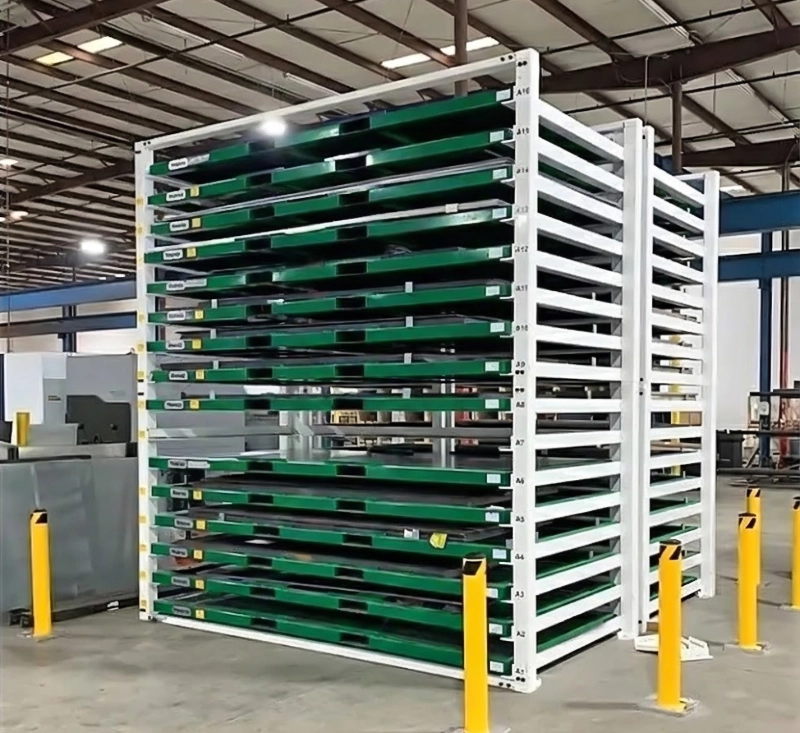
Comparison: High-density stacker systems utilize verticality without the wide aisle requirements of cantilever arms.
Selectivity: 100% vs. “Buried” Stock
Cantilever racks store materials in deep stacks. To access a bundle on the bottom shelf, a forklift driver must first move the bundles above it or attempt to carefully slide the forks underneath, often blindly. This process, known as “double handling,” is a major source of labor inefficiency.
The drawer mechanism of the roll-out rack provides “100% Selectivity.” Every drawer acts as an independent shelf that can be accessed without moving any other stock. Whether the operator needs the top sheet or the bottom sheet, the retrieval time is identical—typically under 2 minutes. This creates a “Random Access” inventory model that supports high-mix production schedules far better than the “Last-In-First-Out” constraints of cantilever stacking.
Structural Rigidity and Material Protection
Cantilever arms are designed to flex under load. Over time, this deflection can cause sheets to sag, creating a permanent curvature (“bowing”) in the metal, particularly with thinner gauges of aluminium or stainless steel. Additionally, the open sides of cantilever racks expose stock to accidental side-swipes from passing forklifts.
Roll-out racks feature a fully supported, four-sided steel frame for each drawer. This rigid base ensures that sheets remain perfectly flat, preserving the material’s integrity for laser cutting. The enclosed nature of the cabinet-style design also protects high-value inventory from shop dust and impact damage.

The enclosed structure offers superior protection against impact and dust compared to open cantilever arms.
Häufig gestellte Fragen
Can roll-out racks hold as much weight as cantilever racks?
Yes. A standard heavy-duty cantilever arm might hold 1,000 kg. In contrast, a single roll-out drawer is engineered to hold up to 5,000 kg. A single tower unit can carry a total load of 20-40 tons, matching or exceeding the density of cantilever systems.
Is the roll-out system more expensive?
The initial hardware cost per storage position is typically higher than basic cantilever racking. However, when factoring in the reduction in forklift labor, the elimination of damaged material, and the value of reclaimed floor space, the Total Cost of Ownership (TCO) is often lower over a 2-year period.
Do I need to replace my forklifts to use this system?
No. The roll-out system actually reduces the need for specialized forklifts (like Combilifts or sideloaders) often required for narrow-aisle cantilever setups. Standard forklifts can be used for loading, or you can switch entirely to overhead cranes.
Can I store varying lengths of sheet in the same rack?
Unlike cantilever racks where arms can be adjusted horizontally, roll-out drawers have fixed dimensions (e.g., 3m or 6m). It is recommended to size the rack for your longest material. Shorter sheets can be stored in longer drawers without issue.
How does installation time compare?
Roll-out racks are modular and often arrive partially pre-assembled or in flat-pack kits that bolt together quickly. Installation is generally faster and less invasive than anchoring large cantilever uprights and bracing.
Möchten Sie mehr über unsere Produkte erfahren?
“Don’t hesitate to contact us now! Our professional team is ready to answer any questions you may have—and we’re ready to provide a free, tailored solution just for you.”

 EN
EN  DE
DE  RU
RU  NL
NL  PT
PT  JA
JA  ES
ES  IT
IT