
|
In heavy fabrication workshops, the process of moving 5-ton steel plates with an overhead crane is a daily necessity fraught with risk and inefficiency. Traditional floor stacking forces operators into hazardous positions and wastes valuable production time. This article explores a structural solution that transforms crane loading from a dangerous bottleneck into a safe, streamlined, one-person operation, directly addressing the core EHS and productivity challenges faced by heavy equipment manufacturers. |
The Hidden Dangers of Handling Heavy Plate Steel
For facilities manufacturing parts for agricultural machinery, construction equipment, or automotive frames, handling thick, heavy steel plate is standard procedure. However, the common practice of stacking these materials on the floor or in static racks introduces significant operational risks. Operators often have to climb onto stacks to attach lifting gear or use pry bars to separate plates, creating scenarios ripe for crushing injuries and falls. This process is not only a direct violation of many OSHA safety standards but also incredibly inefficient. To access a plate at the bottom of a stack, multiple other multi-ton plates must first be moved, consuming crane time and halting production at downstream workcells like large-format laser cutters or press brakes.
Transforming Crane Access with a Dynamic Storage System
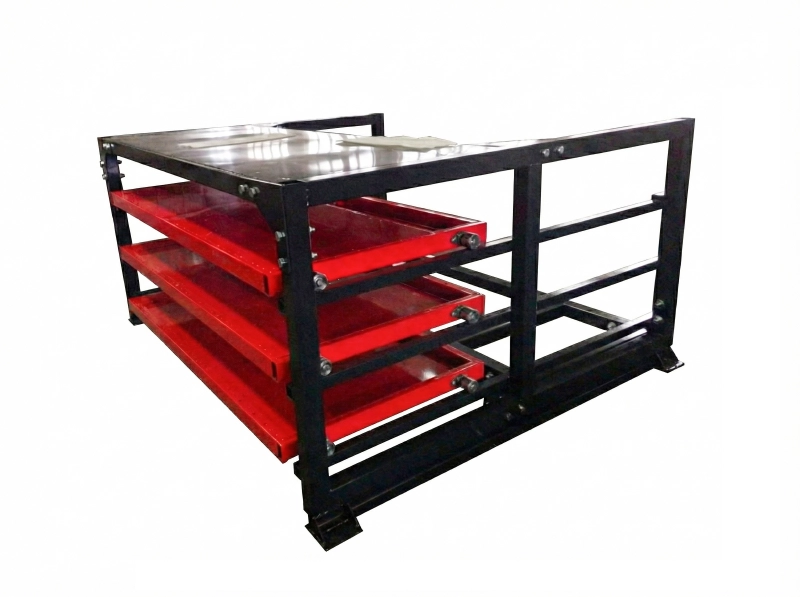
The solution lies in shifting from static, layered storage to a dynamic, accessible system. A Schwerere metallplatten with fully extendable drawers fundamentally changes the interaction between the operator, the crane, and the material. This isn’t just a better shelf; it’s a re-engineered workflow.
Achieving Unobstructed Vertical Access with 100% Extension
The primary advantage of this design is the ability for each drawer to roll out completely from the main frame. When a 5-ton capacity drawer is fully extended, the material it holds is completely clear of the rack structure above it. This creates an unobstructed zone for Overhead Crane Loading. The crane hook, equipped with a vacuum lifter or clamps, can descend vertically and engage the plate directly. This eliminates the dangerous practice of “side-pulling” or trying to maneuver slings underneath a partially accessible plate, dramatically improving safety and precision.
Mechanical Advantage: Moving 5 Tons with a Single Hand
The idea of a single person moving several tons of steel seems impossible, but it’s achieved through a simple and robust engineering principle: the gear and rack system. A hand-operated crank is connected to a transmission shaft with pinion gears. These gears engage with a rack fixed to the bottom of each drawer. With a precisely calculated gear ratio, typically 1:1.5, the operator’s input force is multiplied. This mechanical advantage makes moving a fully loaded, 5000 lbs drawer capacity shelf smooth and effortless. This removes the need for brute force and allows for precise positioning of the material for crane access.

Engineered Stability and Anti-Tip Safeguards
Extending a multi-ton load creates a significant tipping force. A professionally engineered system accounts for this with multiple safety layers. The frame, constructed from high-strength Q235 Carbon Steel, is designed to be anchored directly to a C30-grade concrete floor with chemical anchor bolts. This creates a solid foundation that counteracts the cantilevered load. Furthermore, each drawer is equipped with mechanical stoppers and limit wheels that prevent over-extension and ensure it travels smoothly along its designated track, guaranteeing stability even under maximum load conditions.
The Ripple Effect: How Safer Handling Boosts Your Bottom Line
Adopting a system that prioritizes safe and efficient crane access delivers benefits far beyond the storage bay. By reducing material retrieval time from 15-20 minutes to under 2 minutes, you directly increase the uptime of your most valuable production machinery. Eliminating the need to shuffle plates prevents surface scratches and edge damage, reducing scrap rates on expensive materials. Most importantly, creating a demonstrably safer work environment not only protects your team but also simplifies EHS compliance, reduces insurance liabilities, and builds a culture of operational excellence essential for any serious heavy equipment manufacturer.
Häufig gestellte Fragen
1. What is the typical weight capacity for a heavy-duty roll-out drawer?
Standard heavy-duty configurations are designed to handle loads from 3,000 lbs (1.5 tons) to over 10,000 lbs (5 tons) per drawer, making them suitable for the thickest steel plates used in heavy machinery fabrication.
2. Can these racks be customized for non-standard plate sizes?
Yes. A key advantage of these modular systems is their ability to be customized. Drawer dimensions (length and width) can be engineered to match specific material sizes, such as 1500x3000mm or 2000x6000mm plates.
3. Is special training required to operate the crank system safely?
Operation is intuitive, but basic safety training is crucial. The most important rule is the “one-drawer-at-a-time” principle. Operators must be trained to never extend more than one loaded drawer simultaneously to maintain the rack’s center of gravity and ensure stability.
4. How does this system compare to a heavy-duty cantilever rack for crane access?
While a cantilever rack allows crane access to the top level, it makes accessing lower levels extremely difficult without first removing all material above. A roll-out rack provides independent, 100% access to every single level, making it far more efficient for operations that require frequent access to a variety of material thicknesses.
5. What kind of maintenance is required?
Maintenance is minimal due to the robust mechanical design. It typically involves a quarterly inspection of bolts and anchors for tightness and the application of industrial grease to the gear, rack, and bearing components to ensure smooth, low-friction operation.

 EN
EN  DE
DE  RU
RU  NL
NL  PT
PT  JA
JA  ES
ES  IT
IT