

Your multi-million dollar laser cutter is idle again. Not because of a complex job or maintenance, but because your operator is carefully navigating a forklift, shuffling through stacks of pallets to find that one specific gauge of 5052 aluminum sheet buried at the bottom. Every minute it waits is a direct hit to your workshop’s profitability and extends your lead times. It’s time to stop the “pallet shuffle” and feed your machines at the speed they were designed to run.
The Real Cost of Floor Stacking in a Modern Fabrication Shop
In any high-performance Das ist was anderes als die wellblech. workshop, from Melbourne to Milwaukee, the workflow is king. Yet, the most common bottleneck isn’t the CNC machine—it’s the disorganized pile of raw materials feeding it. Stacking aluminum, stainless, and mild steel sheets on wooden pallets directly on the floor seems like a simple, low-cost solution. In reality, it creates a cascade of hidden costs that erode your margins daily.

Before: The familiar chaos of floor-stacked sheets leads to inefficiency and safety risks.
Consider this typical scenario:
- Machine Starvation: Your laser cutting machine or turret punch press sits idle while an operator spends 15-20 minutes carefully unstacking three pallets to get to the required material. This isn’t just lost time; it’s lost production capacity and a direct blow to your machine’s OEE (Overall Equipment Effectiveness).
- Materielle Schäden: Every time a heavy pallet is moved, there’s a risk of scratching or denting the sheets below. For high-value materials like polished stainless steel or anodized aluminum, a single deep scratch can render an entire sheet useless, turning profit into scrap.
- Safety Hazards: Maneuvering a forklift in tight spaces to lift and move unstable stacks of heavy metal sheets is one of a workshop’s highest-risk activities. It’s a constant worry for warehouse managers and a potential source of costly workplace accidents.
- Wasted Space: Spreading pallets across your valuable floor space consumes an enormous footprint. That’s area that could be used for a new welding station, a quality control bay, or simply to improve workflow and reduce congestion.
From Chaos to Clockwork: The Aluminum Sheet Storage Drawer System
The solution lies in shifting from passive, horizontal stacking to active, vertical management. An Aluminium in eine schublade, also known as a roll-out sheet rack, is not just a piece of equipment; it’s a new operational philosophy for your raw materials. It’s engineered specifically to eliminate the bottlenecks inherent in traditional storage.
100% Selectivity: End the “Pallet Shuffle” Forever
The core of the system is its drawer-based design. Each drawer can be fully extended, providing 100% direct access to the sheets stored within.

100% drawer extension provides immediate, unobstructed access to any sheet.
This simple mechanical advantage has a profound impact on your workflow. Need the 1/8″ 304 stainless sheet from the fourth level down? No problem. A single operator can extend that specific drawer in under a minute, ready for the overhead crane or vacuum lifter. The “digging” and “shuffling” process is completely eliminated, reducing material retrieval time by up to 90%.
Vertical Density: Reclaim Your Workshop Floor
By utilizing vertical space, a drawer system can store the same amount of material in as little as 20% of the floor space required by pallet stacking. Imagine freeing up hundreds of square feet in your workshop. This isn’t just about tidiness; it’s about unlocking potential. That reclaimed space is now available for revenue-generating activities, allowing you to expand your capabilities without expanding your building.
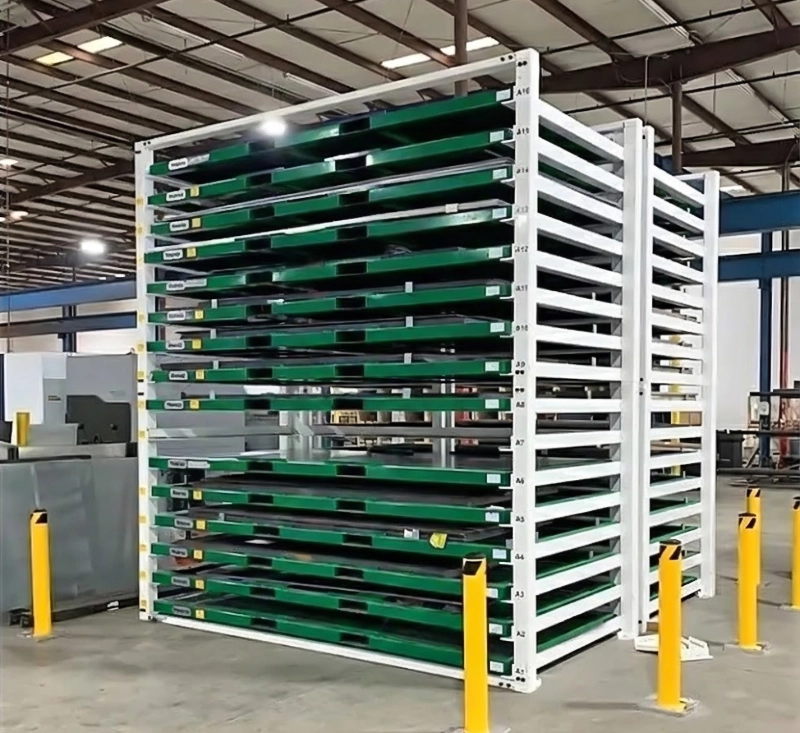
Maximize your vertical cube to free up valuable production floor space.
The Tangible ROI: Boosting Throughput and Protecting Profits
Investing in a proper Das ist dann das wellblech im lagerhaus system delivers a clear and measurable return. By transforming your material handling from a chaotic liability into a streamlined asset, you directly impact your bottom line.
| Pain Point Addressed | Structural Feature | Quantifiable Business Impact |
|---|---|---|
| Idle Laser Cutter (Machine Starvation) | 100% Pull-Out Drawers | Increases daily machine uptime by 1-2 hours, directly boosting output and revenue per machine. |
| Scratched/Damaged Sheets | Individual, Protected Drawers | Reduces scrap and material damage costs by over 95%, protecting high-value inventory. |
| Inefficient Labor Use | Ergonomic Single-Person Operation | Reduces material handling labor by 50-66%, freeing up skilled operators for value-added tasks. |
| Wasted Floor Space | High-Density Vertical Design | Saves up to 80% of storage floor space, deferring or eliminating the need for costly facility expansion. |
Engineered for Your Specific Workflow
Not all fabrication shops are the same. That’s why these systems are not one-size-fits-all. They are configured to match your specific materials, equipment, and processes.
- Manuelle schublade: For heavy plates up to 6,600 lbs (3,000 kg), a mechanical hand-crank mechanism allows a single operator to safely and effortlessly move the drawer without needing a forklift.
- Full Forklift Access: In high-volume environments, the entire drawer can be designed as a heavy-duty pallet. A forklift can remove the entire drawer, transport it to a processing cell, and return it, creating an incredibly efficient bulk-handling workflow.
- Custom Dimensions: Racks are built to your specifications, perfectly accommodating standard sheet sizes (e.g., 4’x8′, 5’x10′, 2m x 4m) and custom dimensions, ensuring no wasted space.

Full forklift-accessible models streamline the entire material flow from receiving to production.
By implementing an organized, efficient, and safe storage system, you’re not just buying a rack. You’re investing in higher throughput, better quality control, a safer workplace, and the capacity for future growth.
Frequently Asked Questions for Sheet Metal Fabricators
1. Can the drawers be customized to fit our standard 5′ x 10′ aluminum sheets?
Absolutely. Every system is engineered to order. We design the drawer width and depth to perfectly match your most common sheet sizes, including 4’x8′, 5’x10′, and any other metric or imperial dimensions, ensuring optimal space utilization.
2. What is the weight capacity per drawer? We handle heavy steel plate up to 3/4 inch thick.
Standard drawer capacities range from 3,000 lbs up to 10,000 lbs (approx. 1.5 to 4.5 metric tons). For materials like 3/4″ steel plate, we would engineer a heavy-duty drawer, likely with a hand-crank mechanism, to ensure safe and easy single-person operation.
3. How does the rack integrate with our existing overhead crane and vacuum lifter?
The system is designed for seamless integration. The 100% pull-out drawer brings the entire stack of sheets clear of the rack’s frame, providing full, unobstructed overhead access for any crane, jib crane, or vacuum lifting device, making loading and unloading safe and efficient.
4. We work with expensive, polished stainless steel. Will the drawers scratch the bottom sheet?
This is a critical consideration. The drawer beds are flat and smooth steel surfaces. For delicate materials, we can offer options such as UHMW (Ultra-High-Molecular-Weight) plastic liners or wooden surfaces to provide a non-marring, protective layer that prevents any metal-on-metal contact and preserves the finish of your most sensitive sheets.
5. We’re tight on space. How much floor area can we realistically save?
On average, customers save between 70% and 80% of the floor space previously dedicated to flat-stacking pallets. For example, the material that once occupied a 500 sq. ft. area can often be consolidated into a vertical rack system with a footprint of just 100-120 sq. ft., freeing up significant space for production.

 EN
EN  DE
DE  RU
RU  NL
NL  PT
PT  JA
JA  ES
ES  IT
IT