

Stop scratching your 316L hygienic tubes.
In a high-end steel service center, capacity isn’t just about weight—it’s about accessibility and surface integrity. If you are still digging through stacks of polished stainless steel with a forklift, you are bleeding money on scrap and labor. Discover how a high-capacity rolling system transforms your workflow from a 15-minute ordeal to a 2-minute precision operation.
Defining True “Capacity” in Steel Service Centers
When we discuss Heavy duty rolling cantilever rack capacity, most facility managers at steel service centers immediately think of static load: “How many pounds per arm?” While our Tcrack system is engineered to handle massive loads—up to 13,200 lbs (6,000 kg) per level—raw weight is only half the equation.
For distributors handling high-value assets like hygienic stainless steel components, ASME BPE standard tubes, or precision ground bar stock, “capacity” must also include throughput capacity und storage density. Traditional static cantilever racks restrict you to the limitations of your forklift’s mast height and turning radius.
Benedikte und daraus machte sich Teleskop-Kragarmregal, you convert “dead air” into active storage. You aren’t just storing weight; you are storing value without the risk of “honeycombing” your inventory.
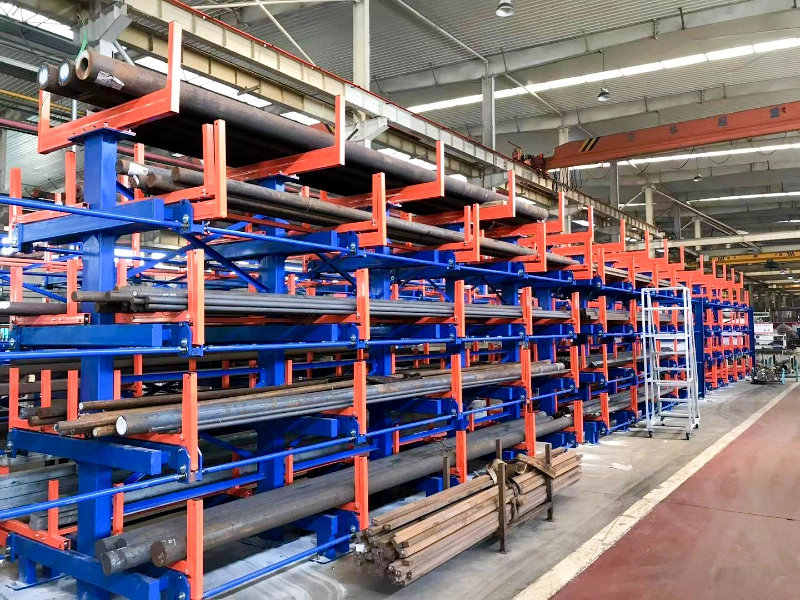
Figure 1: High-density storage of heavy solid round bars in a multi-level rolling system, anchored for maximum stability.
The “Overhead Crane” Advantage: Zero Forklift Dependence
The primary bottleneck in handling 20-foot or 40-foot tube bundles is the forklift. Maneuvering a long load through narrow aisles is a safety nightmare and often results in the “spearing” of adjacent bundles.
The rolling cantilever design allows for 100% extension of the rack arm. This exposes the entire bundle to the aisle, removing all overhead obstructions. This feature is critical for facilities using Overhead Cranes or Vacuum Lifters. Instead of dragging materials out, your operator simply cranks the drawer open and lifts the material vertically.
This “Pick-and-Lift” method is the only way to ensure the surface finish (Ra) of delicate materials like electropolished tubes remains within spec.

Figure 2: An overhead crane vertically lifting a bundle of tubes from a fully extended rack drawer—zero friction, zero damage.
Technical Architecture: How One Person Moves 10,000 Lbs
You might wonder how a single operator can move a rack level loaded with 5 tons of solid steel bars without hydraulic assistance. The secret lies in the Rack and Pinion transmission system combined with precision-machined bearings.
The Mechanics of Motion
- Transmission Shaft: A solid steel shaft connects all uprights (whether 3, 4, or 8 columns), ensuring that when the handle is turned, torque is applied evenly across the entire length of the rack. This prevents the “crabbing” or jamming effect common in cheaper drawer systems.
- Gear Reduction: The crank mechanism utilizes a specific gear ratio that amplifies human force, allowing a standard operator to generate enough torque to roll out a fully loaded arm with minimal effort.
- Safety Interlocks: To prevent tipping, the system includes a mechanical interlock that allows only one level to be extended at a time, keeping the center of gravity within the base footprint.

Figure 3: Close-up of the transmission shaft and bearing housing that ensures smooth, synchronized movement of heavy loads.
ROI Analysis: Rolling Rack vs. Static Rack
For a Steel Service Center, floor space is a fixed cost, but inventory density is variable. Switching from static aisles to a Crank-out Cantilever system yields immediate operational gains.
| Metrisch | Static Cantilever Rack | Tcrack Rolling System |
|---|---|---|
| Aisle Width Required | 12ft – 20ft (Forklift turning radius) | 4ft – 6ft (Person/Crane access only) |
| Handling Method | Forklift (High risk of collision) | Overhead Crane / Vacuum Lifter |
| Retrieval Time | 15-20 Mins (Digging for bottom stock) | < 2 Mins (Direct access) |
| Schädigung der oberfläche. | High (Sliding friction & fork impact) | Zero (Vertical lift, non-contact) |

Figure 4: The narrow aisle advantage—maximizing floor space by eliminating the need for wide forklift corridors.
Solving the “Long Stock” Deflection Issue
When storing flexible materials like small-diameter stainless steel tubing or aluminum profiles over 20 feet long, sagging is a major concern. Permanent deflection ruins the straightness tolerance required for CNC machining.
Our rolling capacity is not just about the *arm* strength, but the *system* rigidity. By utilizing an 8-upright configuration (as opposed to the standard 3 or 4), we reduce the unsupported span of the material. This ensures that your precision ground bars remain perfectly straight, even when stored for months. The synchronized drive shaft ensures that all 8 arms extend in perfect unison, preventing the material from twisting during the rollout phase.
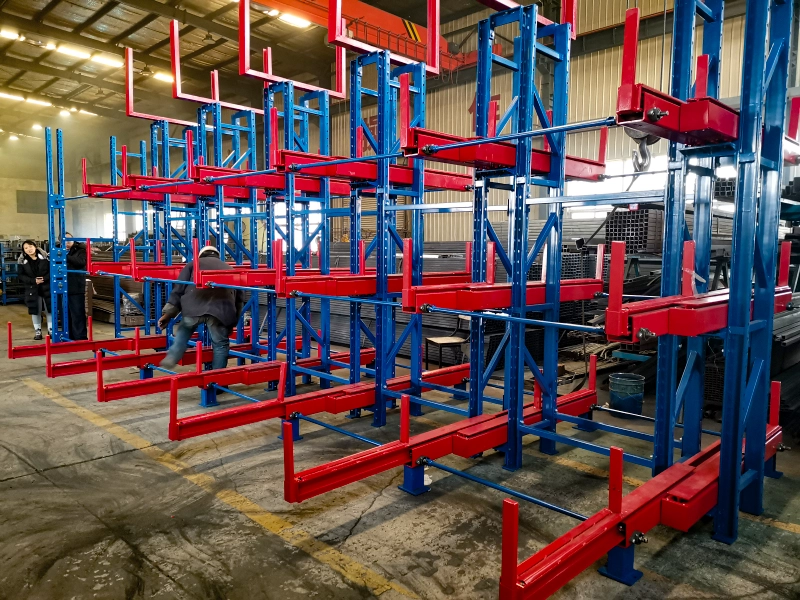
Figure 5: An 8-column system designed specifically for 12-meter long material to prevent sagging and ensure safe retrieval.
Häufig gestellte Fragen
1. Can we store 316L stainless steel directly on the arms without contamination?
We recommend and provide optional polymer or wood-lined arm covers. This isolates your carbon steel rack from your stainless inventory, preventing iron contamination and galvanic corrosion.
2. What is the maximum length of tube bundles this system can handle?
The system is modular. We have deployed solutions for material lengths up to 40 feet (12 meters) by increasing the number of upright columns and synchronizing the transmission shafts.
3. Does the “Heavy Duty” rating apply to the arm fully extended?
Yes. The rated capacity (e.g., 6,000 kg per level) applies to the dynamic load when the arm is 100% extended. The structural base and bearings are engineered to handle the cantilevered moment arm at full extension.
4. Can this system integrate with our existing Amada laser cutting cell?
Absolutely. Many Steel Service Centers place these racks directly next to the laser or saw infeed. The crane picks the material from the rack and places it directly onto the machine shuttle table, acting as a “Point of Use” buffer.
5. Is floor reinforcement required for installation?
Typisch industriefußböden (stahlbeton Von sechs bis acht zoll) sind in der regel genug. Aber wegen der geringen größe und der leistung bieten wir ihnen genaue berechnungen zur fehlertoleranz vor der installation.

 EN
EN  DE
DE  RU
RU  NL
NL  PT
PT  JA
JA  ES
ES  IT
IT