

Handling 6-meter (20ft) bar stock shouldn’t paralyze your warehouse operations. If your forklift drivers are spending 20 minutes “digging” out a bundle of 1018 steel from the bottom of a stack, you are bleeding labor costs. Switch to a system that allows 100% overhead crane access and cuts retrieval time to under 2 minutes.
The “Dead Stock” Dilemma in Metal Service Centers
If you are managing a steel service center or a heavy fabrication shop, the 6-meter (approx. 20-foot) bar is your standard unit of measure—and your biggest headache. Whether it’s hollow structural sections (HSS), solid round bars, or aluminum extrusions, the length creates a massive logistical challenge.
In traditional setups, you likely rely on floor stacking or static cantilever racking. The problem? Selectivity. To get to the specific heat number or alloy grade buried at the bottom level, your team has to move the top three bundles. This creates a dangerous “shuffle” in the aisle, risks bending the material, and ties up your forklift for extended periods. The bottom bundles often become “dead stock” simply because they are too difficult to access.

By eliminating the forklift turning radius required for 6m bars, Tcrack systems reduce aisle width to just a few feet, maximizing vertical density.
Why Roll-Out Technology Changes the Game
The solution lies in changing the mechanics of storage. A Teleskop-Kragarmregal (often called a crank-out rack) functions like a heavy-duty industrial drawer. Instead of a fixed arm, the cantilever arm is mounted on a rack-and-pinion gear system.
1. 100% Extension for Overhead Crane Access
This is the critical differentiator. With a standard static rack, you must use a forklift to spear the load from the side. This requires wide aisles (often 15-20 feet) to maneuver a 20-foot load.
With a roll-out system, the entire storage level extends 100% out into the aisle. Once extended, the material is completely exposed from above. This allows you to use your facility’s overhead crane or jib crane to pick the bundle directly. The crane takes the weight, not the forklift, significantly reducing the risk of tipping accidents.

The “Tcrack” system allows for direct vertical picking via overhead crane, bypassing the need for forklifts in long-bar handling.
2. Preventing Deflection in Long Stock
A common concern with 6m or 12m bars is sagging (deflection), particularly with pliable materials like aluminum profiles or small-diameter copper tubing. If the support points are too far apart, the material bows, causing permanent deformation.
Unser Der kurbel ragte in das auslegerregal systems are engineered with specific column spacing to mitigate this. For example, for a 12-meter application, we utilize an 8-column design. This dense support structure ensures that even when the rack is fully extended under a 6,000kg load, the transmission shaft keeps all arms perfectly synchronized, preventing the “skewing” that can jam lesser quality racks.
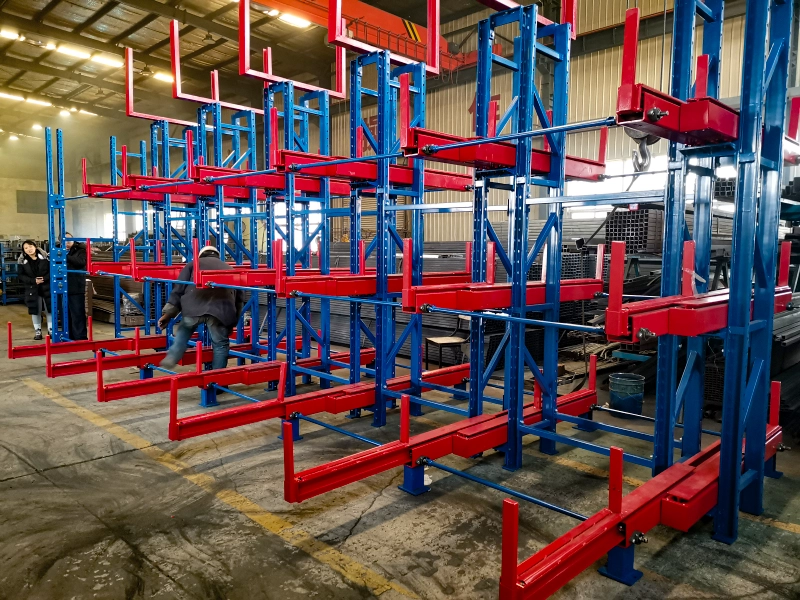
A multi-column (8-post) configuration ensures that 6m and 12m bars remain straight without sagging, preserving material integrity.
Preserving Surface Quality: 316L Stainless and Aluminum
In industries like aerospace or food-grade manufacturing, a scratch on a polished 316L stainless steel tube is not just a cosmetic flaw—it’s a scrapped part. Traditional “digging” with forklift tines is the primary cause of surface damage in metal warehouses.
The roll-out design allows for “Touchless Handling.” The material is lifted vertically by nylon slings or a vacuum lifter attached to the crane. There is no sliding of metal-on-metal. Furthermore, the arms can be fitted with UHMW plastic or rubber strips to ensure that your high-value inventory never touches bare carbon steel, preventing iron contamination and galvanic corrosion.

Note the stop blocks and organized separation. This ensures specific SKUs can be accessed without moving adjacent materials.
Technical Comparison: Static vs. Roll-Out
Is the investment justified? Review the operational metrics below regarding the handling of 6m bar stock.
| Feature | Bodenstapelung | Static Cantilever | Tcrack Roll-Out Rack |
|---|---|---|---|
| Aisle Width Req. | 15-20 ft (Forklift Radius) | 12-15 ft (Forklift Radius) | 5-6 ft (Man/Crane Only) |
| Retrieval Time | 15-20 Minutes (Digging) | 5-10 Minutes | < 2 Minutes |
| Handling Method | Wie ein gabelstapler. | Wie ein gabelstapler. | Overhead Crane / Hoist |
| Damage Risk | High (Crushing/Scraping) | Medium (Insertion Error) | Near Zero (Vertical Lift) |
| Max Load (Per Arm) | K.A. | Varies | Up to 6,000kg (13,200 lbs) |
Häufig gestellte Fragen
1. Can this system handle lengths longer than 6 meters?
Yes. While 6m (20ft) is standard, our modular design supports 12m (40ft) and beyond. We simply add more vertical columns and synchronize the transmission shaft to ensure the entire length rolls out evenly without binding.
2. What is the weight capacity per drawer level?
Our heavy-duty models are engineered for extreme loads. A single level can support up to 6,000kg (approx. 13,200 lbs) or more, depending on the arm length and material specifications. This is ideal for solid steel bars or thick-walled pipes.
3. Do I need electrical power to operate the racks?
Not necessarily. The standard Tcrack system uses a mechanical crank with a high gear ratio, allowing a single operator to move tons of material with one hand. However, for high-frequency or ultra-heavy applications, we offer electric motor-driven options with remote control.
4. How is the rack anchored to the floor?
Safety is paramount. The racks are secured using heavy-duty chemical anchors or expansion bolts, typically requiring a concrete depth of 150-200mm. The base is designed to distribute the dynamic load of the extended drawer effectively.
5. Can I store mixed lengths on the same rack?
Yes. Because the arms provide continuous support (especially in multi-column configurations), you can store a 3m cutoff on the same level as a full 6m bundle, provided the weight is distributed safely.

 EN
EN  DE
DE  RU
RU  NL
NL  PT
PT  JA
JA  ES
ES  IT
IT