
|
In heavy fabrication, managing 3-ton to 5-ton steel plates is a daily battle against inefficiency and risk. Floor stacking creates hidden dangers and operational bottlenecks, forcing skilled operators to spend valuable time digging for materials instead of running machines. A modern approach transforms this chaotic ground-level storage into a controlled, high-density system, directly integrating with existing overhead cranes to create a safer and more productive workflow. |
Heavy Plate Storage: Taming 5-Ton Steel with Crane-Ready Racks
For workshops specializing in heavy equipment, shipbuilding, or large-scale structural fabrication, handling massive steel plates is a constant challenge. The conventional method of stacking these plates on the floor or on static A-frames is not just inefficient; it’s a significant source of operational risk and hidden costs. Every time an operator needs a plate from the bottom of the stack, a time-consuming and hazardous “dig-out” operation begins, tying up both personnel and valuable crane time.
The Hidden Costs of Floor-Stacked Heavy Plate
Relying on floor stacking introduces several critical issues that directly impact profitability and safety. The most apparent is the risk to personnel. Operators often have to climb onto unstable stacks or use pry bars to attach lifting gear, creating prime conditions for crush injuries and falls that are a major concern for any EHS (Environment, Health, and Safety) program. Furthermore, this method leads to significant material degradation. Plates at the bottom of a pile are susceptible to moisture, rust, and surface damage from the weight and friction of the plates above them. This seemingly “free” storage method quickly becomes expensive through material waste and lost productivity.
A Systemic Shift: From Static Piles to Dynamic, High-Capacity Access
The solution lies in shifting from a passive storage philosophy to an active, dynamic one. By converting horizontal floor space into organized vertical capacity, you can fundamentally change how materials flow through your facility. This is achieved through engineered systems designed specifically for extreme loads and integration with heavy lifting equipment.
Unlocking Vertical Space with 5-Ton Capacity Drawers
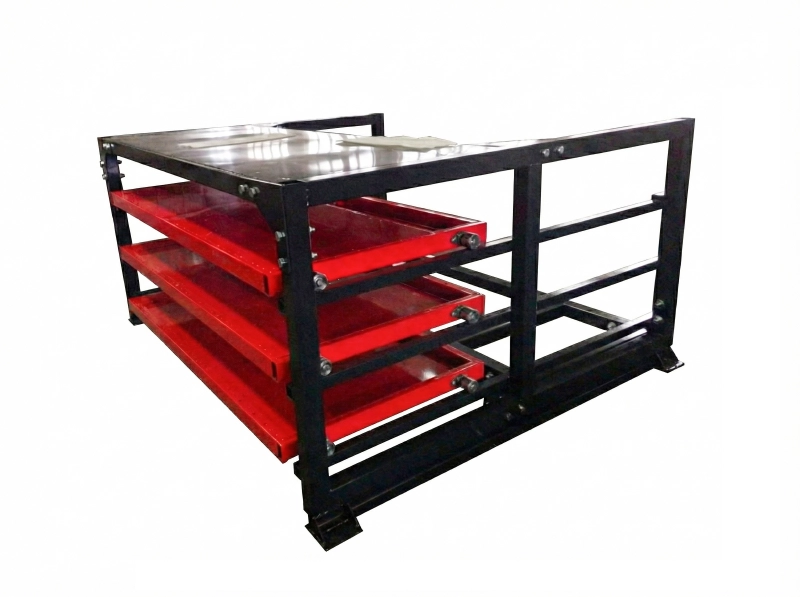
Modern Schwerere metallplatten systems are built from industrial-grade structural materials like Q235 carbon steel to handle immense loads. Each drawer is engineered as an independent, mobile platform with a 5000 lbs drawer capacity or more. This allows you to stack up to 10 layers of heavy plate in the same footprint that previously held only one or two, dramatically increasing your storage density and freeing up valuable floor space for more production machinery.

The Power of Mechanical Advantage: The Crank-Out System
Moving a multi-ton load should not require a forklift or excessive manpower. The core of this efficiency is a precision gear and pinion mechanism. By incorporating a gear ratio (e.g., 1:1.5), the system multiplies the force applied by a simple hand crank. This mechanical advantage allows a single operator to smoothly and safely extend a fully loaded, 5-ton drawer with minimal effort. This eliminates the need for dangerous pushing or pulling, making the process both ergonomic and safe.
Integrating with Your Workflow: Seamless Overhead Crane Access
The true value of an advanced storage system is its ability to integrate seamlessly into your existing production flow. For heavy fabrication, this means perfect compatibility with Overhead Crane Loading.
Eliminating Manual Handling Risks with 100% Extension
A key design feature is the ability for each drawer to extend 100% from the main frame. When a drawer is fully extended, the plate it holds is completely clear of the rack structure above it. This provides an unobstructed vertical path for an overhead crane hook and lifting magnets or clamps. Operators can stand safely to the side while the crane does all the work. This direct, vertical lift path eliminates the hazardous practice of dragging plates off a stack or using a forklift to dangerously “pick” at a plate, dramatically reducing the risk of accidents and meeting stringent safety standards.
Beyond Storage: Building a Safer, More Productive Fabrication Bay
Adopting a purpose-built crane loading rack is more than an investment in storage; it’s an investment in a safer, more organized, and more profitable operation. By providing immediate access to any plate, you reduce machine downtime spent waiting for materials. By protecting your raw materials in individual, accessible bays, you cut down on waste from damage and rust. Most importantly, by creating a controlled and ergonomic process for heavy material handling, you build a safer work environment that protects your most valuable asset: your team.
Häufig gestellte Fragen
1. What is the typical maximum load capacity per drawer for these heavy-duty racks?
These industrial storage systems are designed for extreme loads. Standard configurations often support 3,000 kg (approx. 6,600 lbs) to 5,000 kg (approx. 11,000 lbs) per drawer, with custom engineering available for even heavier applications common in the heavy equipment manufacturing sector.
2. Is it safe for one person to extend a drawer carrying 5 tons of steel?
Yes. The system’s safety is based on two principles: a gear reduction mechanism that makes the movement effortless and safe, and robust structural features. These include anti-tip anchoring systems that secure the rack to a concrete foundation and mechanical drawer interlocks that prevent more than one drawer from being opened at a time, ensuring stability.
3. How exactly does this rack system improve safety with overhead cranes?
It improves safety by creating a predictable and clear lifting zone. The 100% full-extension feature moves the entire plate away from the rack structure, allowing the crane’s lifting device to descend vertically without obstruction. This eliminates the need for workers to manually guide hooks under plates or stand in potentially hazardous zones, drastically reducing the risk of crush or pinch-point injuries.
4. What are the foundation requirements for installing such a heavy rack?
A stable foundation is critical. Installation typically requires a reinforced concrete floor, often C30 grade or higher, with a minimum thickness of 200mm (about 8 inches). The rack’s uprights must be securely fastened to the floor using heavy-duty chemical anchor bolts to counteract the tipping forces when a heavy drawer is extended.
5. Can these racks store items other than large steel plates?
Absolutely. While optimized for sheet and plate, their high-capacity, fully-extendable drawers are ideal for storing other heavy, bulky items. This includes large stamping dies, heavy molds, large fixtures, and other tooling that requires safe handling and crane accessibility.

 EN
EN  DE
DE  RU
RU  NL
NL  PT
PT  JA
JA  ES
ES  IT
IT