

In the steel service center business, the “cost” of a rack isn’t just the invoice price—it’s the cost of that 316L stainless steel tube you just scrapped because it got scratched during a forklift retrieval. It’s the cost of your Amada laser cutter sitting idle while your operator digs through a floor stack to find the right bar stock.
If you are handling high-value hygienic components, heavy wall pipes, or 40-foot structural beams, a Teleskop-Kragarmregal isn’t an expense; it’s a yield protection strategy. Let’s break down the real investment required.
The Price Tag vs. The Cost of “Floor Stacking”
When you ask “How much does it cost?”, the answer varies significantly based on your load requirements and automation level. However, to give you a baseline: a heavy-duty, manual crank-out bay typically requires a higher initial capital expenditure (CapEx) than static cantilever racking, often ranging from 2x to 3x the cost per bay.
But here is why metal fabricators pay it:
In a traditional static setup, you need a 12-foot to 20-foot aisle for your heavy-duty forklift to maneuver a 20-foot bundle of tubing. That is “dead air” you are paying rent on. With a Kurbel auslegersystem system an, you reduce that aisle to a mere walking path (approx. 4-5 feet). You are essentially buying back 50% of your warehouse floor to install more processing machinery.

Figure 1: Notice the narrow aisle width. By switching to overhead crane loading, you eliminate the massive turning radius required for forklifts.
Core Factors Influencing Your Quote
The price of your Tcrack system is engineered based on three primary variables specific to the steel industry:
1. Load Capacity & Arm Length (The “Sag” Factor)
Are you storing hollow aluminum profiles or solid stainless steel bars? The engineering changes drastically.
- Light Duty (approx. 1,000 – 2,000 lbs per arm): Uses standard Q235 steel components. Lower cost.
- Heavy Duty (4,000 – 13,000 lbs per arm): Requires high-grade structural H-beams and reinforced transmission shafts.
If you are storing 40-foot (12m) bundles, we must increase the number of columns (e.g., from 4 to 8 uprights) to prevent the material from deflecting (sagging) between arms. More steel = higher cost.
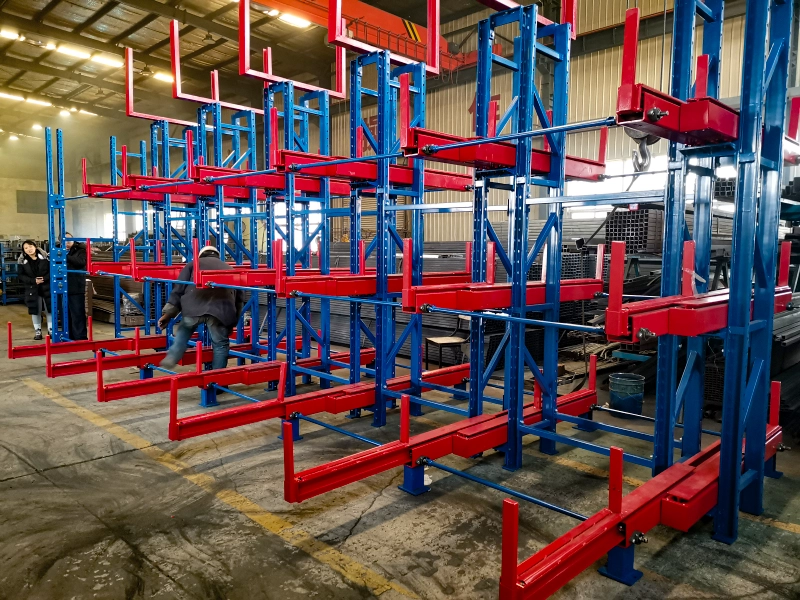
Figure 2: An 8-column system designed for 12-meter long materials. The density of uprights prevents expensive extrusion deflection.
2. The Drive Mechanism: Manual vs. Electric
This is the biggest price lever.
- Manual Crank (Standard): Uses a rack-and-pinion gear system with a reduction ratio. A single operator can move 6,000 lbs with about 30 lbs of hand force. This is the most cost-effective solution for low-to-medium turnover inventory.
- Electric/Motorized: Necessary for ultra-heavy loads or integration with automated saws. Adds costs for motors, control panels, and safety sensors.
| Feature | Manual Crank-Out | Electric Roll-Out |
|---|---|---|
| Primary Application | General Pipe/Tube Storage, Maintenance Shops | High-Volume Steel Service Centers, Die Storage |
| Cost Impact | Base Price | Base Price + 30-50% |
| Wartung | Low (Grease rack & pinion quarterly) | Medium (Motor & Sensor checks required) |

Figure 3: The manual ergonomic handle allows one operator to move tons of steel. This mechanical advantage keeps costs lower than fully motorized systems.
Hidden Savings: The “Crane Direct” Workflow
The sticker price of the rack ignores the operational savings. With Tcrack, the arms extend 100% out into the aisle. This allows your Overhead Crane to access every single stick of pipe directly.
The Math of Efficiency:
- Zero “Digging”: No more moving the top three bundles to get to the bottom one. This reduces retrieval time from 20 minutes to 2 minutes.
- Damage Reduction: When you drag a bundle of stainless steel out of a pigeonhole rack, you risk surface scratches. Scratched hygienic tubing is scrap. Vertical crane lifting eliminates friction damage.

Figure 4: 100% extension allows for overhead crane access. This eliminates forklift damage and speeds up changeovers for laser cutters.
Logistics & Installation Costs
Finally, consider how the rack gets to you. Many “cheap” racks are bulky welded units that ship essentially as “air,” costing a fortune in freight.
We engineer our systems to be Modular and Knock-Down. We can fit a massive storage system into a standard 40HQ container by optimizing the component packing. This significantly lowers the landed cost for our international clients.

Figure 5: Optimized loading into a 40HQ container reduces ocean freight costs, a critical factor in the total landed price.
Summary
So, how much does it cost? It costs less than the value of the space you save and the material you stop damaging. For a precise figure tailored to your specific tube lengths and weight requirements, we need to run the engineering numbers.
Frequently Asked Questions (Steel Storage Edition)
1. Can I store mixed lengths of pipe (e.g., 20ft and 10ft) on the same rack?
Yes. We recommend an 8-column design for this scenario. You can place short bundles across 4 columns and long bundles across all 8, preventing the “widow-maker” situation where short pipes fall through wide gaps.
2. Will the rack arms scratch my polished stainless steel or aluminum?
Standard arms are painted steel. For sensitive materials like 316L hygienic tubes or aerospace aluminum, we offer optional rubber-lined arms or UHMW plastic covers to ensure non-marring contact.
3. How much force is needed to crank out a fully loaded arm (6,000 lbs)?
Thanks to the gear reduction ratio and precision bearings, it requires only about 25-35 lbs of initiation force. It is designed to be a one-person operation, well within OSHA ergonomic guidelines.
4. Brauche ich einen besonderen stempel?
These are heavy-duty systems. We typically require a reinforced concrete floor with a minimum thickness of 6-8 inches and a compressive strength of 3,000+ PSI to safely anchor the columns.
5. Can this system work with my existing vacuum lifter?
Absolutely. Since the arms extend 100% (completely clear of the rack structure), there is zero overhead obstruction, making it the ideal partner for vacuum lifters handling sheet metal or delicate tubes.

 EN
EN  DE
DE  RU
RU  NL
NL  PT
PT  JA
JA  ES
ES  IT
IT